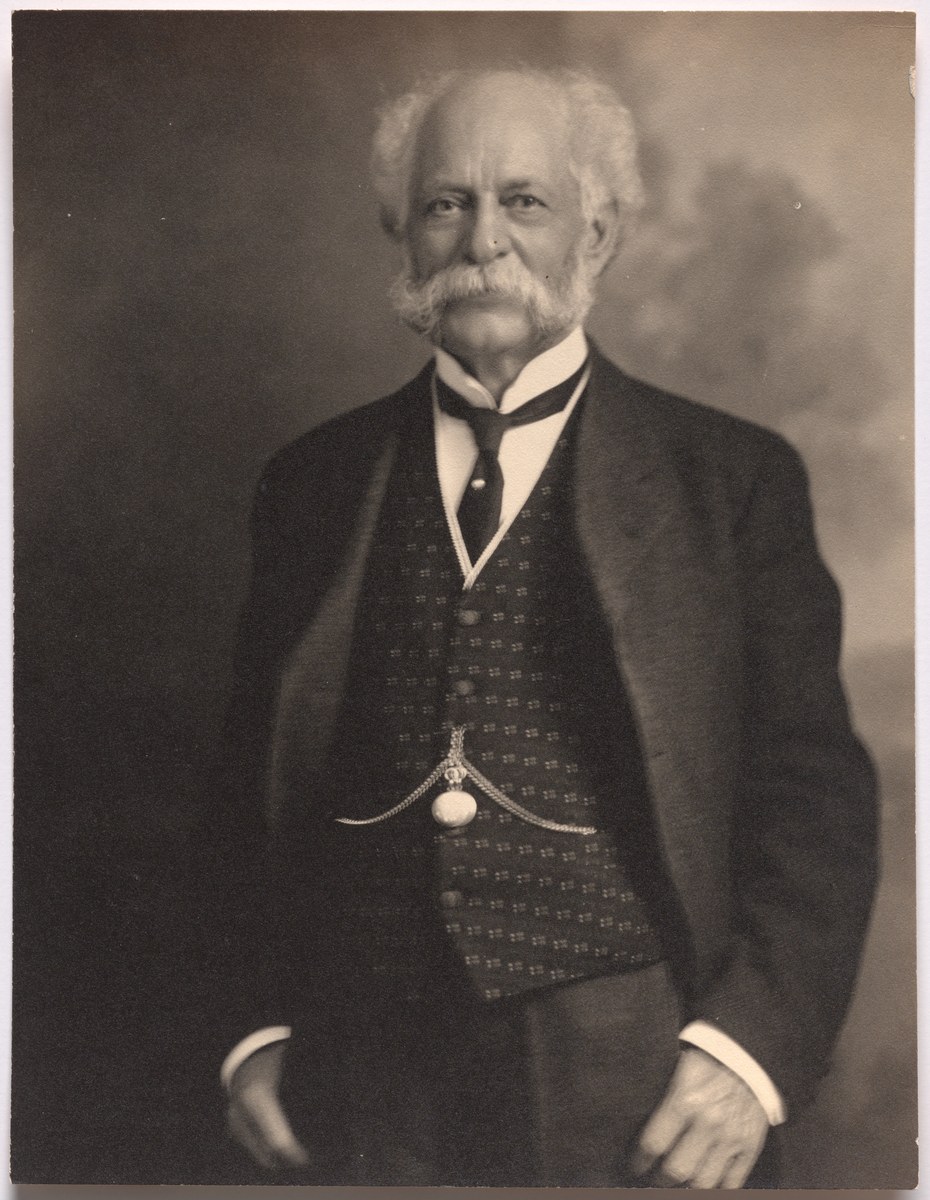
Pach Brothers Studio, about 1914, National Portrait Gallery, Smithsonian Institution, Open Access (CC0) · Gelatin silver print 'Henry John Heinz' by Pach Brothers Studio, about 1914, National Portrait Gallery, Smithsonian Institution (object NPG.93.388.14; sheet 22.7 x 17.5 cm). The Open Access image (3101 x 4000) was downscaled to 930 x 1200 with no upscaling and no crop. · CC0 (Smithsonian Open Access; the museum's record gives 'CC0' for both the object and the image); the studio portrait is also from about 1914
entrepreneur · 19th Century
Henry J. Heinz
1844–1919
Known For
Not yet included in personality matching — the documented evidence doesn't yet cover enough of the personality model. Everything else on this page is fully available.
Trait Constellation
Key Achievements
In 1869 he began selling horseradish from Sharpsburg, Pennsylvania, and built it into the H. J. Heinz Company, a branded food maker sold as '57 Varieties' that had 6,500 employees and 25 branch factories when he died in 1919.
He sold his products as 'Strictly Pure', packing horseradish in clear glass so buyers could see it, and supported the Pure Food and Drug Act of 1906.
His Pittsburgh plant was run as a model factory, with employee dining rooms, free medical care, a gymnasium, an auditorium and classes, and was open to public tours.
Moments That Reveal Them
At the 1893 Chicago fair his exhibit sat on an upstairs gallery that few visitors climbed to, so he had boys hand out tags promising a free watch charm to anyone who came to his booth, and crowds followed.
This is consistent with improvising a low-cost fix when a promotion was failing. Resourcefulness
On his first trip to London in 1886 he walked into Fortnum & Mason with no letter of introduction, asked for the head of grocery purchasing and opened his sample bag, and the buyer agreed to take all seven lines.
This is consistent with approaching a prominent buyer directly without an introduction. Social Assertiveness
Turning Points
His first firm failed in the 1870s, and in 1876 he returned as manager of a new company, F. & J. Heinz, started with his brother and cousin; he took full control in 1888 and renamed it the H. J. Heinz Company.
This is consistent with rebuilding a business after a collapse rather than leaving the trade. Persistence
Similar People
People whose overall profiles resemble theirs.

Yi Sun-sin

Nelson Mandela

Nellie Bly

Martin Luther King Jr.

Malala Yousafzai
Sources
- Henry J. Heinz (Q982831), verified live via the Wikidata API (2026-11-06): label 'Henry J. Heinz', description 'American businessman (1844-1919)', Korean label 헨리 J. 하인즈, born 11 October 1844, died 14 May 1919, citizenship United States. Orientation only; not used as support for any row.
- Senator John Heinz History Center, collection page 'H.J. Heinz Company' (read in full). CANONICAL SIGNIFICANCE SOURCE: company founded in 1869 by Henry John Heinz as a horseradish producer in Sharpsburg; the first business failed after the Panic of 1873 and he re-established it in 1876 with help from his brother John and cousin Frederick; tomato ketchup followed in 1876; he took control in 1888 and the H.J. Heinz Company name began; factories and branches in the 1890s and by 1905 incorporation and factories in England and Spain; he lobbied in favour of the Pure Food and Drug Act of 1906 and pioneered efforts to maintain cleanliness and quality; he took a notably progressive attitude to employees; at his death in 1919 the company had 6,500 employees and 25 branch factories. Institutional collection description, favourable in tone.
- Robert C. Alberts, 'The Good Provider: H. J. Heinz and His 57 Varieties', American Heritage 23(2), February 1972 (magazine excerpt from Alberts's biography, read in full; quotes his private diary). Clear glass horseradish bottles against adulterated rivals; the 1875 over-extension and bankruptcy (assets $110,000, liabilities $170,000) and the 1876 restart as F. & J. Heinz; seed-and-buy contracts with pickle growers (1880); the 1886 call on Fortnum & Mason with no introduction; the factory with its employee facilities and open plant tours; the '57 Varieties' slogan (1896, by this account) and the 1893 Chicago fair stunt; support for the 1906 food laws; the company's size at his death. Admiring biographer who also records the paternalism-and-no-union aim and that 57 was a sales slogan; largely a self-diary-derived narrative.
- Brian Butko, 'Heinz: Much More than 57 Varieties', Senator John Heinz History Center blog, 12 May 2015 (read in full). COUNTER-VOICE: says Heinz was scorned in the 1870s for poor business decisions, that his business was short of capital and collapsed and that he was arrested on creditors' fraud charges, then rebuilt on the family's moral lessons; describes the plant's restaurant, dressing rooms, hospital, gymnasium, rooftop garden, classes and work-time carriage rides; dates the 57 Varieties phrase to 1892 (Alberts says 1896, so the slogan date is not used). Institutional author, local museum.
- The Henry Ford, curated set 'Henry J. Heinz: His Recipe for Success' (read in full). 'Strictly Pure' label of 1872 and clear glass against rivals' coloured containers; recipe notebook and tasting rooms for consistency; partnering with growers and building branch factories near farms; the Pittsburgh plant deemed a model factory with awards for 'industrial betterment'; says he became an advocate for the Pure Food and Drug Act. Museum set text, celebratory; mostly object captions.
- Pittsburgh Quarterly, 'Make No Little Plans' (article on Pittsburgh at the 1893 World's Columbian Exposition; only the Heinz passage was read, quoting a History Center curator). Heinz's exhibit stood on the second floor of the Agriculture Building, so he hired boys to hand out tags offering a 'novel watch charm' to anyone who came to the booth; crowds came in droves, the other food exhibitors gave him a silver loving cup, and the pickle charm became the pickle pin. Regional magazine; one passage only.
- Elizabeth Lewis Otey, 'Employers' Welfare Work', Bulletin of the U.S. Bureau of Labor Statistics No. 123, 1913 (US government report, FRASER digital copy; the H. J. Heinz Co. section on pp. 33-34 and the introduction read). INDEPENDENT AND CRITICAL-CONTEXT SOURCE: describes the Heinz welfare work (clean uniforms, manicurist, dining room with coffee at 1 cent, free woman physician, lockers, picnic, roof garden, natatorium, classes, a premium for good work, a sick-benefit association) but explains much of it as a necessity of handling food, and its introduction records labour circles' complaint that welfare work is tinctured with paternalism and dependence on the employer's goodwill.
- Smithsonian National Portrait Gallery, object record NPG.93.388.14, 'Henry John Heinz' by Pach Brothers Studio, c. 1914, gelatin silver print (read via the Smithsonian Open Access API). Portrait source record for the image used; rights field 'CC0'.