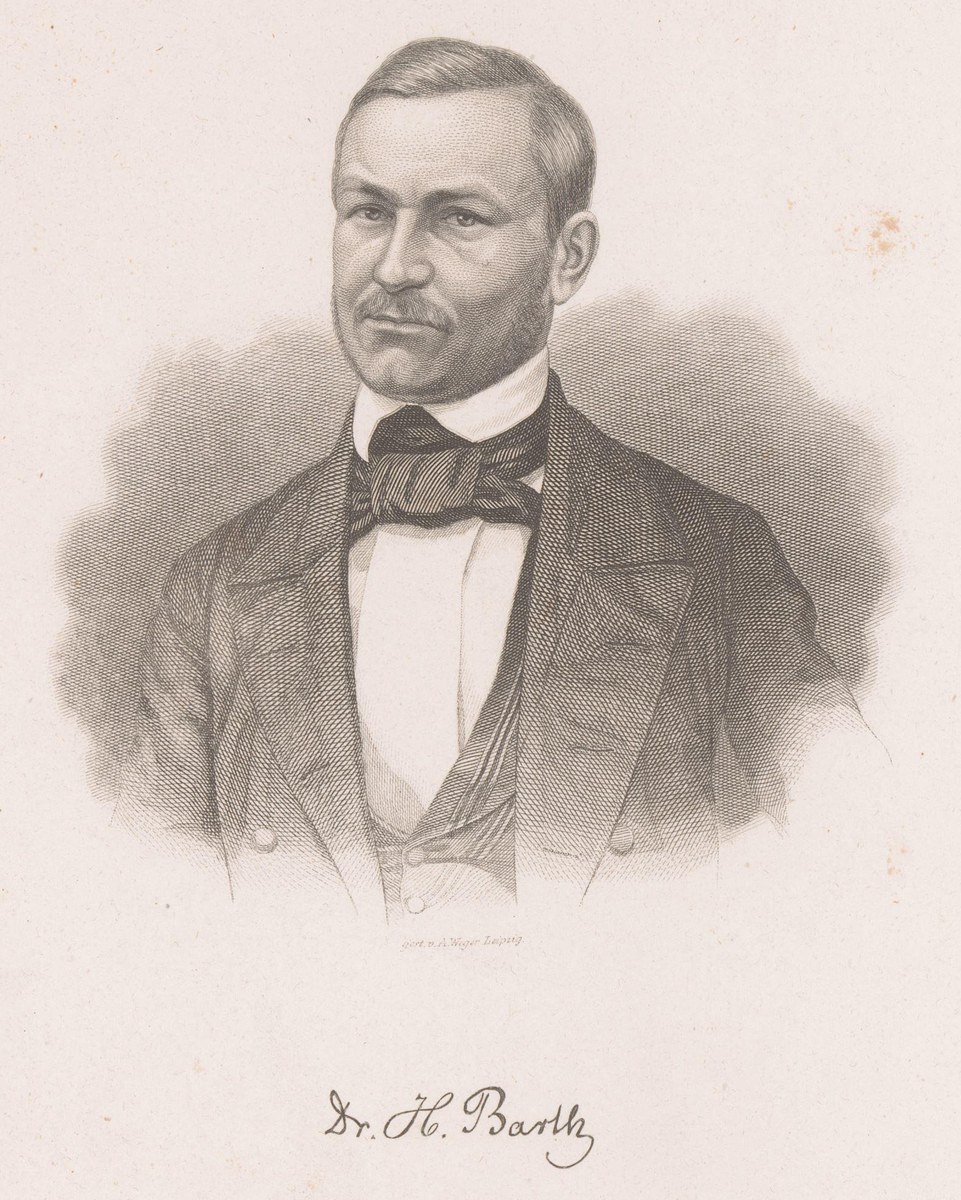
August Weger (printmaker), Portrait of Heinrich Barth, engraving, 1850-1892, Rijksmuseum, Amsterdam (RP-P-1915-724), public domain · Engraved portrait print 'Portret van Heinrich Barth' by the printmaker August Weger, Leipzig, published by Baumgaertner's Buchhandlung, Leipzig, dated by the museum only as between 1850 and 1892; Rijksmuseum, Amsterdam, object RP-P-1915-724, released as Public Domain Mark and CC0. The museum scan was 2984 x 3794 pixels; this project cropped it to the engraved portrait with its facsimile signature and reduced it to 961 x 1200 pixels, never enlarging it · Public Domain (Rijksmuseum Public Domain Mark; printmaker died 1892)
explorer · 19th Century
Heinrich Barth
1821–1865
Known For
Not yet included in personality matching — the documented evidence doesn't yet cover enough of the personality model. Everything else on this page is fully available.
Trait Constellation
Key Achievements
Led the 1850-55 British-sponsored expedition from Tripoli across the Sahara to Lake Chad, the Benue and Timbuktu, continuing alone after his two companions died, and recorded it in the five-volume Travels and Discoveries.
Spent about six months in and around Timbuktu in 1853-54, where Sheikh al-Baqqai's protection gave him access to Sudanic chronicles that reinforced his view that Africa had a history of its own.
Became a pioneer of the study of African history and languages, collecting vocabularies of Central African languages, and from 1863 held a professorship of geography at Berlin and founded the Carl Ritter Foundation.
Moments That Reveal Them
After Adolf Overweg died in September 1852 and he was alone, Barth decided to push west to Timbuktu, reaching it on 7 September 1853 through lands no European had crossed.
This is consistent with a person who kept to a scientific goal after the loss of his companions. Persistence
The mapmaker August Petermann reported that Barth read his watch and compass about every five minutes and measured camel pace at different times of day to fix route lengths.
This is consistent with painstaking record-keeping, though it comes from a collaborator and Humboldt faulted his position-fixing. Detail Orientation
Turning Points
Richardson's death in March 1851, followed by Overweg's in September 1852, left Barth in charge and, in time, alone, turning a three-man mission into a solo six-year survey.
This is consistent with a person able to carry an expedition's scientific aims on his own. Need for Autonomy
Similar People
People whose overall profiles resemble theirs.

Louis Pasteur

Benjamin Franklin

Gertrude Bell

Abraham Lincoln

Maya Angelou
Opposite Profile
Not a rival — a different profile shape worth a look.
Otto von Bismarck
Sources
- Heinrich Barth (Q60141), verified live via the Wikidata API (2026-11-02): label 'Heinrich Barth', description 'German explorer (1821-1865)', born 1821-02-16, died 1865-11-25, citizenship Germany (and a second state), Korean label present. Orientation only; not used as support for any row.
- Encyclopaedia Britannica, 'Heinrich Barth' (print view, revised 2026), read in full: German geographer and one of the great explorers of Africa; classical education at Berlin; fluent in French, Spanish, Italian, English and Arabic; 1845-47 Mediterranean coast travels published 1849; 1850 departure from Tripoli with Richardson and Overweg on a British-sponsored expedition; assumed command when Richardson died; explored south and southeast of Lake Chad and mapped the upper Benue; went to Timbuktu after Overweg died in 1852 and stayed six months; about 10,000 miles travelled, routes laid down by dead reckoning, the first account of the middle Niger; his large Reisen und Entdeckungen volumes (1857-58) with anthropological, historical and linguistic information; professor of geography at Berlin 1863. CANONICAL SIGNIFICANCE SOURCE. Concise reference biography; no behavioural detail beyond the route.
- Julius Loewenberg, 'Barth, Heinrich', Allgemeine Deutsche Biographie vol. 2 (1875), pp. 96-99, read in full on German Wikisource (proofread twice against the source): a near-contemporary German national biography giving his education (philology under Boeckh, geography under Ritter), the 1845-48 Mediterranean journey, the 1849-55 expedition by date and route (Air, Kano, the Benue, Lake Chad, Baghirmi, Timbuktu 5-7 September 1853, a seven-month stay, being reported dead, meeting Eduard Vogel in December 1854), the cost of about 10,000 thalers, Petermann's praise of his route surveys (reading watch and compass about every five minutes and measuring camel pace), Humboldt's 1852 complaint that he could not fix positions astronomically, the professorship in Berlin in 1863 and the Carl Ritter foundation he founded, the unfinished Central African vocabularies (1862-63), and his death in 1865. In German; a 19th-century national biography, patriotic in tone, and Petermann (who drew his maps) is an admiring collaborator.
- Heinrich Barth Institute (University of Cologne), 'Information boards Timbuktu' project page, read in full: states that he spent about six months in and around Timbuktu, received protection from Sheikh al-Baqqai who gave him access to manuscripts including chronicles of Sudanic history, that his 1849-1855 expedition covered almost 20,000 km, that he drew on comparative linguistics, Arabic manuscripts, oral tradition and rock art to study African history, and that the institute regards him as a pioneer of African history and of the scientific study of African languages. An institute named for him, so admiring; used for significance and the kinds of evidence he collected, not for personality.
- Kirkus Reviews, review of Steve Kemper, 'A Labyrinth of Kingdoms' (June 2012), read in full: an independent trade review of the first English-language biography; describes him as taking careful notes on the peoples he met, mixing with local people and questioning them constantly, bribing suspicious chiefs, being held captive for months, being stranded in Timbuktu, and as arrogant and introspective; says his 1857 account was criticised for its tolerant portrayal of Arabs. Brief; the reviewer's character remarks are his own.
- Gerhard Mueller-Kosack, review of Steve Kemper, 'A Labyrinth of Kingdoms' (Mega-Chad book reviews, 2012), read in full: a specialist review of the Kemper biography; says Barth was a meticulously organised explorer-scientist who guarded his independence by going off on scientific excursions early in the expedition, that Richardson worried about his impatience in travelling ahead, that he was 'thorny' but loyal and made friendships (al-Bakkay), that he took things personally and later fell out with British and German officials and academics, that he used his linguistic skills and educated allies for safety, fired his gun into the air at night to signal he could protect himself, and aimed to describe almost every inch of the landscapes, languages and histories he met; also says Kemper reports a lack of compassion over his companions' deaths and a tediously detailed style. A scholarly critical-and-sympathetic secondary reading; the review itself notes the book's main text is unreferenced.
- Christian Science Monitor, 'Heinrich Barth: the greatest explorer you've never heard of' (13 July 2012), read in full: an interview with biographer Steve Kemper; says Barth was prickly and easily offended, was held in effective house arrest in Timbuktu for seven months but made outings despite threats, wrote about 3,500 pages, recorded market conditions, prices and who held power, found the Benue, reported Timbuktu's manuscripts and scholars, and was neglected because he was German working for Britain, his book was dense, and his findings about Islam and African societies conflicted with European colonial interests. An author interview promoting his own book, so admiring and not independently assessed.