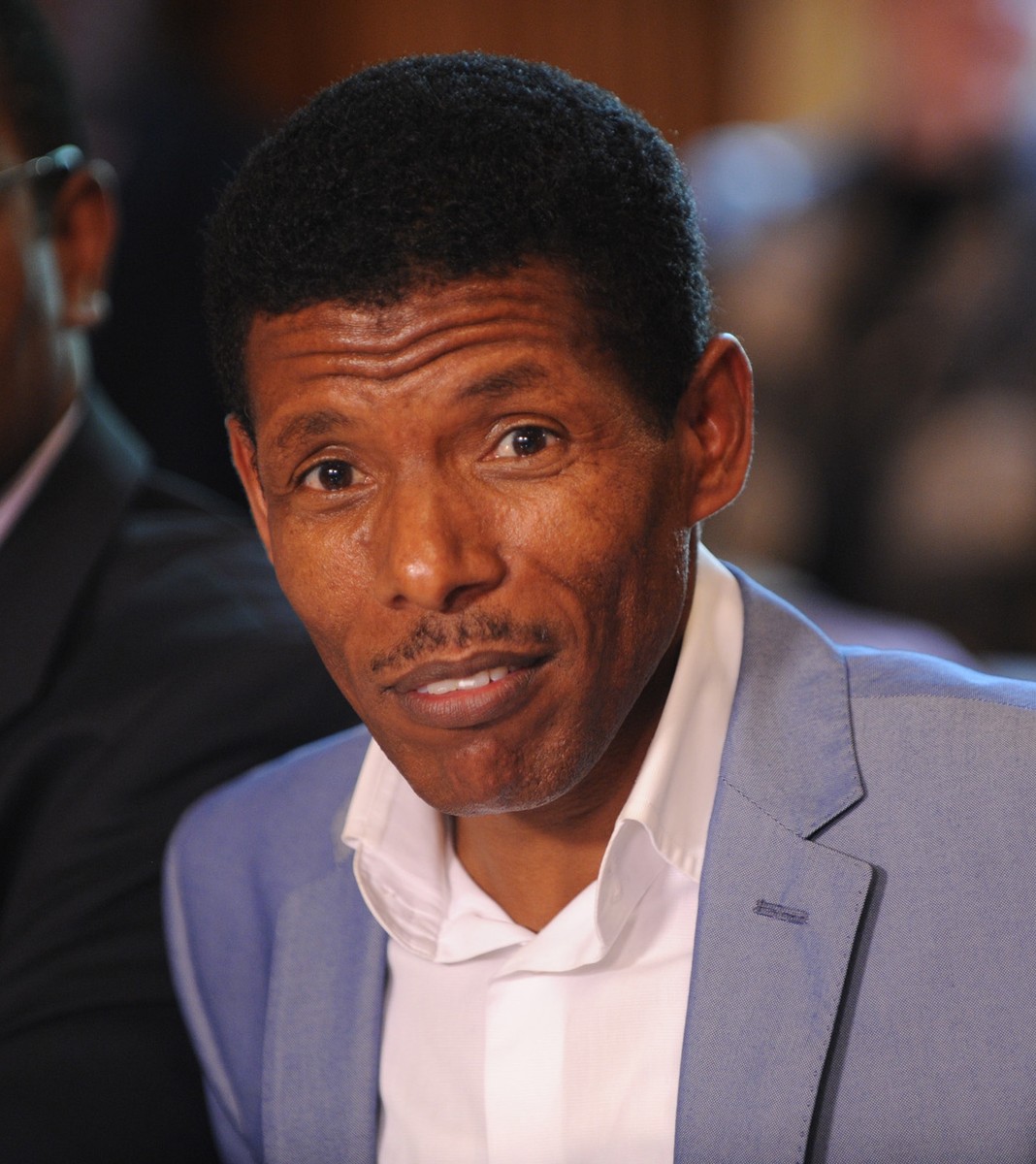

Photo: Foreign and Commonwealth Office, 2012, CC BY 2.0 · Wikimedia Commons, 'Olympic great Haile Gebrselassie speaking at the Olympic hunger summit in Downing Street, 12 August 2012 (cropped).jpg' -- photograph of Haile Gebrselassie published by the UK Foreign and Commonwealth Office on its Flickr stream (photo 7766483966), taken 12 August 2012. The live Flickr photo page (2026-10-24) shows the photo itself under CC BY 2.0 with owner 'foreignoffice'; the Commons page tags it OGL v1.0 on the basis of the FCO stream. Both licences allow reuse with attribution; the photo-level CC BY 2.0 on Flickr is the licence recorded here. Commons crop 1235 x 1387 pixels from a 2128 x 1416 original; stored file downscaled to 1068 x 1200, never upscaled. CAVEAT FOR THE LEAD: the photo-level licence (CC BY 2.0) differs from the Commons licence tag (OGL v1.0); the Flickr photo page lists no OGL statement. If the strict rule against any licence mismatch applies, set this portrait to held; the next step would be a different file with a single consistent licence (the other candidates on Commons are uploader-assertion own-work photos or lower-quality). Alternatives rejected: the 2010 Manchester Run file (own-work, poor-quality side shot), a 2010 Dubai file tagged public domain by the uploader without basis, and photographs taken with other people. · CC BY 2.0
athlete · Contemporary
Haile Gebrselassie
b. 1973
Known For
Not yet included in personality matching — the documented evidence doesn't yet cover enough of the personality model. Everything else on this page is fully available.
Trait Constellation
Key Achievements
He won the Olympic 10,000 metres at Atlanta in 1996 and at Sydney in 2000, and was world champion in 1993, 1995, 1997 and 1999.
He set 27 official and unofficial world records at distances from 2000 metres to the marathon, ending with 2:03:59 in Berlin in 2008, a mark that stood until 2011.
After finishing fifth in the 2004 Olympic 10,000 metres he turned to road racing and won the Berlin Marathon four years in a row, from 2006 to 2009.
Moments That Reveal Them
In the 2000 Sydney 10,000 metres he and Kenya's Paul Tergat left the field behind, and he edged ahead of Tergat only in the last stride; four years earlier in Atlanta he had won the same rivalry by six metres.
This is consistent with a competitor who stays in close finishes and wins them. Competitiveness
In November 2010 he dropped out of the New York Marathon and announced he was stopping; he returned to competition the following April and formally retired in May 2015.
This is consistent with a reluctance to end a competitive career at the first announced stopping point. Persistence
Turning Points
After the 2004 Athens Olympics, where he finished fifth in the 10,000 metres, he made road racing his main focus, and in 2007 and 2008 set marathon world records in Berlin.
This is consistent with a willingness to change event when a track career had peaked. Adaptability
Similar People
People whose overall profiles resemble theirs.


Bette Davis

Abraham Lincoln

Oscar Niemeyer

B. R. Ambedkar

John D. Rockefeller
Opposite Profile
Not a rival — a different profile shape worth a look.
Jalal ad-Din Muhammad Rumi
Sources
- Haile Gebrselassie (Q171500) -- verified live via the Wikidata API (2026-10-24): English label 'Haile Gebrselassie', description 'Ethiopian long-distance runner and businessman (born 1973)', Korean label '하일레 게브르셀라시에', born 18 April 1973, no death date, citizenship Ethiopia. Orientation only; not used as support for any row. (The hinted item Q312044 is a reptile species and was not used.)
- Rolf Bryhn, 'Haile Gebrselassie', Store norske leksikon (Norwegian national encyclopedia, updated November 2024; read in full in Norwegian): Olympic 10,000 metres champion at Atlanta 1996 and Sydney 2000, world champion in 1993, 1995, 1997 and 1999, fifth at Athens 2004 and sixth at Beijing 2008, the switch to road racing after 2004, marathon wins at Amsterdam, Berlin (2006-2009), Fukuoka and Dubai, 27 official and unofficial world records from 2000 metres to the marathon, the 2:03:59 Berlin marathon record that stood until September 2011, the IAAF's 1998 male athlete award, and the November 2010 New York Marathon withdrawal and retirement announcement. CANONICAL SIGNIFICANCE SOURCE. Reference-work entry by an outside author; no trait claims.
- Chris Chavez, 'Even in retirement, Haile Gebrselassie is still running strong', Sports Illustrated, 30 October 2015 (read in full): his May 2015 retirement after the Great Manchester Run, his 2010 New York Marathon exit followed by a declaration he was stopping, his return to competition the next April with only one more marathon completed, 27 world records and 11 major marathon wins, the 2007 and 2008 Berlin marathon records (2:04:26 and 2:03:59), his Hall of Fame induction, his current twice-a-day running, and his own remarks on Mo Farah and Eliud Kipchoge. Sports-magazine interview report; much of the colour is his own words (self-account), the career facts are the writer's. Family and illness passages were not used.
- Simon Robinson, 'Quotes of the Day: the traditional clash between Ethiopia and Kenya in distance running', TIME, 8 August 2004 (read in full): Kenenisa Bekele inspired by Gebrselassie; Ethiopia's centrally controlled system under coach Woldemeskel Kostre versus Kenya's free-market approach; an account of the coach telling Gebrselassie before the Sydney Games that he could not be put in the team unless he travelled with it, after which he came and won; Kenyan and Ethiopian officials' contrasting remarks; the writer's note that Gebrselassie owns well-known Addis Ababa property (business, not scored). Independent magazine feature with Kenyan, Ethiopian and British voices; medical details in the Sydney episode were not used.
- AthleticsAfrica, 'Haile Gebrselassie' profile (last updated 2005, read in full): the Arsi origins of Ethiopian distance runners, his 1992 world junior titles, first world record at 5000 metres in 1994, the 1996 Atlanta 10,000 metres in which he tracked Paul Tergat and won by six metres, and the 2000 Sydney final in which he edged Tergat 'in the very last stride'. Athletics-website profile with some admiring wording and a childhood anecdote that was not used; read for the race accounts.
- AthleticsAfrica, 'Ethiopian Gebrselassie quits running after New York heartbreak', 8 November 2010 (read in full): the retirement announcement after he dropped out of the 2010 New York City Marathon, the abandoned plan to win a third Olympic gold in London 2012, his 18-year international career with two Olympic golds, eight world titles and 27 world records, and his words 'let me give a chance to the youngsters'. Short news report quoting him; the injury detail was not used, and the later reversal is taken from the Sports Illustrated report.
- Daily Nation (Kenya), 'Plot to put Ethiopians in their place', 23 July 2009 (read in full): Kenyan runners' stated plans to beat Bekele and Gebrselassie at the Berlin World Championships, including a Kenyan runner beaten by Gebrselassie in the final kick at Hengelo who wanted revenge. Rival-side press report used only as a counter-voice on his place as a benchmark opponent; no behavioural row rests on it alone.
- Wikimedia Commons file page 'Olympic great Haile Gebrselassie speaking at the Olympic hunger summit in Downing Street, 12 August 2012 (cropped).jpg' and the Flickr photo page of the UK Foreign and Commonwealth Office (live check 2026-10-24) -- checked for the portrait: photograph by the Foreign and Commonwealth Office, taken 12 August 2012.