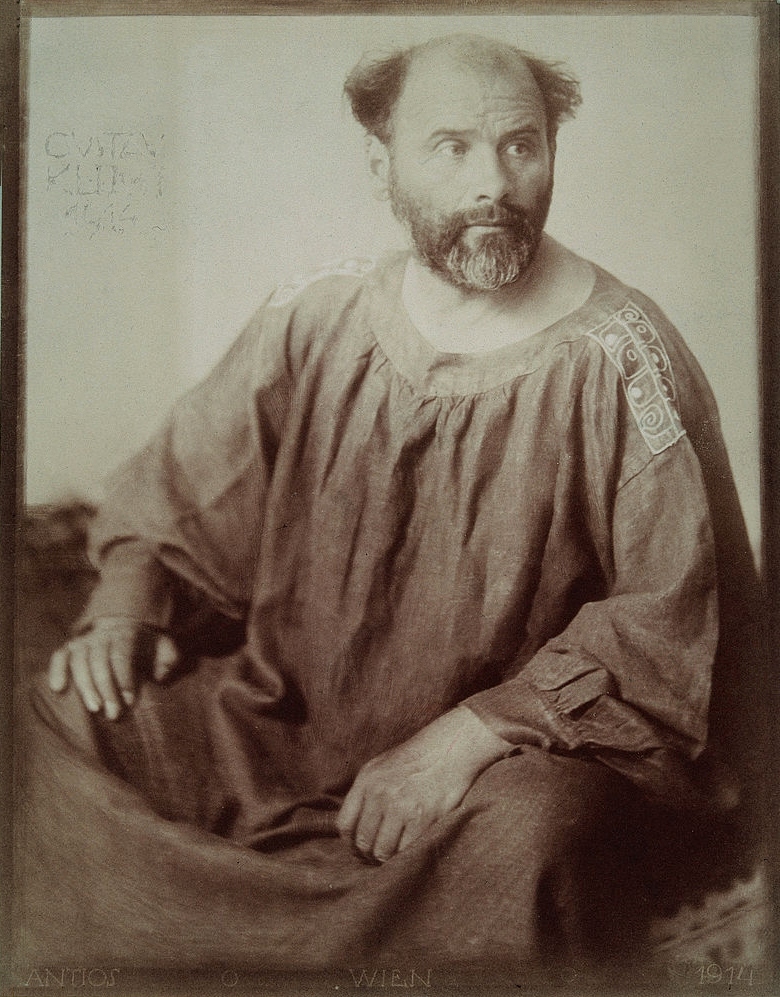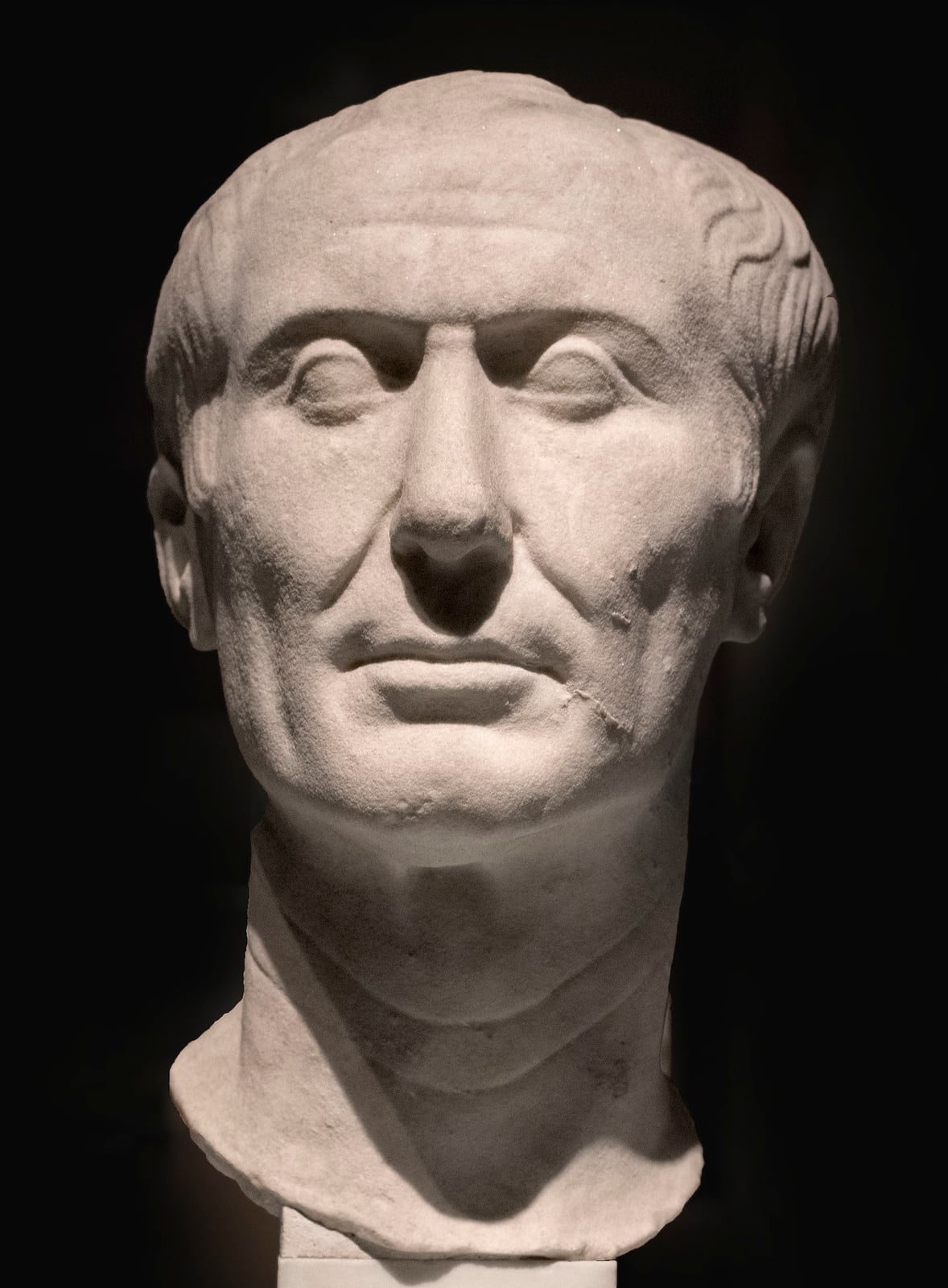

Anton Josef Trcka ('Antios'), portrait of Gustav Klimt, 1914 (signed 'ANTIOS WIEN 1914'); public domain, author died 1940. The Klimt Foundation database prints a Foundation copyright notice under its reproduction of the print. · Photograph by Anton Josef Trcka ('Antios'), 1914, via Wikimedia Commons (File:Klimt.jpg, Wikidata P18); same photograph shown by the Klimt Foundation (Gustav Klimt Database) · Public domain (author died 1940)
Trait Constellation
Key Achievements
From about 1904 Klimt developed the 'golden' manner of his mature work, laying gold leaf and mosaic-like ornament over flat figures in Portrait of Adele Bloch-Bauer I (1907) and The Kiss (1908-09). The Austrian ministry bought The Kiss at the 1908 Kunstschau for the state's Modern Gallery, and the painting belongs to the Belvedere in Vienna.
In 1897 Klimt became the first president of the Vienna Secession, an association of artists that broke away from Vienna's established artists' society to show modern art on its own terms. The group built its own exhibition house in 1898, and Klimt contributed drawings and designs to its magazine Ver Sacrum.
His Beethoven Frieze (1901-02), about 34 metres of wall painting, was made for the Secession's 1902 exhibition built around Max Klinger's Beethoven statue. In 1905-1911 he also designed the marble, gold and enamel dining-room frieze of the Palais Stoclet in Brussels, now part of a UNESCO World Heritage site.
Moments That Reveal Them
In March 1901, while the Medicine painting was being attacked in the press and raised in parliament, Klimt made a rare public remark in the Wiener Morgenzeitung, as quoted by the Belvedere: he had no time to join the squabble, and what mattered to him was not how many people liked a picture but who did.
This reply is consistent with the profile's independent thinking: it names a standard for judging his own work that does not depend on public approval. It is a single remark, and his defence in print was largely left to supporters such as Bahr and Hevesi. Independent Thinking
In 1908 Klimt was president of the committee that organised the Vienna Kunstschau. The Belvedere says the organising left him no time to finish The Kiss before the opening; the ministry bought the unfinished picture there, Klimt wrote on 16 July 1908 that he would complete it at once, and its completion is documented only from June 1909.
This episode is consistent with the profile's slower completion of major works, though the Belvedere ties this delay partly to his organising workload and the exhibition deadline. Execution Speed
Turning Points
In May 1905, after the controversy had made it impossible to hang his three faculty paintings in the university, Klimt withdrew from the commission, repurchased all of them and returned the advances he had received; the Belvedere's provenance records give 25 May 1905. The collector August Lederer bought the Philosophy that year. The commission begun in 1894 ended with none of the paintings hanging in the university, and later large-scale work such as the Stoclet frieze was made for private clients.
This is consistent with the profile's autonomy need: Klimt chose to own the paintings rather than see them moved to a state gallery. That refusal rests on the Belvedere's online account, and the same text says friends and patrons helped him repay, so it was not a solitary act. Need for Autonomy
Similar People
People whose overall profiles resemble theirs.

Mahatma Gandhi

Marie Curie

Leonardo da Vinci

Jane Goodall

Frida Kahlo
Sources
- Gustav Klimt (Q34661) -- verified live via wbgetentities (2026-10-04): en label 'Gustav Klimt', description 'Austrian symbolist painter (1862–1918)', P569 14 Jul 1862, P570 6 Feb 1918, instance of human, ko label '구스타프 클림트' with a Korean Wikipedia sitelink, P18 'Klimt.jpg', 'Gustav Klimt 1912.jpg', 'Gustav Klimt in 1887.jpg'. Orientation only; not used as support for any row.
- Gustav Klimt, English Wikipedia article (plain-text extract read 2026-10-04) -- orientation only; used to cross-check dates and the outline of the career, never to support a scored row.
- 'Klimt, Gustav (1862-1918), Maler', Osterreichisches Biographisches Lexikon 1815-1950, vol. 3 (Austrian Academy of Sciences, 1965, pp. 409-410), online edition -- national biographical reference entry (non-self, institutional, written decades after his death). Read in full: training and decorative commissions with his brother Ernst and Franz Matsch, election as first president of the Vienna Secession in 1897, the three University of Vienna faculty paintings (commissioned 1896 per this entry, worked on until about 1907), the 1900 Paris medal, the rejected professorship, the Secession split and the Stoclet frieze, and the assessment of his place in Austrian painting. Its dating of the repurchase of the faculty paintings (1904) differs from the Belvedere's provenance records (25 May 1905); the Belvedere date is used here.
- Agnes Husslein-Arco and Alfred Weidinger (eds.), Gustav Klimt: 150 Jahre (Belvedere, Vienna, 2012), PDF of the museum's own catalogue (belvedere.at) -- museum scholarship (non-self). Read locally: the director's introduction; the reception essay by Christina Bachl-Hofmann and Dagmar Diernberger (quoting Berta Zuckerkandl, Hermann Bahr, Ludwig Hevesi, Karl Kraus, Arthur Roessler, the 1900 professors' petition and the hostile daily press, plus Klimt's one public remark of 1901); the catalogue entries on the Philosophy, Medicine and Jurisprudence paintings (with provenance, including Klimt's repurchase of 25 May 1905), the Beethoven Frieze, the Kiss (Lovers), Adele Bloch-Bauer I and the Fritza Riedler portrait, the red sketchbook and death-theme entries; the essays on Klimt and Egon Schiele and on the Salome; and the Beethoven Frieze chronology 1900-1999. Klimt's private letters to Emilie Floge printed in the volume were not used.
- Hermann Bahr (ed.), Gegen Klimt (Vienna: J. Eisenstein, 1903), Internet Archive full text (Getty Research Institute copy) -- a deliberately partisan compilation: Bahr's friendly preface followed by the hostile Viennese press clippings on the Philosophy (March 1900), Medicine (March 1901), 'Goldfische' (1902) and the Beethoven Frieze (1902). ADVERSARIAL contemporary record of the reception, framed by a supporter. Read: Bahr's preface in full, the 1900 clippings on the Philosophy including the Neue Freie Presse reports on the professors' petition and the counter-declaration of other professors, and the March 1901 clippings on the Medicine.
- Ludwig Hevesi, Acht Jahre Sezession (Marz 1897 - Juni 1905): Kritik, Polemik, Chronik (Vienna: Konegen, 1906), Internet Archive full text (achtjahresezessi00heve) -- the collected newspaper criticism of the Secession's leading supporter-critic (friendly but contemporary and dated). Read locally: the column on Klimt's Pallas Athene (Nov 1898), 'Aus der Sezession. Klimts Schubert' (March 1899, including the report, on the word of committee members, of demands made on the Medicine design), 'Der Protest gegen Klimts Philosophie' (18 May 1900, including Hevesi's own statement that he, not Klimt, wrote the explanatory catalogue text for the picture), and the November 1903 columns on the Klimt exhibition (Jurisprudence still unfinished at the opening; his visit to Klimt's attic studio; the study drawings; 'Aus dem Reiche des Todes').
- XIV. Ausstellung der Vereinigung bildender Kunstler Osterreichs Secession Wien: Klinger, Beethoven, April-Juni 1902, exhibition catalogue (Vienna: Holzhausen, 1902), Internet Archive full text (Frick Art Reference Library copy) -- the Secession's own primary document (institutional, self-description of the group, not Klimt's words). Read: the preface on the exhibition concept (space designed under Josef Hoffmann around Max Klinger's Beethoven statue) and the room-by-room description of Klimt's wall frieze in the left side hall, with the list of the other artists' contributions.
- Provisorischer Katalog der Kunstschau Wien 1908 (Vienna, 1908), Internet Archive full text -- primary exhibition document listing the exhibition committee with 'Gustav Klimt, President' and the room devoted to Klimt (room 22). Read: the committee page, the ticketing and sales notes and the room list.
- UNESCO World Heritage Centre, 'Stoclet House' (list entry 1298; description and Outstanding Universal Value statement) -- international heritage-body assessment (non-self). Read in full for the 1905-1911 construction under Josef Hoffmann and the statement that Koloman Moser, Gustav Klimt and other Wiener Werkstatte artists worked under Hoffmann to realise a total work of art.
- Osterreichische Galerie Belvedere, 'The Stories Behind Klimt's Faculty Paintings', Google Arts & Culture online story -- museum text (non-self). Fetched 2026-10-04 through a summarising fetch tool (page content is script-rendered), so used only as a secondary pointer for details that the Belvedere catalogue also supports (the ministry's plan to hang the paintings in the Modern Gallery and Klimt's refusal; the repayment in 1905; Zuckerkandl's interview of 12 April 1905).