Ada Lovelace
94% Profile Match
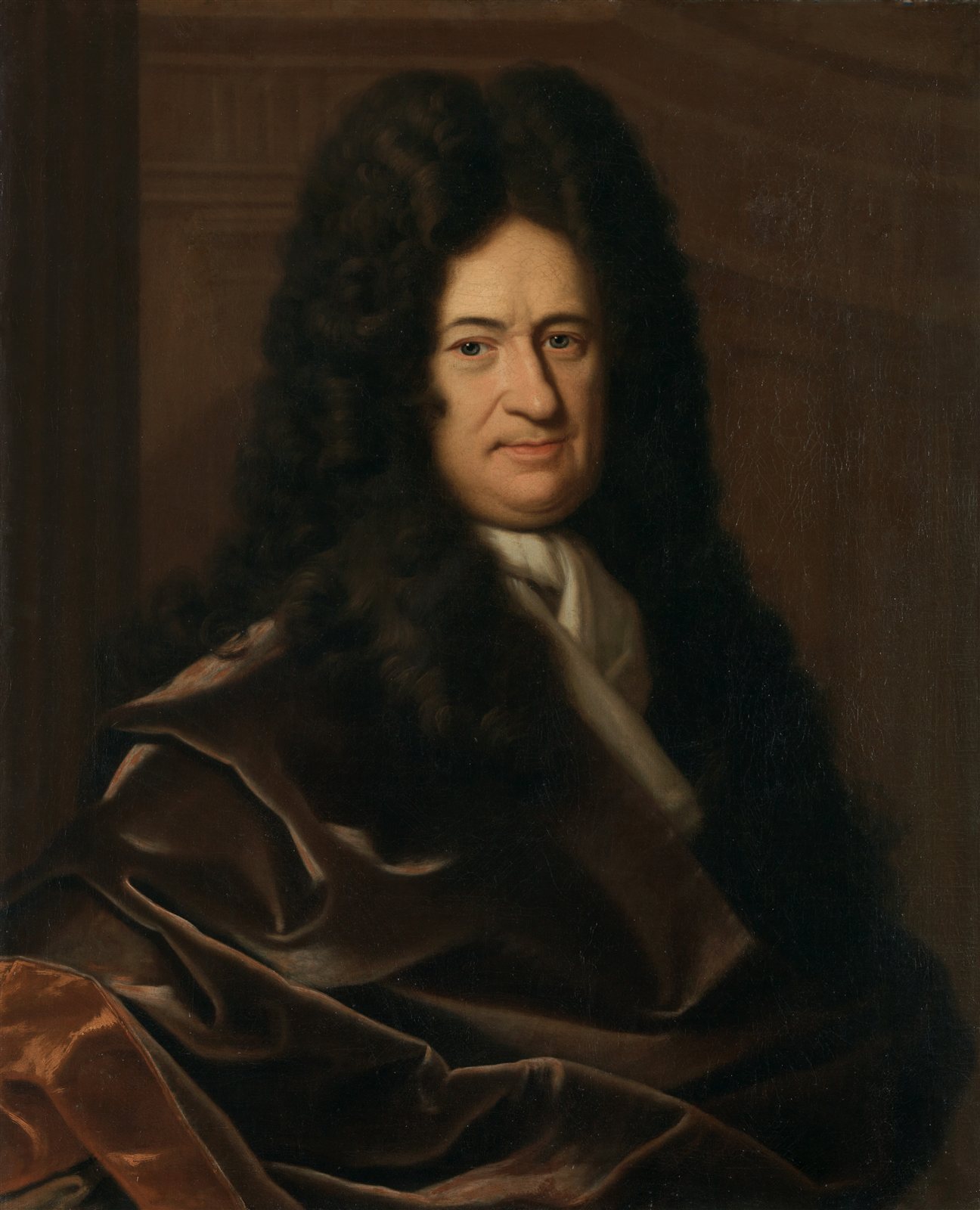
Christoph Bernhard Francke, 'Bildnis des Philosophen Gottfried Wilhelm Freiherr von Leibniz', oil on canvas, c. 1695; Herzog Anton Ulrich-Museum, Braunschweig. Public domain (PD-Art, PD-old-100-1923: the painter died in 1729). Commons records no restrictions. · Herzog Anton Ulrich-Museum, Braunschweig (inventory GG 558 per Wikidata Q29171873), via Wikimedia Commons file 'Christoph Bernhard Francke - Bildnis des Philosophen Leibniz (ca. 1695).jpg' (original 4486x5538, downsized to 1600px long edge at JPEG quality 85) · Public domain
In Paris in 1672-76 Leibniz worked out a differential and integral calculus. He first wrote the integral sign on 21 November 1675, had the rule d(x^n) = n x^(n-1) dx by autumn 1676, and published the method in Acta Eruditorum in 1684 and the integral calculus in 1686. His d and integral notation is the one still used. Isaac Newton had developed his own method earlier but did not publish it, and the Stanford Encyclopedia reports that most historians now take the two to have worked independently.
Leibniz built a philosophical system around a few principles: nothing is without a sufficient reason, and the world is made of simple substances he called monads. In the Theodicy (1710) he argued that this world is the best of all possible worlds, and in the Monadology (1714) he summarised the system. Voltaire's Candide later satirised the 'best of all possible worlds' argument, and Bertrand Russell, a critical reader, called the Monadology a coherent but arbitrary fairy tale.
Leibniz designed a calculating machine intended to add, subtract, multiply and divide, and showed an incomplete model to the Royal Society in London in 1673. He had perfected a binary system of arithmetic by 1679 and published it in 1701 as 'Essay d'une nouvelle science des nombres', sent to the Paris Academy on his election.
After a campaign that began in 1695, Leibniz persuaded the Elector of Brandenburg to found the Brandenburg Society of Sciences on 11 July 1700, and he was named its first president for life. MacTutor reports that it was not very successful at first but led some years later to the Berlin Academy. His similar plans for academies in Dresden, Vienna and St Petersburg were not realised in his lifetime.
In January 1673, in London, Leibniz explained his results on series to the mathematician John Pell, who said they were in a book by Mouton. Leibniz consulted Mouton's book the next day and found Pell was right. MacTutor adds that he then recognised his mathematical knowledge was less than he wished and redoubled his efforts, and Merz says the meeting led him to procure the books Pell named and to study mathematics more systematically in Paris under Christiaan Huygens.
Checking the book at once, accepting the correction and changing how he studied is consistent with updating beliefs on evidence; the later priority dispute and his blaming others for the Harz failures show the pattern was not uniform. Belief Updating
From November 1715 until his death in November 1716, Leibniz exchanged five papers with Samuel Clarke, a defender of Newton, on space, time, free will and attraction across a void. He rejected absolute space and the void by appealing to the principle of sufficient reason, answered Clarke's replies point by point, and questioned whether Clarke was willing to listen to reason. Clarke replied that Leibniz had asserted his principle without proof and begged the question, and the exchange was cut off by Leibniz's death.
Taking on the leading Newtonian position directly and answering each objection is consistent with independent thinking; the exchange is also one-sided in tone in places, and the opposing party judged his main premise unproved. Independent Thinking
In 1672 the Elector of Mainz sent Leibniz to Paris on a diplomatic mission, and he stayed four years. There he met Huygens, Arnauld and Malebranche, studied mathematics and physics under Huygens, and read unpublished manuscripts of Descartes and Pascal. The Stanford Encyclopedia calls it the most important opportunity of his life, and the calculus notation and calculating-machine designs date from these years. He left in 1676 for the post of librarian at Hanover, where he spent the rest of his life.
Using a diplomatic posting to seek out the leading mathematicians and manuscripts of the day is consistent with opportunity sensing; the posting itself came through his patron rather than his own search. Opportunity Sensing
People whose overall profiles resemble theirs.


Not a rival — a different profile shape worth a look.