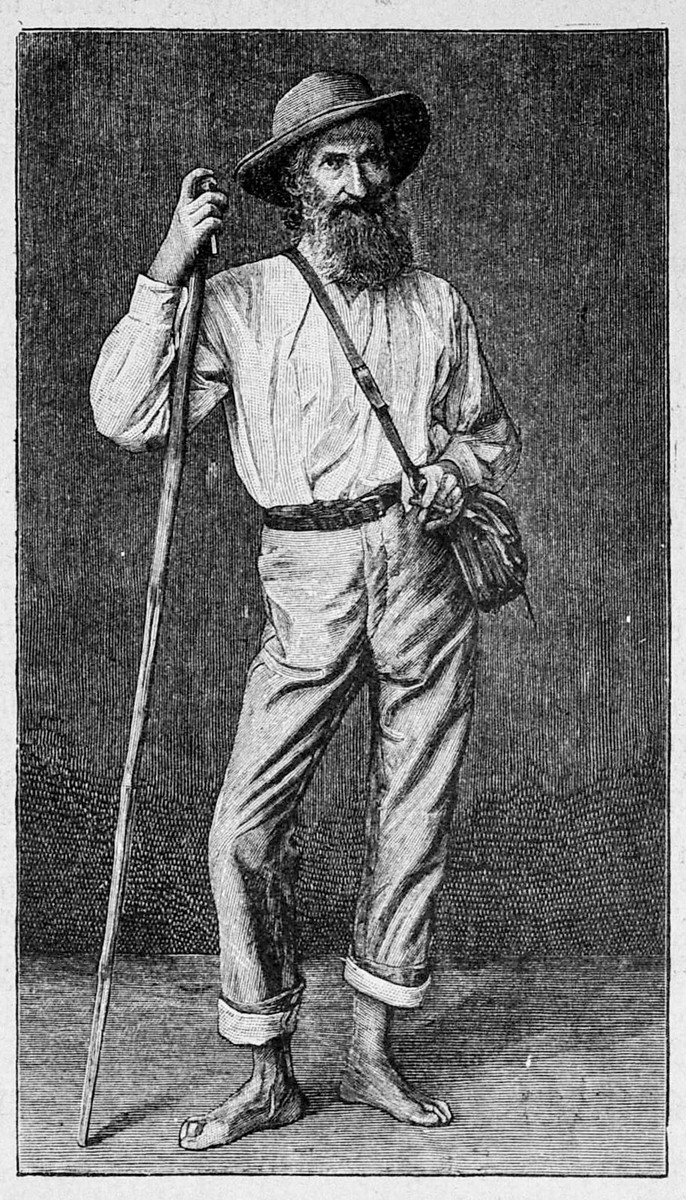
Unsigned wood engraving, after an unnamed photograph, in Die Gartenlaube (Leipzig: Ernst Keil's Nachfolger), 1892, p. 288; scan via Wikimedia Commons (public domain). Cropped and downscaled. · Wood-engraved portrait captioned 'Der Naturforscher Dr. Fritz Müller in Blumenau', published with Peter Vogel's article about him in the Leipzig family magazine Die Gartenlaube, 1892, p. 288 (the article text, p. 291, says it carries his portrait on p. 288). Engraver and the underlying photograph are not named. The file is the illustration cropped from a Wikimedia Commons scan of the 1892 volume (916 x 1602 pixels) and downscaled to 686 x 1200 with no upscaling. · Public domain by age: an unsigned illustration first published in Leipzig in 1892 (before 1931 in the United States and well over 70 years from publication for an anonymous work elsewhere). No museum or library holds an item record for this scan: it is a volunteer's scan of his own bound volume uploaded to Wikimedia Commons, so the basis is age, not an institutional statement.
Trait Constellation
Key Achievements
Wrote Für Darwin (1864), testing Darwin's theory against the development of marine Crustacea he studied on the Brazilian coast; Darwin paid for the 1869 English edition.
Explained why unrelated unpalatable butterflies come to look alike: predators learn warning patterns, so look-alikes share the losses. The idea is named Müllerian mimicry after him.
From Blumenau, sent Darwin field observations on climbing plants, orchids, termites and bees, and from 1876 worked as a travelling naturalist for the National Museum in Rio de Janeiro.
Moments That Reveal Them
Handling wild-caught male butterflies, he noticed a strong smell from the hair tufts on their wings and linked it to chemical signalling between the sexes.
Consistent with close, hands-on attention to small details of specimens in the field. Detail Orientation
Over 1865-1882 he wrote Darwin some 106 letters; Darwin forwarded several of his observations to journals, including six short papers in Nature.
Consistent with a sustained habit of sharing findings with a distant collaborator. Collaboration
Turning Points
After receiving the German translation of Darwin's Origin in 1861, he reorganised his crustacean studies as a test of Darwin's theory, which led to Für Darwin and the correspondence with Darwin.
Consistent with a willingness to reorient his research around a new theory he judged worth testing. Analytical Rigour
Similar People
People whose overall profiles resemble theirs.


Sor Juana Inés de la Cruz

Leonardo da Vinci

Benjamin Franklin

Abraham Lincoln

Charles Darwin
Sources
- Fritz Müller (Q62086), verified live via the Wikidata API (2026-11-06): English label 'Fritz Müller', description 'German-Brazilian biologist (1822-1897)', born 31 March 1822, died 21 May 1897, citizenship Germany and Brazil, no Korean label. Orientation only; not used as support for any row.
- English Wikipedia, 'Fritz Müller' (read for orientation and to find the scholarly references; not used as support for any row).
- Dictionary of Scientific Biography entry 'Müller, Fritz (Johann Friedrich Theodor)' (Gale text on Encyclopedia.com, read in full). CANONICAL SIGNIFICANCE SOURCE: calls Für Darwin (1864) a fundamental contribution to evolutionary biology and his name immortalised in 'Müllerian mimicry'; he applied Darwin's ideas to the Crustacea as a specific test case; he explained why unrelated unpalatable species resemble each other (predators must learn, so look-alikes share the losses); his work ranged from Coelenterata, Annelida and Crustacea to entomology and plant fertilisation; almost 250 articles; Darwin paid for the 1869 English translation and quoted him extensively; the entry describes 'extraordinary powers of observation', modesty and indifference to fame; he lost the museum post in 1891 when he refused to move to Rio. The entry also covers political, religious and private-life material that is not used here. Standard scholarly reference work, admiring in tone.
- Neue Deutsche Biographie vol. 18 (1997), article 'Müller, Fritz (Müller-Desterro)' by Karl Mägdefrau, with the older Allgemeine Deutsche Biographie entry (Heß, 1906) on the same Deutsche Biographie page (both read; the ADB text was read in part). German national biographical reference: he left school teaching because of an irresistible wish to study animals and plants abroad; naturalist for the National Museum in Rio from 1876; visiting botanists (Schimper, Schenck, Möller) lodged with him for long research stays; he dealt with Crustacea, leeches, termites, stingless bees, mimicry and later flower ecology and lianas; about 250 papers; wide correspondence with Darwin, Haeckel, Weismann and his brother Hermann; honorary membership of the Entomological Society of London and the Leopoldina (1884); Darwin's phrase 'the prince of the observers'; the 1892 relocation order and his dismissal without compensation. Independent of the English-language sources. Includes political and religious background that is unscored context.
- Peter Vogel, 'Ein deutscher Pionier der Wissenschaft in Brasilien', Die Gartenlaube (Leipzig) 1892, pp. 288 and 291, with a portrait of the sitter on p. 288 (Wikisource transcription of both pages read in full). Eyewitness report of a 1887 visit to Blumenau: describes him barefoot with a bamboo staff, taking in his own post, calling himself the 'hand-labourer of the master' (Darwin), a naturalist who observes living animals, never shot an animal to kill it and walks unarmed; praises his observing genius and quotes Darwin's 'prince of observers'; reports the press news that his museum post had been terminated because he would not move to Rio. Contemporary popular magazine, admiring, one visitor's account.
- Klaus Hartfelder, review of David A. West, 'Darwin's Man in Brazil: The Evolving Science of Fritz Müller' (2016), Genetics and Molecular Biology 41(3), 2018, pp. 722-724 (PMC, open access, read in full). Modern scholarly overview: Müller reorganised his crustacean studies as a test of Darwin's theory after receiving the Origin in 1861, nearly 30 papers on marine invertebrates 1858-1865; Für Darwin; Darwin sponsored the 1869 translation; 106 letters to Darwin; observations on climbing plants, orchids, termites and bees that Darwin forwarded to journals; the 1879 mimicry paper with its mathematical argument; his male-scent observations on butterflies; his critical distance from Haeckel's recapitulation idea; a later Gould reading of his work; his name the most cited reference in the Origin from the fourth edition onward; his move to travelling naturalist in 1876. A review of one biography, admiring and relying on West and Möller.
- Darwin Correspondence Project letter 4885A (Müller to Darwin, Desterro, 31 August 1865) with the Darwin Online record of Darwin's letters to Müller (Möller ed., 1921, vol. 2) containing the Darwin: A Companion entry (van Helvert and van Wyhe, 2021) on Müller (both pages read). Records letters from 1865 to 1881, six short papers by Müller in Nature with introductory notes by Darwin, Darwin's regard for him as one of the most able naturalists living, the 1880 flood in which he was nearly drowned and Darwin's offer of 100 pounds for lost books (not needed), the dismissal for refusing to live in Rio, and the editors' remark that Haeckel took the recapitulation theory from Für Darwin without acknowledgement. Scholarly editorial apparatus of the Darwin archives; sympathetic to Darwin's circle.
- Thomas N. Sherratt, 'The evolution of Müllerian mimicry', Naturwissenschaften 95, 2008 (PMC, open access; abstract, introduction and framing read; the body was skimmed). COUNTER-VOICE: 130 years after Müller, reports that his specific model of learning with a fixed number n of attacks per season has not been supported and that several experiments suggest two distinct unpalatable prey types may be as easy to learn as one, while his general insight that rare unpalatable forms suffer higher mortality than common ones is well supported; notes a long-running debate about co-mimics of unequal defence.
- James Mallet, 'Mimicry: an interface between psychology and evolution', Proceedings of the National Academy of Sciences 98, 2001 (PMC, open access commentary, read in full). Says Müller in 1879 used a mathematical argument, perhaps the first in evolutionary ecology (Malthus excepted), to show that pairs of unpalatable species gain mutualistic benefits from resemblance; his relative-benefit formula was soon shown to be an approximation and his fixed-n assumption is doubted by Speed and others, though the benefit to both species remains positive. Independent, partly critical modern scientific commentary.