Mahatma Gandhi
89% Profile Match
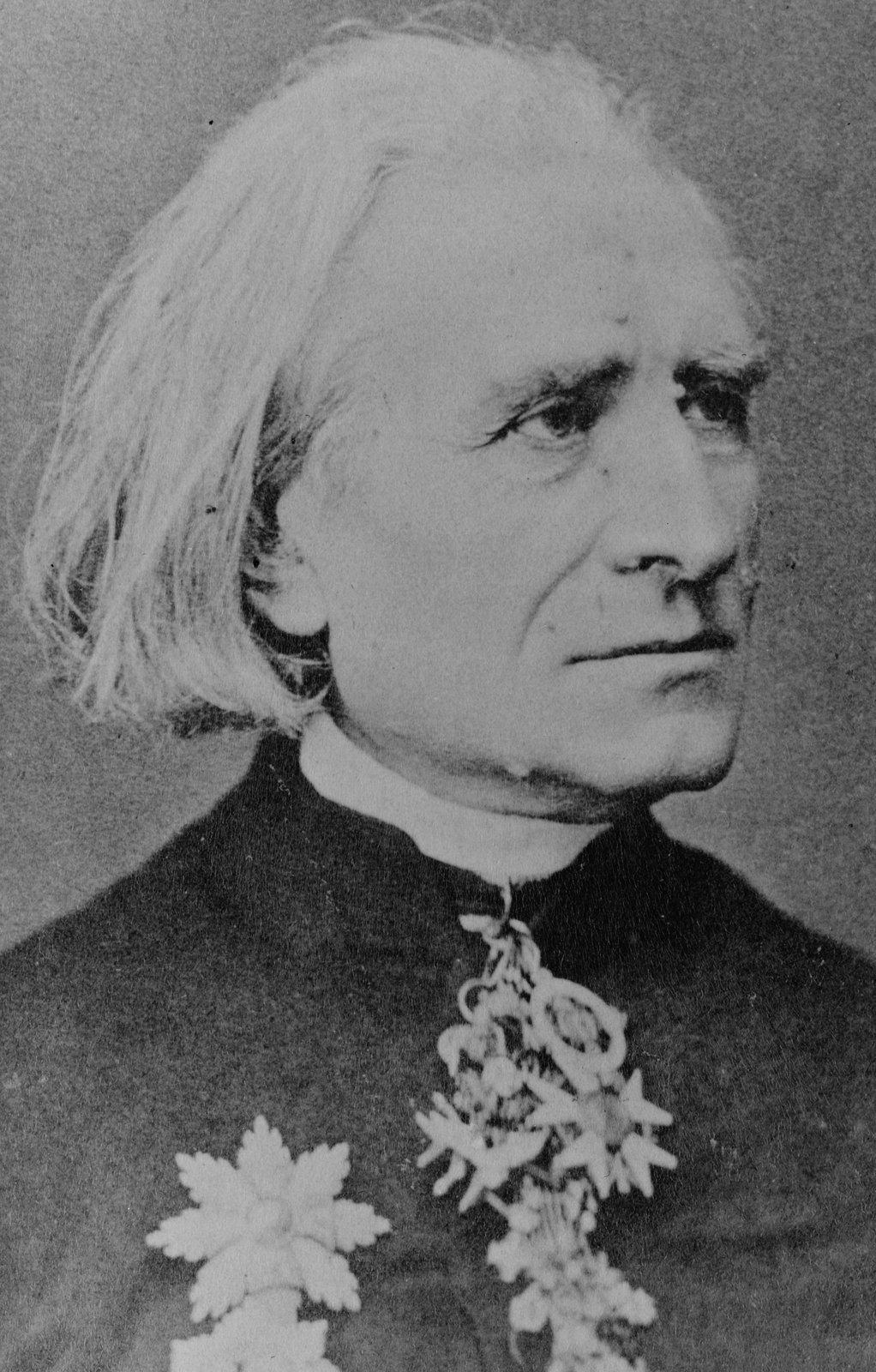
Unknown photographer, 'Franz Liszt', photographic print on carte de visite mount, between 1880 and 1886; Library of Congress Prints and Photographs Division (LC-USZ62-130770), no known restrictions on publication; cropped to the photograph · Library of Congress Prints and Photographs Division, 'Franz Liszt' (carte de visite, no. 1226; LC-USZ62-130770; LCCN 2004680099), via Wikimedia Commons 'Franz Liszt LCCN2004680099.jpg' · Public domain
From the late 1830s Liszt toured Europe as a concert pianist, often giving whole programmes alone: in March 1840 Robert Schumann reported that Liszt nearly always gave his concerts unassisted, and described his Dresden and Leipzig concerts, which included Weber's Concertstuck and Schubert's Erlkonig. The wave of public enthusiasm that followed his Berlin concerts of 1841-42 was named 'Lisztomania' by Heinrich Heine.
As a composer Liszt wrote the symphonic poems, one-movement orchestral works built on a literary or pictorial programme, twelve of them between 1848 and 1858 while he lived in Weimar. His piano music includes the Piano Sonata in B minor, dedicated to Robert Schumann, many Hungarian Rhapsodies, and the Annees de pelerinage, which in 1852 he described as a thorough remodelling of his earlier Album d'un voyageur. Their reception was divided: Schumann doubted in 1840 that he would match his playing as a composer, and James Huneker in 1899 found the B minor sonata fascinating though without a true sonata structure.
Liszt settled in Weimar in 1848 as court Kapellmeister. There the court theatre gave the first performance of Wagner's Lohengrin on 28 August 1850, which Liszt prepared and for which he wrote a detailed account that Wagner says drew attention to the work abroad, and in 1852 it staged Berlioz's Benvenuto Cellini. Liszt resigned his conducting post in 1858, after a hostile demonstration at the premiere of Peter Cornelius's The Barber of Baghdad.
Liszt taught piano in group classes in which each pupil played in turn before the others. The American pupil Amy Fay described the Weimar classes of 1873, where he taught her without charge, and the Wikipedia article lists Tausig and Bulow among his pupils. In 1875 he was named president of the new Royal Hungarian Academy of Music in Budapest, which opened that November; his own letters say the plan was not his idea, and in 1876 he began teaching a piano class there.
In March 1840, still tired from six concerts in eight days in Prague, Liszt played in Dresden and then in Leipzig. Schumann reports that he said he was ready at once to give a concert for any charitable institution, played for the poor in Dresden and then for the Leipzig pension fund for aged or invalid musicians, and chose pieces by Mendelssohn, Hiller and Schumann himself, playing them almost at sight.
Offering a benefit concert at once and taking up colleagues' music even when tired is consistent with impact motivation; Schumann also notes the visible strain it cost him. Impact Motivation
In June 1873, the pupil Amy Fay saw Liszt in a Weimar class lose his temper once. A student from Stuttgart attempted Beethoven's Appassionata Sonata and made rhythmic mistakes, and Liszt burst out at him and gave a tirade against conservatories and teachers in general; then he stopped, told the student the anger was not meant for him, and asked him to play on.
As Weimar court Kapellmeister Liszt had to submit his programmes to the court intendant. After Franz von Dingelstedt took that post in 1857 and reduced music productions, a hostile demonstration at the 1858 premiere of Peter Cornelius's The Barber of Baghdad led Liszt to resign as conductor of the theatre. In December 1860 he wrote that he would conduct the rehearsals of Wagner's Rienzi at Weimar but refused to conduct its performances.
People whose overall profiles resemble theirs.