Ada Lovelace
93% Profile Match
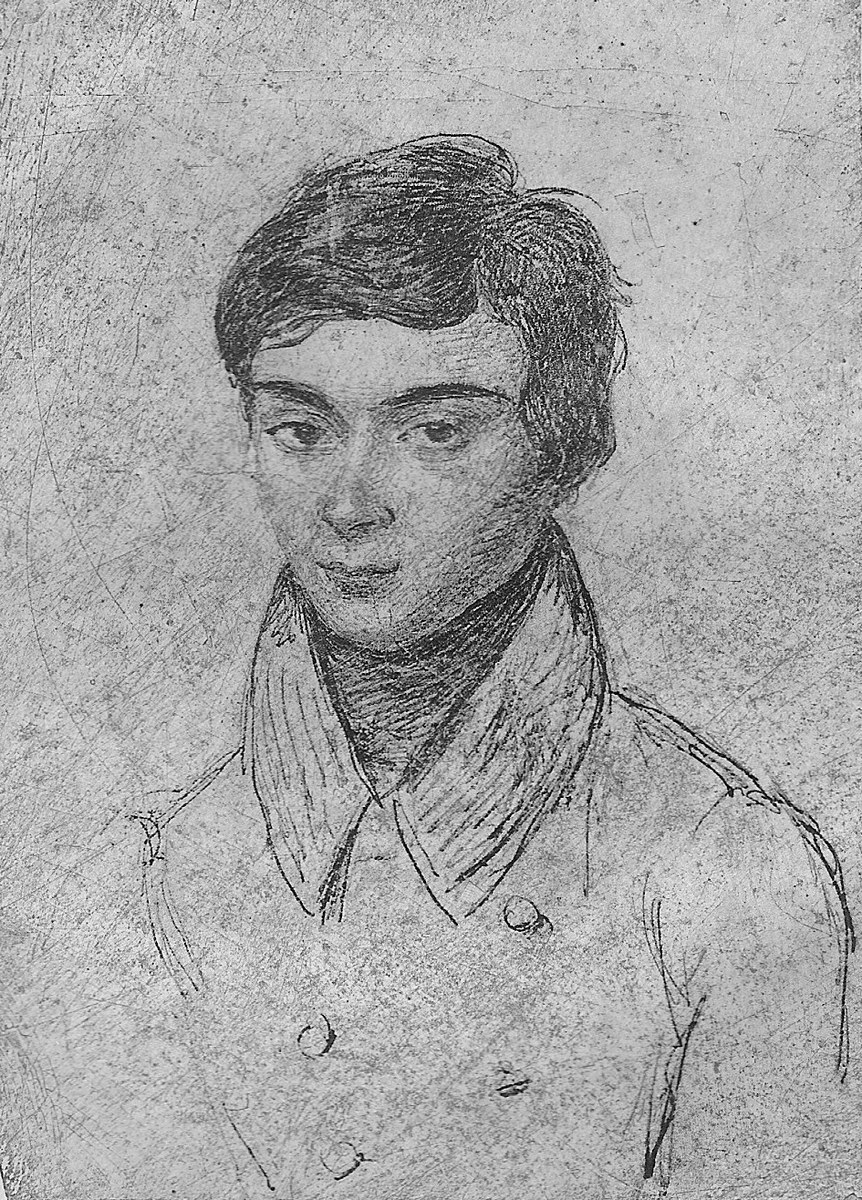
Unknown artist, portrait of Evariste Galois at about fifteen, about 1826, first published in P. Dupuy, La vie d'Evariste Galois (1896); scan via Wikimedia Commons · Pencil portrait of Evariste Galois at about fifteen or sixteen, drawn from life about 1826 by an unknown artist, kept by his niece Madame Guinard (daughter of his elder sister) and first published as a reproduction in Paul Dupuy, 'La vie d'Evariste Galois', Annales scientifiques de l'Ecole normale superieure, 1896, whose text says the portrait was made from nature when he was fifteen or sixteen. The file is a scan of the drawing from Wikimedia Commons, downscaled from 945 x 1316 to 862 x 1200 pixels; no upscaling and no retouching. · Public domain (anonymous drawing of about 1826, first published in France in 1896; public domain in the United States by publication before 1931 and expired in France before 1996)
mathematician · 19th Century
1811–1832
Not yet included in personality matching — the documented evidence doesn't yet cover enough of the personality model. Everything else on this page is fully available.
French mathematician who gave a definitive answer to when an algebraic equation is solvable by radicals, by tying solvability to the group of the equation, a founding step of modern algebra now called Galois theory.
In under a hundred pages he also introduced 'Galois imaginaries', a precursor of the theory of finite fields, and results on elliptic and abelian integrals.
His work was lost or rejected by the Academy of Sciences in his lifetime (he died in 1832, aged twenty) and became known only when Joseph Liouville announced it in 1843 and published it in 1846.
In his first year of mathematics he found the elementary algebra textbooks unsatisfying and went instead to Lagrange's own treatises on the resolution of equations and on analytic functions.
This is consistent with a student who preferred to learn from the original masters rather than from textbooks. Independent Thinking
After his first two memoirs were lost at the Academy, he submitted a third version of his memoir on solvability by radicals on 17 January 1831 at Poisson's invitation, and Poisson and Lacroix reported on it as neither clear nor developed enough.
This is consistent with someone who kept resubmitting his work after setbacks, even when the exposition left readers unconvinced. Persistence
In February 1827 he began his first mathematics class at the Lycée Louis-le-Grand; his director of studies wrote that 'it is the passion for mathematics which dominates him', and within two years he published his first paper, on continued fractions.
This is consistent with a student who turned wholeheartedly to one field once he met it. Mastery Orientation
People whose overall profiles resemble theirs.


Not a rival — a different profile shape worth a look.