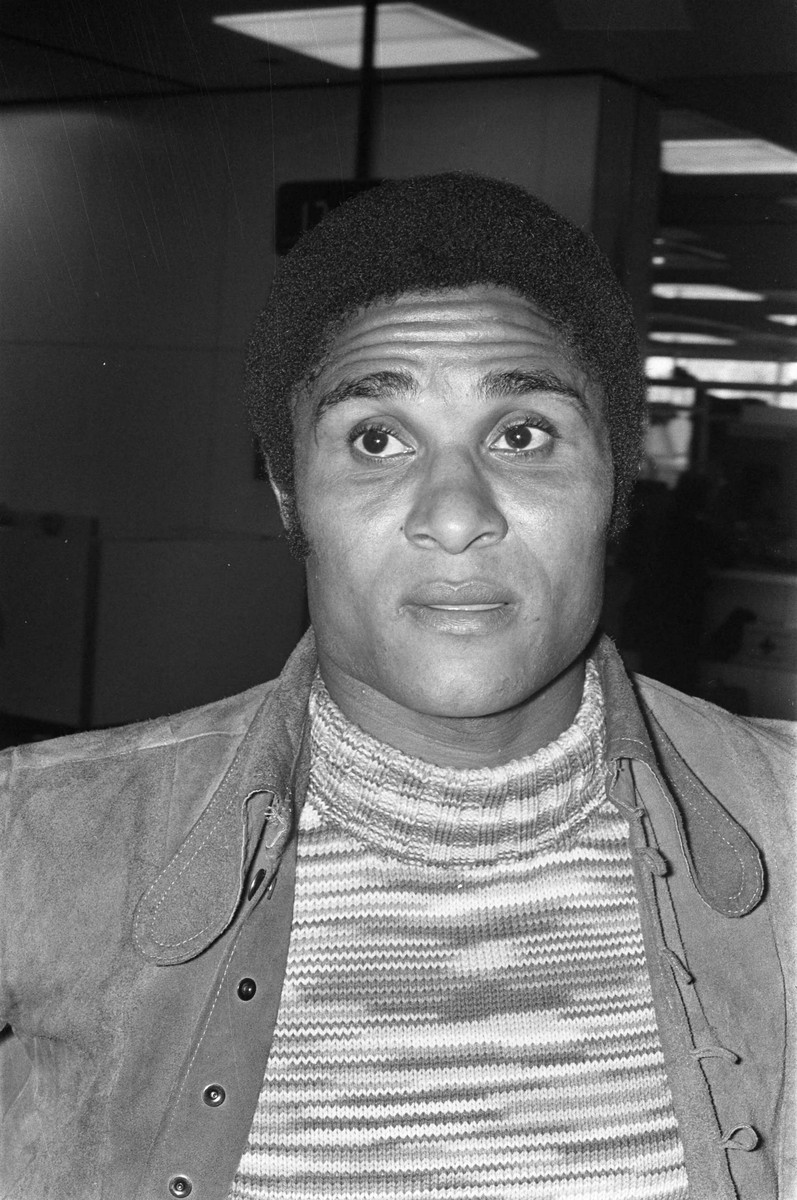

Photo: W. Punt / Anefo, 3 April 1972, Nationaal Archief, CC0, resized from the original · Black-and-white press photograph of Eusébio on the arrival of the Benfica team at Schiphol airport, Netherlands, 3 April 1972, by W. Punt for Anefo; Nationaal Archief (Dutch National Archives), Fotocollectie Anefo, file number 925-5025, titled 'Aankomst Benfica op Schiphol, Eusebio' (permanent link hdl.handle.net/10648/abe5ba56-d0b4-102d-bcf8-003048976d84). Rights review: the live Nationaal Archief record (opened 2026-11-01) gives the photographer as Punt, W. / Anefo, the date 1972-04-03, the person keyword 'Eusebio' and the rights holder as 'Nationaal Archief, CC0', and the image served by the archive's own file service is this photograph; no conflicting notice was found. Identity rests on the archive's title and person keyword and agrees with other archive photographs of him taken in 1963. The lead image (an uploader's scan of a 1973 sticker) was not used; a separate Commons file of a 1963 Anefo frame was rejected because the live archive record for that file number shows a different, head-less frame marked as a failed shot, so the Commons image could not be tied to the archive record. Original 2450 x 3691 pixels, downscaled to 797 x 1200 (no cropping, never upscaled). · CC0 1.0 (public domain dedication by the Nationaal Archief)
Trait Constellation
Key Achievements
As a forward for Benfica he won 11 league titles in 15 seasons and five Portuguese Cups, was league top scorer ten years running and scored twice in the 1962 European Cup final win over Real Madrid; he was named European Footballer of the Year in 1965.
At the 1966 World Cup he scored four goals to turn a 3-0 deficit against North Korea into a 5-3 win and finished as top scorer with nine goals as Portugal took third place.
He won the European Golden Shoe in 1968 and 1973, was named among the sport's top ten greats by a 1998 FIFA panel according to a newspaper obituary, and received the UEFA President's Award, only the third man to do so.
Moments That Reveal Them
At the 1966 World Cup he scored four goals against North Korea after Portugal fell 3-0 behind, and after the semi-final defeat to England he left the field in tears.
This is consistent with a strong drive to win and a refusal to accept a losing position, though it is one tournament described mainly in obituaries. Competitiveness
Former teammate Nuno Gomes recalls that when he arrived at Benfica Eusebio advised him and tried to help him score goals.
This is consistent with a supportive attitude toward teammates, though it rests on one teammate's tribute given soon after his death. Collaboration
Turning Points
In December 1960 he left Mozambique at 18 to sign for Benfica, and after a registration dispute was settled he won the 1962 European Cup with two goals in the final.
This is consistent with a rapid rise to elite competition after a move to a stronger club. Competitiveness
Similar People
People whose overall profiles resemble theirs.

Elizabeth Cady Stanton

Niels Bohr

Duke Ellington

Maimonides

Abraham Lincoln
Opposite Profile
Not a rival — a different profile shape worth a look.
Jalal ad-Din Muhammad Rumi
Sources
- Eusébio (Q162043), verified live via the Wikidata API (2026-11-01): label 'Eusébio', description 'Portuguese footballer (1942-2014)', born 1942-01-25, died 2014-01-05, Korean label 에우제비우. Orientation only; not used as support for any row.
- UEFA.com, 'Eusébio da Silva Ferreira: 1942-2014' (obituary, January 2014; read in full, about 600 words). CANONICAL SIGNIFICANCE SOURCE: one of the most prolific goalscorers in the history of football, who won 11 league titles in 15 seasons at Benfica plus five Portuguese Cups and was league top scorer ten years running; the 1965 Ballon d'Or and European Golden Shoes in 1968 and 1973; the UEFA President's Award, only the third man to receive it after Alfredo Di Stefano and Sir Bobby Charlton; his sportsmanship in the 1968 European Cup final and national mourning on his death.
- UEFA.com, 'UEFA President's Award: Eusébio's memories' (interview feature; read in full, about 450 words). His own account of the 1962 European Cup final in Amsterdam, where he scored twice in a 5-3 win over Real Madrid, of asking to meet his idol Di Stefano and keeping his shirt, and of Benfica as a family that wanted to win and to play attractive football. Self-report and an award body's own feature, so used with caution.
- SL Benfica, 'Eternal Eusébio' (club news page on the ceremony for his entry to the National Pantheon; read in full, about 500 words). Club account with tribute remarks by his former teammate Antonio Simoes; notes that he spent 15 seasons at the club, was three times top scorer of the European Champions Clubs' Cup and won two Golden Boots and a Golden Ball. Club tribute, so admiring; political remarks in it were read but not used.
- 'Eusebio, 71, dignified presence for Portuguese soccer teams', obituary distributed from New York and printed in The Boston Globe, 6 January 2014 (read in full, about 800 words). Independent newspaper obituary: the 1966 World Cup comeback against North Korea, the Ballon d'Or and Golden Boots, 679 goals in 678 official games by FIFA's count, his reported stance toward the injured Pele, his later years in the North American league and his role as a paid football ambassador. The article's own authorship line was not shown on the page.
- John Brewin, 'Eusebio: Portuguese pioneer', ESPN.com FIFA World Cup legends series (7 May 2010), as reposted on a Nigerian commentary site on 6 January 2014 (read in full, about 1,200 words). Independent football writer's career profile: signing for Benfica, the 1966 World Cup, his sportsmanship toward Charlton and the Manchester United goalkeeper, a continuing resentment about the venue change for the 1966 semi-final, and a note that some have questioned his status as an African pioneer given his lack of public interest in African football. The repost, not the ESPN original, was opened.
- Manuela Lanza and news agencies, 'Eusebio was Portugal's greatest: Gomes', Al Jazeera (8 January 2014; read in full, about 700 words). Interviews with two former Benfica teammates, Nuno Gomes and Antonio Simoes, giving first-hand descriptions of his conduct with younger players and on the pitch, a table of his Portugal appearances and goals (64 caps, 41 goals), and a summary of his club honours. Teammates' tributes soon after his death, so admiring.
- FourFourTwo, 'Eusebio: Factfile' (5 January 2014; read in full, about 700 words). Dated career timeline: Benfica debut in 1961, two goals in the 1962 European Cup final, defeats in the finals of 1963, 1965 and 1968, nine goals at the 1966 World Cup, his applause for the opposing goalkeeper in 1968 and the later North American spells; some totals (733 goals in 745 matches) differ from other sources and were not used.
- Wikipedia, 'Eusébio' (read; orientation only, never counted as a source and not used as support for any row). It was read to cross-check dates and honours; its passages on his dealings with the Portuguese regime and on his injuries were not used.