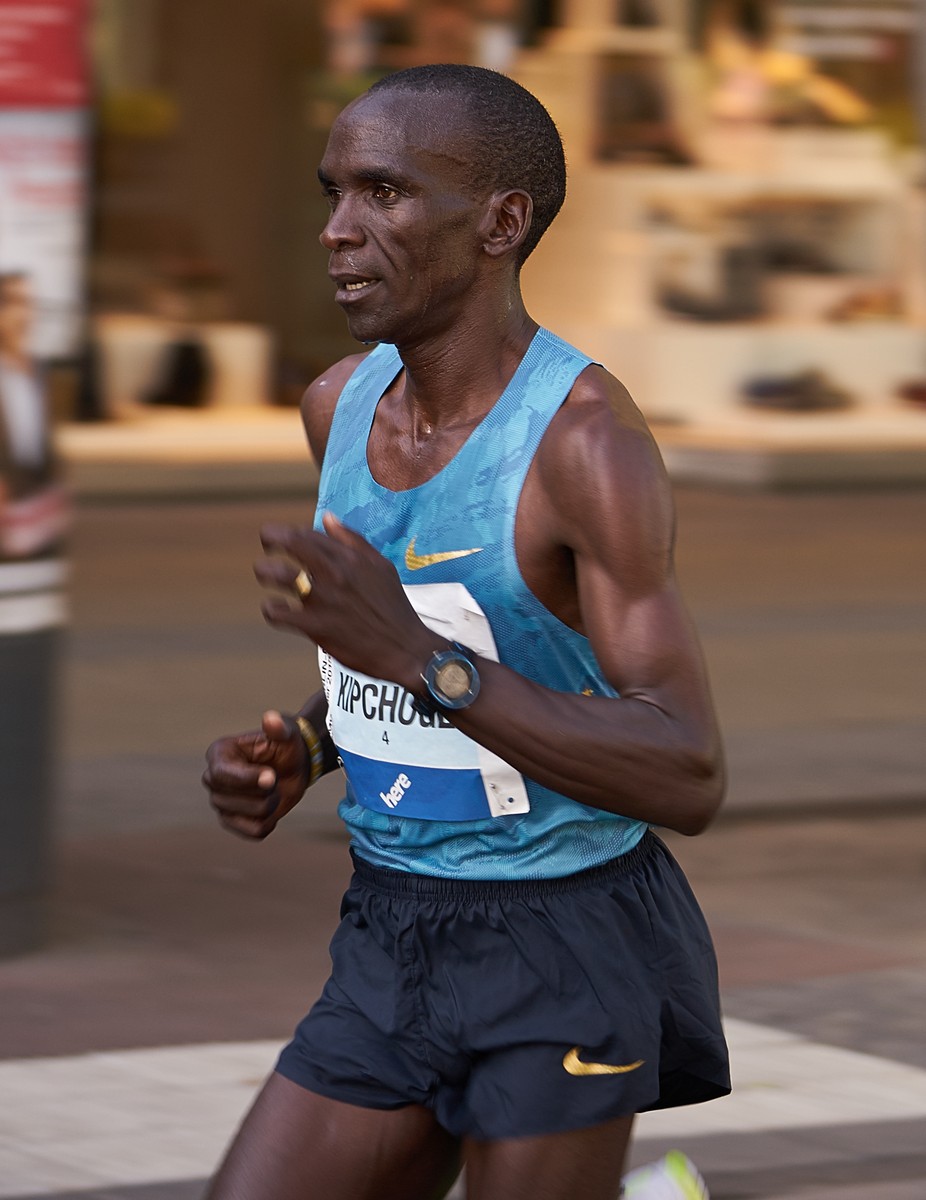
Photo: Denis Barthel, 2015, CC BY-SA 4.0 · Wikimedia Commons 'File:Berlin-Marathon 2015 Runners 1.jpg' -- photograph by Denis Barthel, taken 27 September 2015 at the Berlin Marathon (Commons description 'Kipchoge, Eliud (KEN)'), own work published under CC BY-SA 4.0 ({{self|cc-by-sa-4.0}}). Original 1774 x 2298 pixels (SHA-1 960eb612 matches the Commons record); downscaled to 926 x 1200 (no upscaling, no crop). · CC BY-SA 4.0
athlete · Contemporary
Eliud Kipchoge
b. 1984
Known For
Not yet included in personality matching — the documented evidence doesn't yet cover enough of the personality model. Everything else on this page is fully available.
Trait Constellation
Key Achievements
Kipchoge won ten consecutive major marathons between 2014 and 2019, according to Outside, and ran a world record of 2:01:39 at the 2018 Berlin Marathon, the year World Athletics named him its male athlete of the year.
Kipchoge won the 2003 world 5000 m title, then Olympic 5000 m bronze in 2004 and silver in 2008, and moved to the marathon after missing the 2012 Olympics, winning Olympic marathon gold in 2016 in 2:08:44.
On 12 October 2019 in Vienna, Kipchoge ran 1:59:40.2 in the INEOS 1:59 Challenge, the first marathon distance under two hours; it did not count as a world record because pacemakers rotated and a pace car guided him, CBS Sports reported, and his 2017 Monza attempt of 2:00:25 did not count either.
Moments That Reveal Them
Outside reports that before every race Kipchoge spends about four months in Kaptagat on slight variations of the same workouts, that he wakes at 5:45 a.m. and is in bed by 9 p.m., and that since 2003 he has logged each run's time, distance, massage, exercises and shoes in notebooks, 18 of which he now keeps.
This is consistent with sustained adherence to a fixed training routine. Discipline
People Daily reports that on the treatment table the day after his 1:59:40 run in Vienna, which was not a world record because of rotating pacemakers, Kipchoge told his physiotherapist: 'Now, the next thing. Make it official.'
This is consistent with turning an unofficial result straight into the next goal. Persistence
Turning Points
People Daily reports that Kipchoge failed to qualify for the 2012 London Olympics as a track athlete and moved to the marathon, winning the Rio 2016 Olympic marathon four years later and, per the same profile, 11 of his first 12 marathons.
This is consistent with redirecting his career after a setback rather than leaving the sport. Persistence
Similar People
People whose overall profiles resemble theirs.

Yi Sun-sin

Nelson Mandela

Ruth Bader Ginsburg

Warren Buffett

Marcus Aurelius
Opposite Profile
Not a rival — a different profile shape worth a look.

Leonardo da Vinci
Sources
- Eliud Kipchoge (Q9124) -- verified live via the Wikidata API (2026-10-23): English label 'Eliud Kipchoge', description 'Kenyan long-distance runner', born 5 November 1984, no date of death, citizenship Kenya, Korean label '엘리우드 킵초게', English and Korean Wikipedia sitelinks present. Orientation only; not used as support for any row.
- World Athletics, 'Sixteen years in the making, Kipchoge now confirmed as the best in the world' (worldathletics.org, December 2018), read in full via a saved copy: feature published when he was named IAAF Male Athlete of the Year for 2018 -- his 2003 world under-20 cross-country title and senior world 5000 m title, his switch to the marathon, the Rio 2016 Olympic marathon win (2:08:44) and Berlin 2018 world record of 2:01:39, the 25-second miss in the Monza Breaking2 experiment, his working relationship with coach Patrick Sang and the NN Running group (largely in his own words), and the statement that he had won all but one of his 11 marathons to date. CANONICAL SIGNIFICANCE SOURCE. Governing-body feature; admiring; most quotations are Kipchoge's own, so no behavioural row rests on it alone.
- 'The Surprisingly Simple Training of the World's Fastest Marathoner' (Outside Online), read in full via a saved copy: a journalist's three-day visit to the NN Running Team camp at Kaptagat after the Tokyo Olympics -- a repeated four-month build-up of slight variations on the same workouts, the hard-easy weekly pattern (track, long run and intervals at about 80 percent effort, easy days at about 50), weekly mileage of 124 to 136 miles, the twice-weekly strength and mobility session overseen by physiotherapist Marc Roig, a 5:45 a.m. start and 9 p.m. bedtime, a training log he has kept in notebooks since 2003 (18 volumes) listing times, kilometres, massage, exercises and shoes, comments by physiotherapist Peter Nduhiu and coach Patrick Sang (who says the usual marathoner's mistake is not listening to the body), and the statement that he won ten consecutive major marathons between 2014 and 2019. Independent journalist's on-site report arranged by the team; sympathetic. His own quotations (the 80/50 split, the log) are self-report; the physio and coach remarks and the journalist's observation are the non-self material.
- 'Eliud Kipchoge: The humble home life in rural Kenya behind remarkable athletic success' (People Daily Digital, republished feature from the 2020 visit to the Kaptagat camp), read in full via a saved copy: reporter's visit including the camp's fixed timetable (track Tuesdays, long run Thursdays, intervals Saturdays), shared chores and a camp president elected by residents, teammate Geoffrey Kamworor on the camp's single focus, coach Sang saying Kipchoge 'has never missed a session' (an unverifiable absolute), physiotherapist Nduhiu on his prompt reporting of niggles, the long run at which about 100 runners were whittled to five, his Olympic record (2004 5000 m bronze, 2008 silver, 2016 marathon gold, not qualifying for London 2012) and the sentence that 'now the next thing, make it official' was said on the table the day after Vienna. Independent reporter's profile; admiring. Its passages on his wife, children, home, church, money and animals were not used.
- CBS Sports, 'Eliud Kipchoge becomes first athlete to run marathon in less than two hours, but it's not a world record' (cbssports.com, 12 October 2019), read in full via a saved copy: report of the INEOS 1:59 Challenge in Vienna -- 1:59:40.2, supported by 36 pacemakers and a pace car projecting a laser line, not counted as an official record (his official world record being 2:01:39 from Berlin 2018), his remarks that after Roger Bannister's mile it took 65 years and that he wants to inspire people that no human is limited. News report; its event details are used and the pacing set-up is the critical caveat on the achievement.
- Sports Illustrated, 'Eliud Kipchoge to Attempt Sub-Two-Hour Marathon in Vienna in October' (si.com, 27 June 2019), read in full: announcement of the Vienna attempt with the Prater course description, a reminder that the 2017 Monza Breaking2 run of 2:00:25 did not count as a record because of alternating pacemakers, and his London Marathon win in 2:02:37 earlier in 2019. Short news item; no quotations from Sang or critics.
- Marathon Handbook, 'Eliud Kipchoge Opens Up About Historic First DNF at the 2024 Paris Olympic Marathon' (marathonhandbook.com, August 2024), read in full: report that Kipchoge did not finish the Paris 2024 Olympic marathon, his first DNF, that spectators walked alongside him as he left the course, his own statement 'I have never done a DNF... That's life' listing earlier second, eighth, tenth and fifth places, the winners' names and times, and his statement that it was his final Olympic Games. Independent running-news report; used only as a counter-voice showing that his record was not unbroken; the injury explanation given in the article is his own account and was not used.
- Wikimedia Commons file page 'Berlin-Marathon 2015 Runners 1.jpg' (with the Commons wikitext and API record) -- checked for the portrait's licence: photograph by Denis Barthel, taken 27 September 2015 at the Berlin Marathon, captioned 'Kipchoge, Eliud (KEN)', own work published under CC BY-SA 4.0, 1774 x 2298. Not used for any scoring.