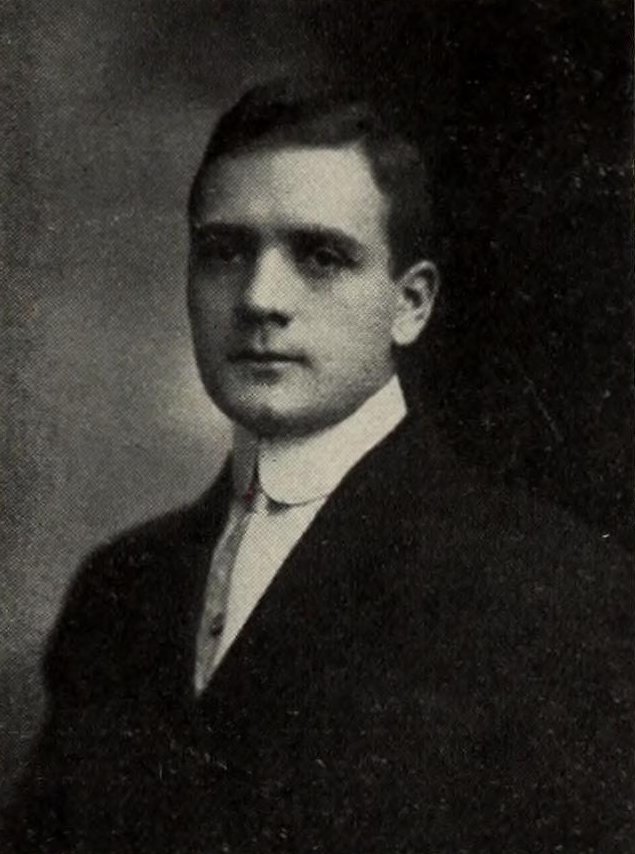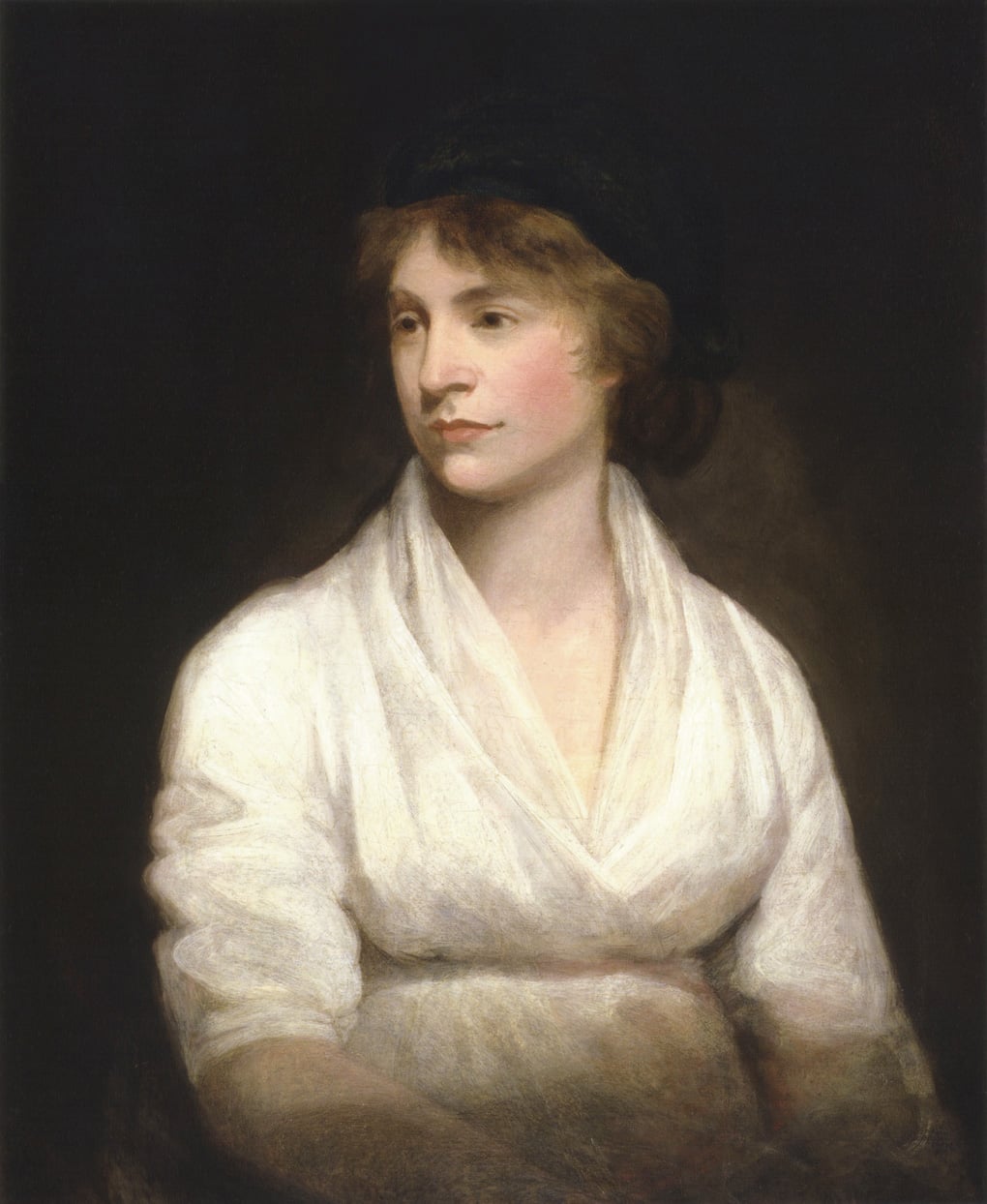

Photograph captioned 'Edwin Powell Hubble -- Awarded Rhodes Scholarship from Illinois', The Cap and Gown 1910, University of Chicago, p. 87; photographer not credited · The Cap and Gown 1910 (University of Chicago yearbook, Chicago, 1910), p. 87, via Internet Archive (capgown1910univ) · Public domain (published in the United States in 1910)
astronomer · 20th Century
Edwin Hubble
1889–1953
Known For
Not yet included in personality matching — the documented evidence doesn't yet cover enough of the personality model. Everything else on this page is fully available.
Trait Constellation
Key Achievements
In 1923-24 Hubble used the 100-inch telescope at Mount Wilson to find Cepheid variable stars in the Andromeda nebula, and soon in M33 and NGC 6822. Their periods and brightness put Andromeda at roughly 900,000 light-years in his 1929 paper, far outside the Milky Way, and effectively settled the long dispute over whether spiral nebulae were separate galaxies. Later work showed his distance scale was too small; Andromeda proved about twice as far.
In 1929 Hubble set his galaxy distances against measured redshifts, mostly Vesto Slipher's, and reported that more distant galaxies appear to recede faster, at about 500 km/s per megaparsec. With Milton Humason, who measured fainter galaxies, he extended the relation from 1931. It became the observational basis of the expanding-universe picture, though Hubble wrote of 'apparent' velocities and kept the interpretation open, and Georges Lemaitre had derived such a relation and estimated its rate in 1927, so historians still debate how to share the credit.
In 1926 Hubble proposed a classification of galaxies into ellipticals, spirals, barred spirals and irregulars. The 'tuning fork' diagram that summarises it appeared in his 1936 book The Realm of the Nebulae, and Allan Sandage completed the system after Hubble's death. The Hubble sequence is still the standard starting point for describing galaxy shapes.
Moments That Reveal Them
In the 1920s Hubble's Mount Wilson colleague Adriaan van Maanen reported rotation measurements of spiral nebulae that, if the nebulae were distant, would have implied impossible speeds. According to the American Institute of Physics history, Hubble first took apart van Maanen's claim of corroboration in a private talk, then published his own remeasurement of four nebulae, which showed systematic errors in van Maanen's figures. Later van Maanen printed a short note saying his motions should be viewed 'with reserve', an arrangement the history says was negotiated with Hubble and the journal's editor.
This episode is consistent with a willingness to contradict a colleague's data openly, while settling the dispute by negotiating how the record would be presented rather than staging a direct confrontation. Conflict Tolerance
Hubble's 1926 galaxy-classification paper contains a footnote asserting priority over a similar scheme by Knut Lundmark; Allan Sandage says some of Hubble's complaints, which he rarely made public, were unfounded. In a letter to Willem de Sitter of 21 August 1930, quoted by the astronomer David Block, Hubble wrote that he considered the velocity-distance relation, 'its formulation, testing and confirmation, as a Mount Wilson contribution' and was 'deeply concerned in its recognition as such'.
These two episodes are consistent with a strong concern for priority and credit. Whether the omissions of earlier work in his 1929 paper were deliberate is disputed and is not part of this reading. Competitiveness
Turning Points
After three years at Oxford, Hubble passed the Kentucky bar examination in 1913 but, according to Osterbrock and colleagues, left no record of practising law; he taught Spanish and physics and coached basketball at a high school in New Albany, Indiana. In 1914 he wrote to his Chicago professor Forest Moulton about returning as a graduate student, and Yerkes Observatory offered him a service scholarship. He later said he had 'chucked the law for astronomy', knowing he might be second-rate or third-rate.
This pivot illustrates taking the initiative to change direction: the move to astronomy came from his own request, at some cost in the security of a profession he was already qualified for. Proactive Agency
Similar People
People whose overall profiles resemble theirs.

George Orwell

Wu Zetian

Aung San Suu Kyi

Mustafa Kemal Atatürk

Elizabeth I of England
Opposite Profile
Not a rival — a different profile shape worth a look.
Wolfgang Amadeus Mozart
Sources
- Edwin Hubble (Q43027) -- verified live via wbgetentities (2026-10-04): en label 'Edwin Hubble', description 'American astronomer (1889-1953)', born 20 Nov 1889, died 28 Sep 1953, citizenship United States, instance of human, ko label '에드윈 허블'. Orientation only; not used as support for any row.
- N. U. Mayall (Lick Observatory astronomer, Hubble's protege and colleague), 'Edwin Powell Hubble, 1889-1953', Biographical Memoirs of the National Academy of Sciences vol. 41 (1970), PDF from nasonline.org -- INSIDER-LEANING official memoir: written with access to Grace Hubble's journals, with Hubble's own corrections to the quoted anecdotes, and accepting at face value stories that later archival work contradicts (see Osterbrock et al.). Read in full for the biographical narrative and the resume of research, including the long quotations from Hubble's own papers of 1920-1934; the later technical sections were skimmed.
- Donald E. Osterbrock (Lick Observatory historian), Ronald S. Brashear (Huntington Library manuscripts curator) and Joel A. Gwinn, 'Self-Made Cosmologist: The Education of Edwin Hubble', in Evolution of the Universe of Galaxies: Edwin Hubble Centennial Symposium (Astronomical Society of the Pacific, 1990), ADS scan -- INDEPENDENT scholarly biography of Hubble's life to 1924, built on contemporary letters and on school, university and Rhodes Trust records rather than on his or his widow's recollections, and openly critical of the embellished versions. Read pages 1-14 in full (youth, Chicago, Oxford, Louisville, Yerkes, army, Cambridge, Mount Wilson, marriage, conclusion); the footnotes were not read.
- Allan Sandage (Carnegie Observatories; Hubble's last assistant and successor), 'Edwin Hubble 1889-1953', Journal of the Royal Astronomical Society of Canada vol. 83 no. 6 (December 1989), ADS scan -- ADMIRING SUCCESSOR's centennial assessment based on a re-reading of Hubble's published papers; it warns that the Huntington archive recollections contradict known facts. Read in full (11 pages of text; references not read).
- American Institute of Physics Center for History of Physics, Cosmology exhibit page 'How Bad Science Supported Doubts that Spiral Nebulae are Separate Galaxies' -- institutional history (non-self, neutral to critical) describing Hubble's handling of the dispute with his Mount Wilson colleague Adriaan van Maanen over rotation measurements, ending with paired notes in the Astrophysical Journal. Read in full.
- American Institute of Physics Center for History of Physics, Cosmology exhibit page 'Who Was Edwin Hubble?' -- short institutional biography (non-self) that treats his boxing and duel stories as reflecting 'a lifelong drive to promote a romantic image', and records that he never practised law. Read in full.
- Helge Kragh (historian of cosmology), 'Hubble Law or Hubble-Lemaitre Law? The IAU Resolution', arXiv:1809.02557 (2018) -- independent, critical scholarly note that checks the historical claims of the 2018 International Astronomical Union resolution and summarises what Hubble and Humason did and did not claim in 1929-1931. Read in full.
- Harry Nussbaumer and Lydia Bieri, 'Who discovered the expanding universe?', arXiv:1107.2281 (2012) -- scholarly summary of their book Discovering the Expanding Universe, reconstructed from original documents; PRO-LEMAITRE in emphasis, but it records what Hubble's 1929 paper did and did not say (no mention of an expanding universe; Slipher velocities taken without references) and Lemaitre's own modest conduct. Read in full.
- David L. Block, 'Georges Lemaitre and Stigler's Law of Eponymy', arXiv:1106.3928 (2011) -- ADVERSARIAL/partisan short essay for Lemaitre's priority; used here ONLY for its quotation of Hubble's letter to Willem de Sitter of 21 August 1930 on recognition of the velocity-distance relation as a Mount Wilson contribution, not for its characterisations of Hubble. Read in full.
- Malcolm A. H. MacCallum, 'Milestones of general relativity: Hubble's law (1929) and the expansion of the universe', arXiv:1504.03606 (2015) -- scholarly overview; read the sections on the pre-history of the law, Hubble's 1929 paper and Hubble's own later hedging (roughly the first third of the paper); the later sections on modern cosmology were not read.
- G. A. Tammann and B. Reindl (Basel), 'Cosmic Expansion and H0: A Retro- and Pro-Spective Note', arXiv:astro-ph/0208176 (2002) -- historical sections of an astronomers' review (colleagues of Sandage; admiring of Hubble's skill but critical of his distance scale); read for the account of Hubble's 1929 diagram, his reaction to de Sitter's 1930 extension, his doubts about expansion in later life and the post-1952 revision of his distances. Read the historical sections.
- G. A. Tammann and B. Reindl, 'Allan Sandage and the Cosmic Expansion', arXiv:1112.0170 (2011) -- introductory paragraphs only: Robertson's remark to Sandage, Hubble's 1936 book, and Hubble's last Hubble diagram annotated 'no recession factor'. The rest of the paper (Sandage's own research) was not read.
- David Hughes (Sheffield astronomer), review 'A starry, starry knight' of Gale E. Christianson's Edwin Hubble: Mariner of the Nebulae, Times Higher Education, 27 June 1997 -- CRITICAL contemporary review of the main biography (which was itself not available as full text and was not read). Read in full; used only as a critical perspective on how the biography presents Hubble's cautious wording of redshifts, his Hollywood circle and his single-technique career, not as support for a scored row.
- Milton L. Humason (Mount Wilson observer and Hubble's long-time collaborator), obituary of Edwin Hubble, Journal of the Royal Astronomical Society 114 (1954) pp. 291-295, as reproduced by the MacTutor History of Mathematics archive -- COLLEAGUE/INSIDER obituary, affectionate and repeating unverified stories (boxing the French champion, 'practising law successfully') that Osterbrock et al. contradict; used for the 1917 enlistment, the 1942 Aberdeen appointment, committee chairmanships and the observation programmes. Read in full.
- 'Edwin P. Hubble 1889-1953', obituary notice in Engineering and Science (Caltech), November 1953 ('The Summer at Caltech' issue) -- institutional obituary notice (non-self) with the Mount Wilson and Palomar director's statement on his work; used for dates, the 1942-1945 Aberdeen appointment and committee service. Read the Hubble notice.
- Kohji Tsumura (Tohoku University), 'Verification of the anecdote about Edwin Hubble and the Nobel Prize', arXiv:1705.10125 (2017) -- scholarly check of Nobel Foundation records: Hubble was nominated in 1953 but the committee did not endorse astronomical work and chose Zernike on 15 September 1953, thirteen days before Hubble died; refutes the story that he was about to win. Read in full; not used for any scored row.