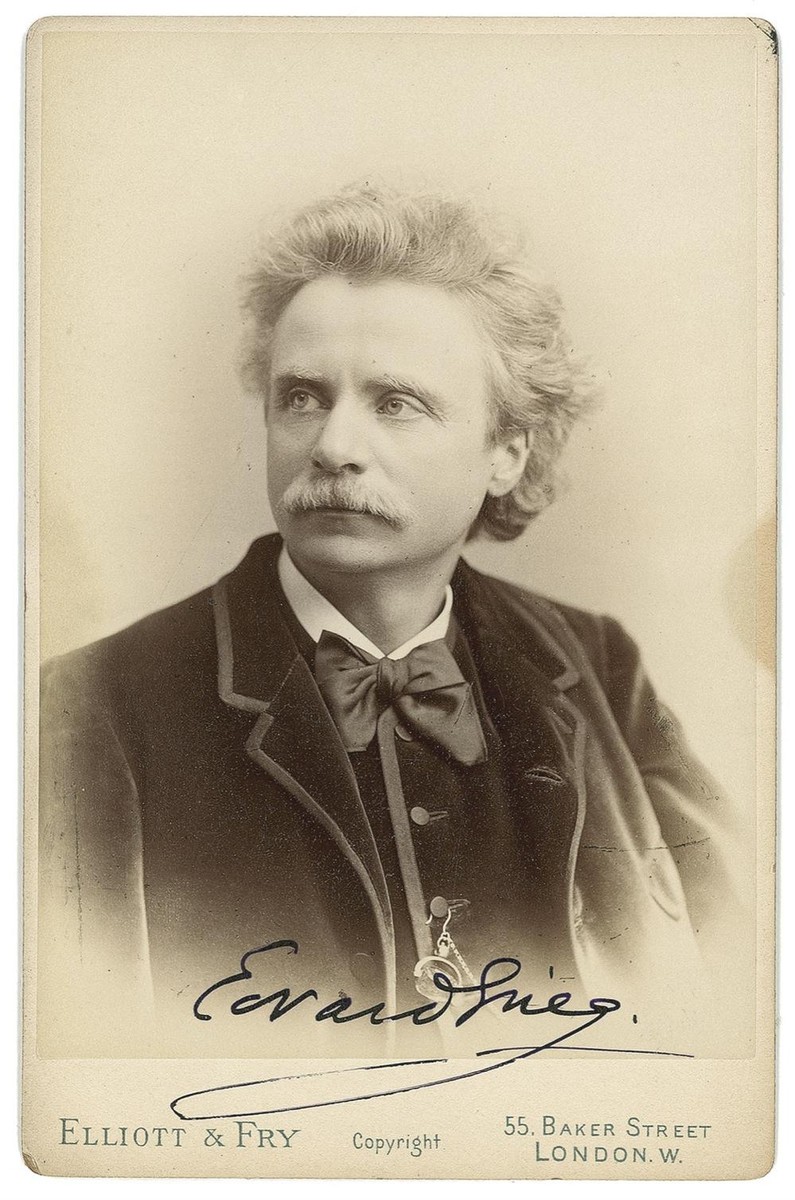

Photo: Elliott & Fry, London, 1888 (public domain) · Wikimedia Commons, 'Edvard Grieg (1888) by Elliot and Fry.jpg' -- cabinet-card photograph of Edvard Grieg taken in London in March 1888 by the studio Elliott & Fry (studio imprint printed on the card), published in The Leisure Hour in 1889; public domain because it is a studio photograph published more than 70 years ago. Original 999 x 1508 pixels, downscaled to 795 x 1200 (never upscaled). · Public domain (studio photograph published 1889)
composer · 19th Century
Edvard Grieg
1843–1907
Known For
Not yet included in personality matching — the documented evidence doesn't yet cover enough of the personality model. Everything else on this page is fully available.
Trait Constellation
Key Achievements
At Ibsen's invitation he wrote the incidental music for Peer Gynt, completed in 1875 and premiered in Christiania in February 1876; he later published two orchestral suites from it, Op. 46 in 1888 and Op. 55 in 1893.
His Piano Concerto in A minor dates from 1868; Franz Liszt received it favourably in 1869, and Grieg kept revising it over the next three decades.
He wrote 66 Lyric Pieces for piano in ten books between 1867 and 1901, in a style drawing on Norwegian folk idiom, along with roughly 140 songs.
Moments That Reveal Them
He barred his early symphony from public performance; the Bergen library records it marked 'Must never be performed', and it was not heard again until 1981.
This is consistent with holding his own early work to a strict standard. Perfectionism
For the 1898 Bergen Festival he brought in the Amsterdam Concertgebouw Orchestra instead of the local orchestra, and the organising committee resigned; the library presents the episode as a catalyst for a later professional Bergen orchestra.
This is consistent with putting the standard of performance ahead of local arrangements. Impact Motivation
Turning Points
In 1869 Franz Liszt responded favourably to the Piano Concerto and later played it at sight in Weimar, an endorsement the biography says boosted Grieg's confidence.
This is consistent with a folk-inflected style finding an international audience early in his career. Creative Originality
Similar People
People whose overall profiles resemble theirs.

Franz Kafka

Chinua Achebe

Elizabeth Cady Stanton

Sequoyah

Oscar Niemeyer
Opposite Profile
Not a rival — a different profile shape worth a look.

Benjamin Franklin
Sources
- Edvard Grieg (Q80621) -- verified live via the Wikidata API (2026-10-24): English label 'Edvard Grieg', description 'Norwegian composer and pianist (1843-1907)', Korean label present, born 15 June 1843, died 4 September 1907, citizenship Norway (the person, not the Bergen statue item). Orientation only; not used as support for any row.
- Mark Cartwright, 'Edvard Grieg', World History Encyclopedia (published 19 May 2023, modified 16 June 2023), read in full via a text fetch: Leipzig Conservatory from 1858 and Copenhagen study under Niels Gade; a symphony of his early years that he barred from public performance (not heard again until 1981); the Piano Concerto in A minor (1868), which Liszt received favourably in 1869 and Grieg kept revising for three decades; Ibsen's request for Peer Gynt music (premiere in Christiania, February 1876) and the two orchestral suites; 66 Lyric Pieces (1867-1901) and the miniaturist label; Slatter (1897) from Hardanger fiddle tunes and the view that he rarely quoted folk melodies directly; Troldhaugen villa and composing cabin from 1885; conducting and touring, his 1898 decision to bring the Concertgebouw Orchestra to the Bergen Festival, which led the organising committee to resign; an unsuccessful 1867 attempt to found a Norwegian music academy; mentoring of younger musicians such as Percy Grainger and Frederick Delius; criticism section (Debussy's 'bonbons wrapped in snow' remark, the view that his output is narrow in scope, folk influence possibly overstated, decline in reputation after his lifetime peak). CANONICAL SIGNIFICANCE SOURCE (with the Bergen Public Library Grieg Archives page). Encyclopedia-style biography by a named historian; the passages on his health and family were not used.
- Terry Blain, 'Peer Gynt: a guide to Edvard Grieg's popular masterpiece', classical-music.com (11 December 2025), read in full via a text fetch: Ibsen's invitation of January 1874; Grieg hesitated after poor first impressions of Ibsen and agreed after being offered a half-share of the fee; he found the play's shifting episodic structure hard to set and called it the most unmusical of subjects; Ibsen made specific suggestions (a wedding dance, 'devilry' for the herd girls, birdsong and bells for the Boyg) of which Grieg took some; 26 numbers sent to the Christiania Theatre in July 1875; premiere 24 February 1876 praised for dramatic contribution and originality; Grieg thought there was too much music, some of it verging on caricature, and was harsh about 'In the Hall of the Mountain King'; a substantially revised and reorchestrated version for Copenhagen in 1886 with four new movements, which he attended and conducted; Suite Op. 46 (1888) and Op. 55 (1893); he never published the complete score in his lifetime. Music-press feature by a named critic; the passage on his parents' deaths was not used.
- Bergen Public Library, history of the Grieg Archives (bergenbibliotek.no/grieg, English pages), read in full via a text fetch: the 1906 codicil by which Edvard and Nina Grieg left his manuscripts, letters, printed music and books to the library on condition that they be kept and made accessible; Troldhaugen sold in 1919 and opened to the public in 1928; the archive's manuscripts (for example the Quartet Op. 27 and Den bergtekne Op. 32, and Nordraak's sketchbook with a draft of the national anthem); a 20-volume critical edition begun in 1962 and completed in 1995; Grieg conducted Harmonien in 1880 and 1881; at the 1898 Bergen festival he brought in the Concertgebouw Orchestra rather than use the local orchestra, which the page presents as a catalyst for a later professional orchestra; the early symphony marked 'Must never be performed' and a 1978 dispute over a performance. CANONICAL SIGNIFICANCE SOURCE (with the World History Encyclopedia biography). Library institutional history of the bequest, not a full biography; the page says little on his composing habits.
- KODE Bergen, 'The collection at Troldhaugen' (kodebergen.no), read in full via a text fetch: the villa opened as a museum in 1928; Grieg's Steinway grand (placed in the villa in 1892) is still used for concerts; the couple's collection of industrial, folk and visual art including Werenskiold's Children Playing (1892) and a silver epergne designed by Gerhard Munthe reflecting an interest in Norwegian folk culture; travel objects and letters; manuscripts largely given to Bergen Public Library in 1906; the page describes frequent travel and international collaboration but not his composing routines. Museum collection page; it documents collecting, not working method.
- Stephen Barber, review of Paul Crossley's selection of Grieg's Lyric Pieces (CRD 3525), MusicWeb International (filed June 2017), read in full via a text fetch: calls Grieg an 'absolute master of the miniature' whose pieces are simple 'in the way that Mozart can be simple' yet demand subtle shaping; hears Schumann's cycles as a model without Schumann's intensity, plus Norwegian folk music and anticipations of Prokofiev and early Scriabin; the ten books span roughly 1866 to 1901, Book I (Op. 12) from the mid-1860s and Book X (Op. 71) from 1901; compares Crossley with Gilels. Independent critic's recording review; admiring of the music, with its reservations about the performances.
- Wikimedia Commons file page 'Edvard Grieg (1888) by Elliot and Fry.jpg' (with its derivative '... - 02.jpg' and the Commons API records) -- checked for the portrait: cabinet-card portrait of Grieg taken during his London trip in March 1888 by the studio Elliott & Fry (printed studio imprint, 55 Baker Street, London, on the card), published in The Leisure Hour (1889) and engraved for The Century (1894), with Grieg ordering a dozen copies according to Lionel Carley's book; Commons licence tag: public domain because the author is a studio and more than 70 years have passed (PD-old-70-1923); original 999 x 1508 pixels. Rights-basis page; no person-specific claim rests on it. The Commons Wikidata lead (a c.1903 photograph from Bergen Public Library, artist unknown, Flickr 'no known copyright restrictions') was rejected because the creator is unknown.