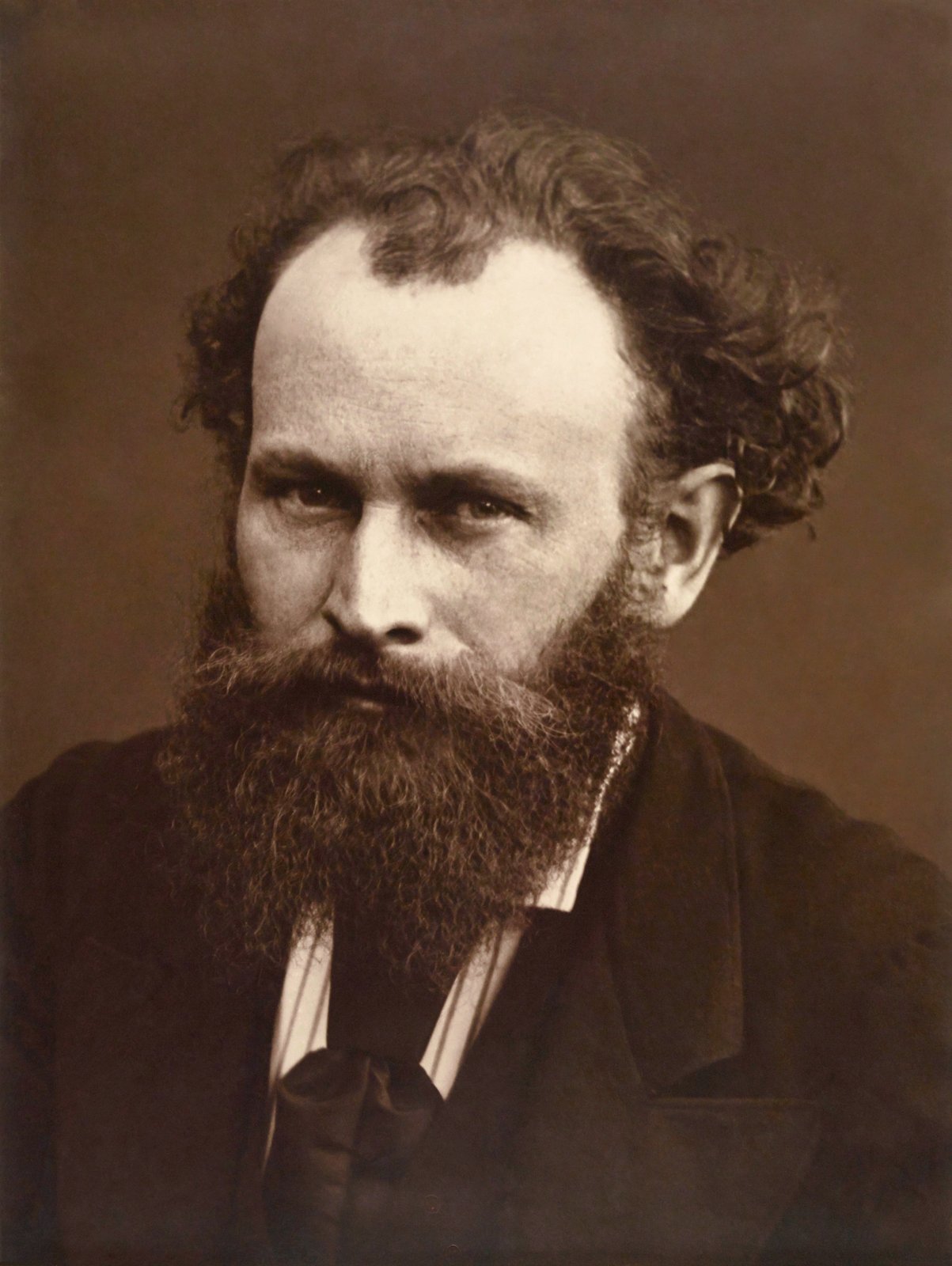

Nadar (Gaspard-Felix Tournachon), photograph of Edouard Manet, before 1870 (BnF catalogue date given only as 18..; subject heading Portraits 1800-1869), enlargement by Paul Nadar; Bibliotheque nationale de France / Gallica; digital restoration (dust and stain removal) by Adam Cuerden on Wikimedia Commons, no separate rights claimed · Bibliotheque nationale de France, departement Estampes et photographie, FOL-EO-15 (9), digitised on Gallica (ark:/12148/btv1b10535676j): photograph of Edouard Manet, bust, full face, by Nadar, enlargement by Paul Nadar (positive print, 39.6 x 29.8 cm), via the Wikimedia Commons file 'Edouard Manet, en buste, de face - Nadar.jpg' · Public domain (Nadar died 1910; BnF Gallica rights field: public domain)
painter · 19th Century
Édouard Manet
1832–1883
Known For
Not yet included in personality matching — the documented evidence doesn't yet cover enough of the personality model. Everything else on this page is fully available.
Trait Constellation
Key Achievements
In 1863 the Salon jury refused Manet's large Le Déjeuner sur l'herbe, a nude woman seated with clothed contemporary men in a landscape. On Napoleon III's order the refused artists were allowed to show at the Palais de l'Industrie, and the picture, catalogued as 'Le Bain', drew a clamour of disapproval. In 1865 the Salon accepted Olympia, a nude Parisian woman in place of a conventional goddess, together with Jésus insulté par les soldats; Duret reports that it was mocked in the press and in caricature, and Proust that the Salon administration took precautions to protect the canvas.
In 1867-68 Manet painted L'Exécution de Maximilien, a large picture of the shooting of Emperor Maximilian of Mexico at Querétaro on 19 June 1867. Duret notes that it is the one work of his showing a scene he had not seen: Manet gathered the circumstances and details of the event, posed a squad of soldiers lent from a barracks as the firing party, and painted it in three successive versions.
Un bar aux Folies-Bergère was his main picture at the Salon of 1882, the last Salon in which he exhibited. A barmaid faces the viewer with a mirror behind her showing her talking to a man and the hall; on the bar are bottles and fruit painted in bright, contrasting colour. Duret reports that critics found the arrangement of the mirror incomprehensible.
Duret writes that Pissarro, Monet, Renoir, Berthe Morisot, Cézanne and Sisley started from the light-toned painting for which Manet had set the example and went on to what came to be called Impressionism; Castagnary, reviewing the Salon of 1875, called Manet head of a school with an incontestable influence on a group of artists. Manet did not take part in the Impressionists' first group exhibition of 1874, according to Hourticq, because he thought it necessary to force the doors of the Salon.
Moments That Reveal Them
In 1867 the Exposition universelle jury refused Manet, so he had a wooden pavilion built near the Alma bridge, on ground he obtained permission to use, and showed about fifty of his pictures there in May. The catalogue opened with a notice that said he did not mean to protest, only to show 'sincere works', and that showing was the way to find friends and allies. Duret and Hourticq report that the public and the press ridiculed the exhibition and that few visitors came; Courbet had built a similar pavilion nearby.
Putting on the exhibition himself once the jury refused him is consistent with proactive agency; Hourticq also notes that this kind of show was burdensome for his means. Proactive Agency
In 1875 Manet wrote to Duret that he had found Claude Monet at Argenteuil dejected and almost penniless. He proposed that the two of them buy ten to twenty of Monet's pictures at 100 francs each, 500 francs apiece, without Monet learning who was behind it, because a dealer or collector might refuse. Duret, who reprints the letter, notes that Manet was himself short of money and that the dealer Durand-Ruel, the only one who had bought such work, could not help at that moment.
Turning Points
In 1863 the Salon jury refused Le Déjeuner sur l'herbe, as it had refused his Absinthe Drinker in 1859. When Napoleon III allowed the refused artists to exhibit separately, Manet's large canvas was among the most noticed; Duret reports a clamour of disapproval, and Proust that the court declared it an offence against decency after the Emperor stopped in front of it. Manet had painted Olympia the same year, which Duret treats as a complement to the picture, and showed it at the Salon of 1865.
Following the refusal with a second challenging nude two years later is consistent with persistence; Duret adds that the public's hostile view of him, once set in 1863, lasted for years. Persistence
Similar People
People whose overall profiles resemble theirs.

Frida Kahlo

Sigmund Freud

Martha Graham

Oscar Niemeyer

James Joyce
Opposite Profile
Not a rival — a different profile shape worth a look.
Theodore Roosevelt
Sources
- Édouard Manet (Q40599) -- verified live via wbgetentities (2026-10-08): en label 'Édouard Manet', description 'French painter (1832-1883)', born 23 Jan 1832, died 30 Apr 1883, ko label '에두아르 마네', P18 'Édouard Manet, en buste, de face - Nadar.jpg'. Orientation only; not used as support for any row.
- Jules Claretie (critic and novelist), 'Peintres et sculpteurs contemporains', 2nd ed. (Paris: Charpentier, 1874), Internet Archive scan peintresetsculp00clar -- CONTEMPORARY, SKEPTICAL-TO-HOSTILE CRITIC: a Salon review 'Deux heures au Salon' (apparently of the 1865 Salon, going by its mention of Olympia and Whistler's Princess of the Land of Porcelain) calls the Olympia a provocation ('defis jetes a la foule') and the chapter 'M. Edouard Manet' (Salon of 1872) judges that he deliberately set out to startle the public and produces 'morceaux de peinture et non des tableaux', while praising his brushwork and his Bon Bock of 1873 in the preface. Read those passages plus the chapter's biographical footnote (Salons 1861-1872); the remainder of the volume was not read. Used as an adversarial voice on how Manet was received, not for the critic's aesthetic verdicts.
- Jules-Antoine Castagnary (art critic, friend of Courbet), 'Salons (1857-1870)' and the later 'Salons' volume (Paris: Charpentier, 1892), Internet Archive scan salons185718701892cast -- CONTEMPORARY CRITIC, sympathetic to realism but not to Manet's treatment of faces and hands: the reviews of the Salons of 1873-1876 credit Manet with sincerity, work done from nature and a 'place in the history of contemporary art', protest the Salon jury's refusal of his 1876 pictures, and at the same time criticise the insufficient modelling of hands and faces in the plein-air Argenteuil and the Bon Bock. Read the Manet passages located by search in the text and their surrounding paragraphs; the rest of the volumes was not read. Page headers in the scan are OCR-unreliable for the year.
- Louis Hourticq (Deputy Inspector of Fine Arts of the City of Paris), 'Edouard Manet', French Artists of Our Day series, English edition (London, 1912), Internet Archive scan douardmanet00lara -- LATER, INDEPENDENT ART-HISTORICAL MONOGRAPH written a generation after Manet's death and not by a friend; it leans on Zola, Duret and Proust for facts but adds its own account of the 1866-1867 refusals, the 1867 pavilion, the 1874 Impressionist exhibition from which Manet abstained, and the 1878 refusal. Read the narrative chapters 1863-1882 in the plate commentary form; the stylistic analysis chapters were skimmed.
- Antonin Proust (Manet's schoolfriend, fellow pupil in Couture's studio and later a government minister for the arts), 'Edouard Manet: Souvenirs', ed. A. Barthelemy (Paris: H. Laurens, 1913), Internet Archive scan edouardmanetsouv00prou -- FRIEND'S MEMOIR, written long after the events from memory, with reconstructed dialogue and some points that other sources do not bear out (for example it says Olympia was first refused and then rescued, which Duret does not report, and Duret contradicts its account of who obtained the Ecole des Beaux-Arts hall for the 1884 retrospective); read for the Couture studio years (about two thirds of the text, the remainder skimmed), the travels, the Salon des Refuses, Olympia, the 1867 exhibition, the 1880-82 Salons and Manet's quoted letter to Proust of 1880. Use for behaviour and for Manet's own reported statements, which are self-sourced through a friend; the accompanying English translator's notes were not relied on.
- Theodore Duret (art critic, collector and friend of Manet), 'Histoire d'Edouard Manet et de son oeuvre' (Paris: Charpentier et Fasquelle, 1902), Internet Archive scan histoireddouar00dure -- FIRST BIOGRAPHY, by an admiring friend and early defender who reprints several letters from Manet and the printed preface to his 1867 exhibition; read for the chapters on the 1863-1867 Salons, the 1867 private exhibition, the 1876-1880 Salon refusals and admissions, Manet's help to Monet and the Impressionists, and the late work. Admiring and partisan about Manet; the facts and the quoted letters are used, the praise is not.
- Emile Zola, 'Edouard Manet, etude biographique et critique' (first published in the Revue du XIXe siecle, 1 January 1867; reprinted in 'Mes haines', Paris: Charpentier, 1879/1893 edition), Internet Archive scan meshainescauseri00zolauoft -- CONTEMPORARY ADVOCATE, a young critic and friend defending Manet in the year of his private exhibition; the essay is an argument as much as a portrait and says so in its own preface, so it is used for what Manet was seen to do and say in 1867 (his years in Couture's studio, his working habits, his reception) and as a contemporary view, not as neutral reporting. Read the biographical opening and the argument sections; the picture-by-picture catalogue was read selectively.