Benjamin Franklin
93% Profile Match
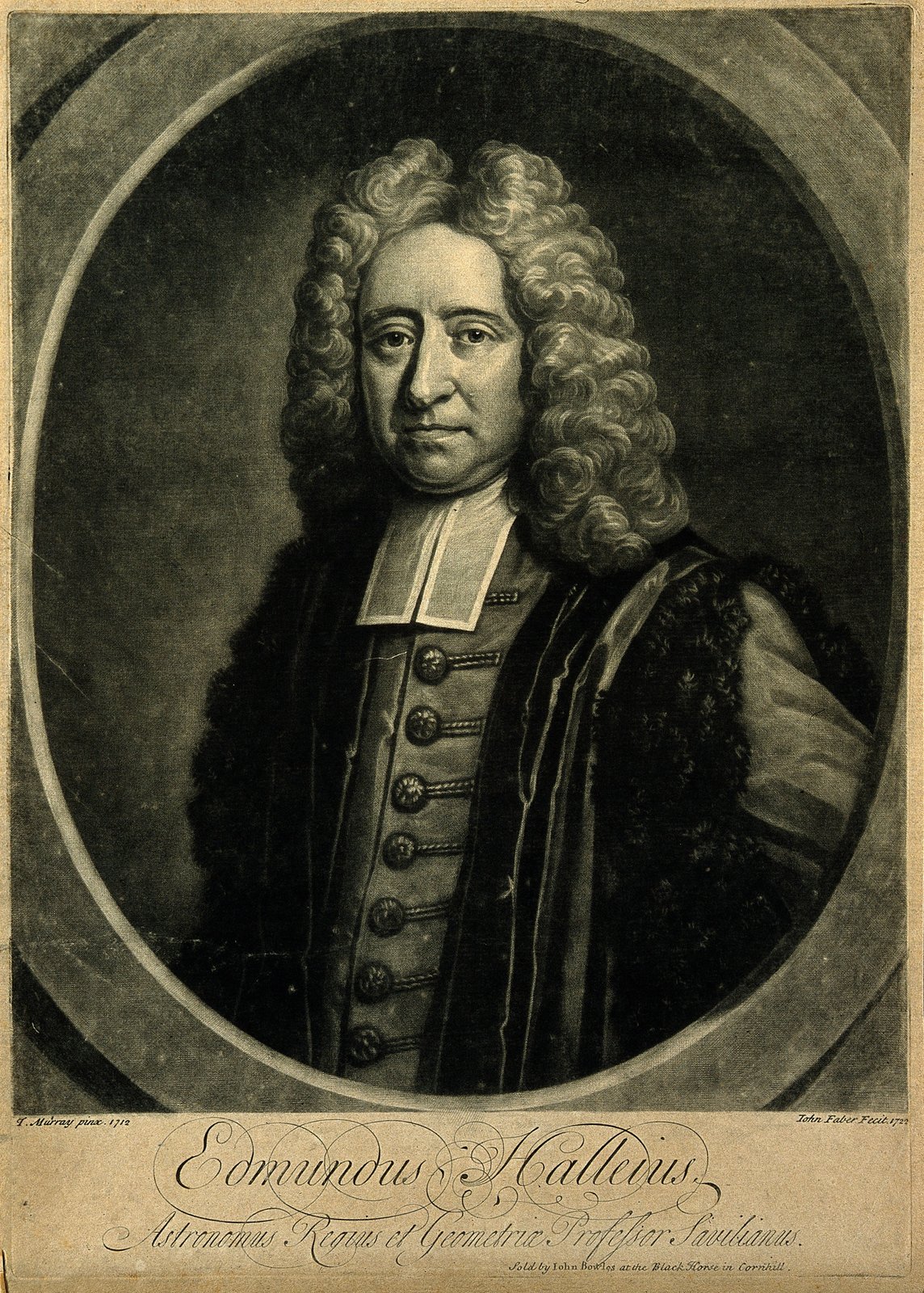
John Faber (engraver) after Thomas Murray; Wellcome Collection (credit line: Wellcome Collection, CC BY 4.0) · Mezzotint 'Edmundus Halleius, Astronomus Regius et Geometriae Professor Savilianus' by John Faber, 1722, after Thomas Murray's portrait of 1712, Wellcome Collection (Iconographic Collections), via Wikimedia Commons · Public domain (print published in London in 1722); the Wellcome Collection scan was released under CC BY 4.0
astronomer · Early Modern
1656–1742
Not yet included in personality matching — the documented evidence doesn't yet cover enough of the personality model. Everything else on this page is fully available.
In his 1705 Synopsis of the Astronomy of Comets Halley computed the orbits of twenty-four comets and concluded that the comets of 1531, 1607 and 1682 were one body on an elliptical orbit, returning about every 76 years, and he predicted its return for late 1758. He died in 1742; the comet was seen again at the end of 1758, and the recovery was widely read as a confirmation of Newtonian mechanics. It has since carried his name.
In January 1684 Halley, Hooke and Wren could not work out what orbits an inverse-square attraction to the Sun would produce, and in August Halley put the question to Newton in Cambridge. This led Newton to the Principia (1687), which Halley saw through the press, paying for the printing and receiving the sales proceeds, and for which he wrote a Latin ode and distributed copies. His biographer Alan Cook notes that Halley contributed nothing to its composition.
Halley left Oxford without a degree in November 1676 and spent about eighteen months on St Helena fixing the positions of southern-hemisphere stars, with a letter from Charles II to the East India Company and an allowance from his father. His Catalogus Stellarum Australium (1679), listing 341 stars, made his name at twenty-two, and on 7 November 1677 he observed a transit of Mercury, from which he argued that a transit of Venus could be used to find the distance of the Sun.
Halley turned scattered observations into charts and tables: a 1686 map of the trade winds and monsoons, which Cook calls the first meteorological chart produced; the 1693 life tables drawn from the bills of mortality of Breslau, one of the earliest links between mortality and age and a forerunner of actuarial method; and, after his Atlantic cruises of 1698-1700, the 1701 chart of magnetic variation showing lines of equal declination, the first such chart Cook says was published.
In 1712 Halley, working with the Royal Society's visitors to the Royal Observatory, took over publication of Flamsteed's unfinished star catalogue. The University of Glasgow reports that it went to press without Flamsteed's consent, altered his work and carried a preface openly criticising the Astronomer Royal; MacTutor adds that the preface charged Flamsteed with sluggishness, secretiveness and lack of public spirit. Newton and Halley had 400 copies printed, and in 1716 Flamsteed burned much of the edition, including Halley's unsigned preface.
Pressing ahead with a publication he knew its author opposed, and writing a critical preface, is consistent with tolerance for open conflict; the Flamsteed side's account is the main source for how it was received, and the quarrel cost Halley a lasting enemy. Conflict Tolerance
For his 1693 paper on mortality, Halley chose the bills of Breslau because the city lay far from the sea, had few strangers and had births slightly above funerals, which suited a standard population. The tables gave ages at death but not the number of inhabitants, so he said he would supply that figure by comparing mortality at all ages, and he then computed the price of annuities on lives for every fifth year of age, a calculation he called very laborious.
Naming what was wrong with the London and Dublin bills, picking a population that avoided those faults, and stating the missing figure openly is consistent with analytical rigor; the paper is Halley's own account of his method. Analytical Rigour
In November 1676, aged twenty, Halley left Queen's College, Oxford, without taking a degree and sailed for St Helena to chart the southern stars, having arranged support from his father, a letter from Charles II and help from the East India Company. The skies were often cloudy and Flamsteed later criticised his procedures, but the catalogue published in 1679 gave him a European reputation at twenty-two, election to the Royal Society in 1678 and an Oxford M.A. conferred by royal command.
Giving up a degree to pursue a self-devised southern survey, and lining up royal and company backing beforehand, is consistent with proactive agency. Proactive Agency
People whose overall profiles resemble theirs.