Carl Jung
93% Profile Match
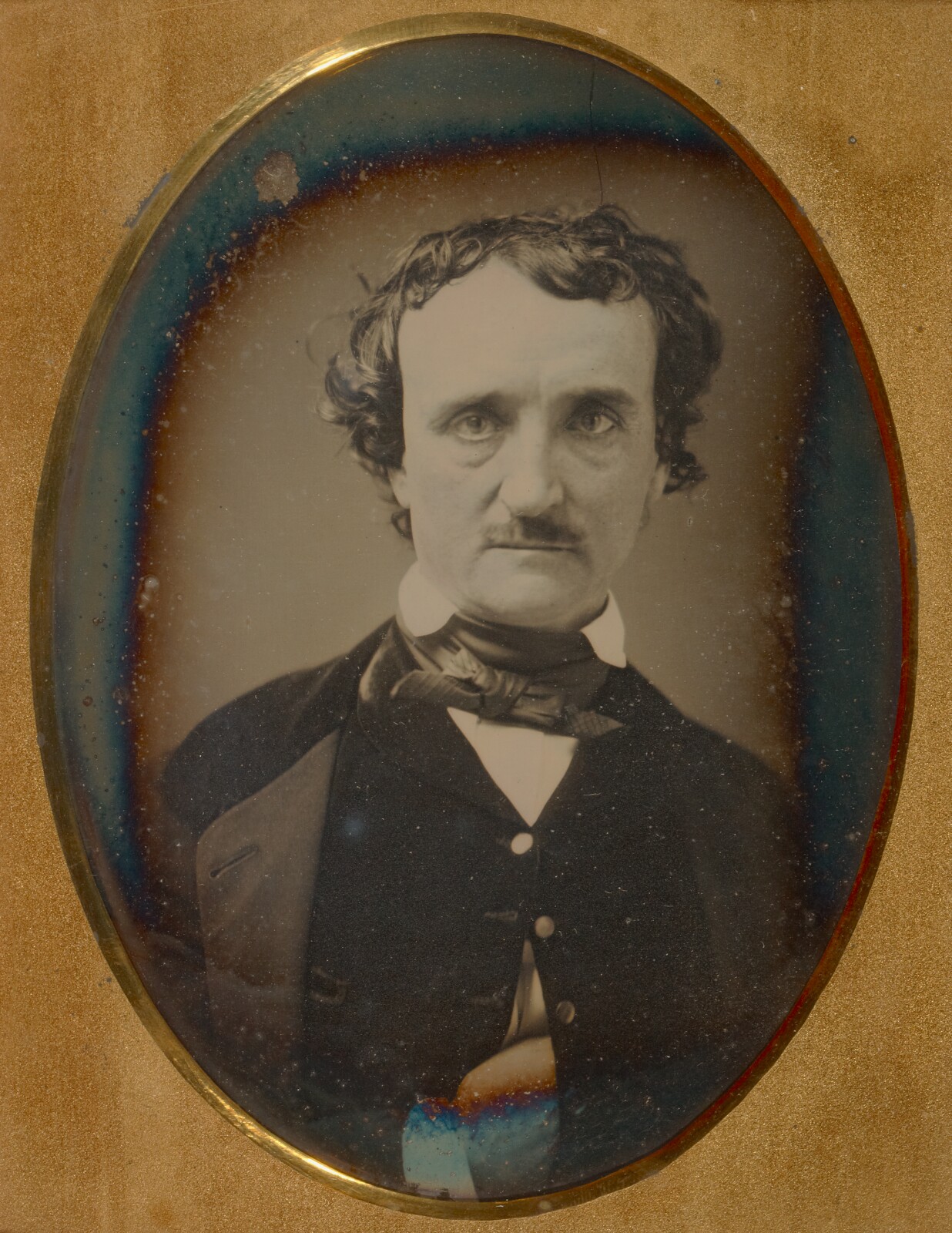
Unknown maker, American, Portrait of Edgar Allan Poe, late May-early June 1849, daguerreotype, 84.XT.957, J. Paul Getty Museum, Los Angeles · J. Paul Getty Museum, Los Angeles, 'Portrait of Edgar Allan Poe' (the 'Annie' daguerreotype), accession 84.XT.957, Open Content digital image via the Getty IIIF service · Public domain (daguerreotype by an unknown American maker, late May-early June 1849; Getty collection record: Public Domain / No Copyright)
writer · 19th Century
1809–1849
Not yet included in personality matching — the documented evidence doesn't yet cover enough of the personality model. Everything else on this page is fully available.
Poe's tales include 'The Fall of the House of Usher' (Burton's Gentleman's Magazine, September 1839) and 'The Murders in the Rue Morgue' (Graham's Magazine, April 1841). His editor T. O. Mabbott judges 'Rue Morgue', 'if not actually the first detective story ever written', the first consciously composed as one and the direct ancestor of all that followed. Lowell wrote in 1845 that 'Usher' alone would have marked its author as a man of genius.
'The Raven' was printed in the New York Evening Mirror on 29 January 1845 with a commendatory note from N. P. Willis, and soon afterwards in the American Whig Review for February under the pseudonym 'Quarles'. Woodberry writes that no brief poem established itself so quickly and widely, and Willis described it as a poem that 'electrified the world of imaginative readers'.
Poe made his living largely as a magazine critic and editor. He reviewed for the Southern Literary Messenger from 1835 (Woodberry reports its circulation rising from 500 to 3,500 copies during his time there), wrote most of the book reviews for Burton's from July 1839 to June 1840, edited Graham's from 1841, and on 25 October 1845 became 'Editor and Proprietor' of the Broadway Journal. Lowell found his criticism marked by 'scientific precision and coherence of logic', if aesthetically limited.
After the 'Literati' sketches Poe published in Godey's Lady's Book in 1846 drew attacks from Charles F. Briggs and Thomas Dunn English, Poe published a reply, which appeared in the Philadelphia Spirit of the Times on 10 July 1846. On 23 July he sued the New York Evening Mirror's editor and proprietor for libel over attacks the paper had printed, including English's, and on 17 February 1847 he was awarded $225 in damages.
Answering a public attack with a printed reply and then a lawsuit, rather than silence, is consistent with tolerance for open conflict. The merits are disputed: Briggs and English were hostile and Poe's own sketches provoked them, so this shows his willingness to fight, not that he was in the right. Conflict Tolerance
To raise money for his Stylus magazine, Poe advertised a lecture on the universe, and on 3 February 1848, on a stormy night, about sixty people came to the New York Society Library. The lecture raised too little, so he offered the full text to the publisher George Putnam, who accepted it as 'Eureka: A Prose Poem'; Putnam printed 500 copies and published it in the summer of 1848.
Turning a lecture meant to fund the Stylus into a book is consistent with persistence in a plan he had pursued since 1840. The Stylus was still never launched, so the sources show effort over time, not success. Persistence
After editing for others since 1835, Poe bought the Broadway Journal, and the issue of 25 October 1845 carried 'Edgar A. Poe, Editor and Proprietor' on its masthead. Mabbott notes he had to borrow money from several people to do it. On 3 December 1845 he gave Charles Lane a half interest, and the last number of the paper appeared on 3 January 1846.
Taking ownership of a paper after years of working under other proprietors fits his stated wish, in his 1843 letter, for 'entire control of the editorial conduct'. The paper lasted only a few months more, so the same drive left him without a secure position. Need for Autonomy
People whose overall profiles resemble theirs.

Not a rival — a different profile shape worth a look.