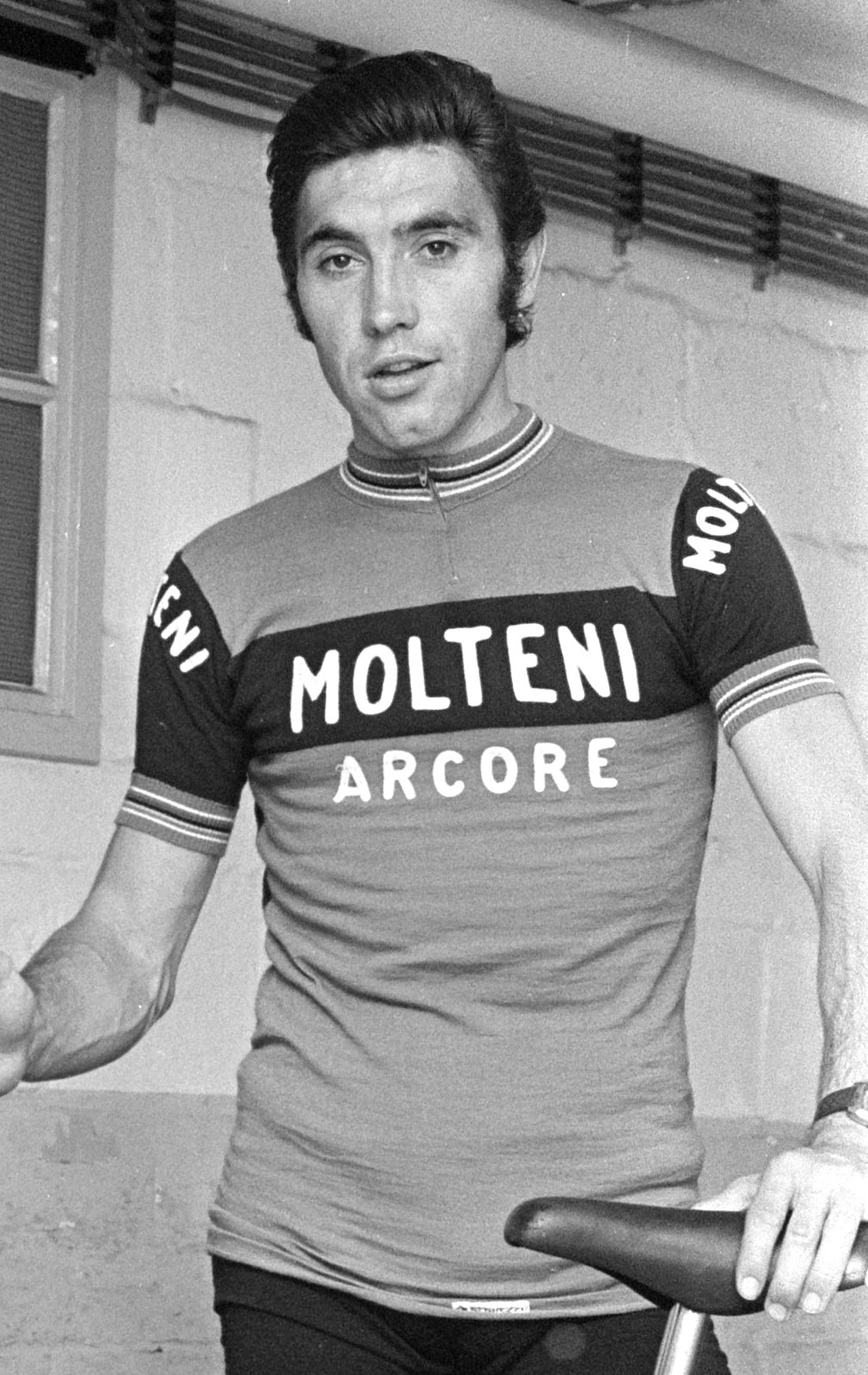

Anefo / Nationaal Archief, 2 August 1973 (Olympisch Stadion, Amsterdam), CC0 1.0 (Merckx cut from 'Joop Zoetemelk en Eddy Merckx schudden elkaar de hand'; resized) · Nationaal Archief (Fotocollectie Anefo, bestanddeelnummer 926-5866), via Wikimedia Commons (extracted crop published on Commons from the archive's Flickr Commons upload) · CC0 1.0
athlete · 20th Century
Eddy Merckx
b. 1945
Known For
Not yet included in personality matching — the documented evidence doesn't yet cover enough of the personality model. Everything else on this page is fully available.
Trait Constellation
Key Achievements
Merckx won the world amateur road championship in 1964 and turned professional in 1965. In 1969 he won the Tour de France, the first Belgian to do so since 1939, and Sports Illustrated's 1972 profile records that he won it again in 1970 and 1971.
On 25 October 1972, on the open-air Olympic velodrome in Mexico City, Merckx rode 49.431 km in an hour, 788 metres more than Ole Ritter's record. Cyclist magazine notes that the mark stood for 28 years.
Merckx retired from racing in spring 1978, and in 1980 he started a bicycle company, Eddy Merckx Cycles, with help from the Italian frame-builder Ugo De Rosa. According to Cycling Weekly, its bikes were later supplied to professional teams including 7-Eleven, Motorola and Quick-Step.
Moments That Reveal Them
On 8 July 1971, at Orcieres-Merlette, Merckx lost 8 minutes 41 seconds to Luis Ocana after pulling a chasing group for about 100 km with no one taking a turn. Two days later he and three Molteni team-mates attacked from the start of the 251 km stage to Marseille and gained about two minutes, according to Belgian retrospectives by RTBF and La DH.
Keeping up the attack after his heaviest Tour loss to that point is consistent with the profile's persistence score; the stage gained back only a small part of the deficit. Persistence
Visiting Merckx's home in 1972, a Sports Illustrated writer found a basement workshop with about 100 wheels left to cure for up to three years, and was told that he experimented with saddle positions for climbs, flat roads and rough roads. The frame-builder Ernesto Colnago later recalled that Merckx took more than 20 bikes a year and would stay at the factory until a bike was right.
These working habits sit alongside the profile's detail-orientation score. Merckx himself connected some of the later adjustments to comfort after a 1969 track crash, and the profile draws no conclusion from that injury. Detail Orientation
Turning Points
For his 1972 Hour Record attempt Merckx chose the Mexico City velodrome, although his sponsor Molteni wanted Milan. His masseur Guillaume Michiels and a 2015 Remezcla feature describe six weeks of preparation, with university tests in Milan and Liege and sessions on rollers in his garage breathing from oxygen bottles to simulate altitude. Merckx describes the same altitude training in a 2004 Cycle Sport interview.
Weeks of set-piece preparation for a single hour offer one example behind the profile's discipline score, and the choice of venue against the sponsor's wish also bears on its need-for-autonomy row. Discipline
Similar People
People whose overall profiles resemble theirs.

Elizabeth I of England

Martin Luther King Jr.

Toussaint Louverture

John D. Rockefeller

Aung San Suu Kyi
Sources
- Eddy Merckx (Q103756) -- identity verified live via the wbgetentities API (2026-09-26): label 'Eddy Merckx', description 'Belgian cyclist (born 1945)', P569 17 Jun 1945, no P570, citizenship Belgium (Q31), instance of human, occupation sport cyclist (Q2309784), nl alias 'Edouard Louis Joseph "Eddy" Merckx', fr aliases 'Le Cannibale', 'L'Ogre de Tervuren', ko label '에디 메르크스' (ko aliases '에디 먹스'), kowiki sitelink '에디 메르크스', P18 'Eddy Merckx Molteni 1973.jpg'. Orientation only; not used as support for any row.
- Richard Abraham, 'Eddy Merckx: the man behind the legend', Cycling Weekly (2016 feature from an interview at the Eddy Merckx Cycles factory, Brussels) -- journalist's feature (non-self framing) with Merckx's own quotations (self). Non-self content used: the 1969 Tour of Flanders episode (manager Guillaume Driessens drove alongside in the team car shouting at him to stop his attack with about 45 miles to go; contemporaneous Cycling report quoted), the 1969 Mourenx stage account, the sidebar on his bike tinkering and the 1980 founding of the bicycle company with Ugo De Rosa's help, and current company boss Rob Beset's remark. Fetched with curl and read in full; health passages (2014 heart operation, 1969 Blois injuries as cause) are NOT used as evidence.
- James Spender, 'From the archive: In conversation with Eddy Merckx: "Psychology is important in racing. He never beat me."', Cyclist magazine (interview c.2019, republished online) -- mainly SELF (Merckx's own recollections of the 1972 Giro against Fuente, the 1969 Mourenx attack, Savona 1969, giving criterium money to team-mates, 1975) plus two non-self secondary retellings: Graeme Fife's 'Inside the Peloton' account of Guerrino Tosello's on-bike microphone question to Merckx on stage 6 of the 1972 Giro, and Richard Moore's (Bicycling) account that after the 1975 Puy de Dome stage Merckx went back down with a gendarme to identify the spectator who punched him and pressed charges. Fetched with curl and read in full; the Blois crash and 1975 injury passages are not used.
- 'Eddy Merckx interview', Cycle Sport special issue 2004 (republished by Cycling Weekly 2010; interviewer unnamed on the page) -- long SELF interview (the 1966 move from Solo-Superia to Peugeot after Van Looy's treatment, lessons from Tom Simpson, 1972 Hour Record preparation with sports doctors and a home trainer with an oxygen mask, his view that a racer races to win, reconciliation with Freddy Maertens) containing one NON-SELF firsthand item: team-mate Patrick Sercu told the magazine that Merckx took on all the negotiations to set up his final team so that his team-mates would be paid for another year, and the interviewer notes he employed former team-mates at his bike factory. Fetched with curl and read in full; the Blois back-injury, pain and illness passages are NOT used.
- John Underwood, 'The Majesty of Monsieur Merckx', Sports Illustrated, 24 Jul 1972 (SI Vault; read via the Wayback Machine copy because the live Vault URL returned 404) -- CONTEMPORANEOUS journalist's feature (non-self) reporting from the spring-1972 Tour of Flanders weekend and a visit to Merckx's home. Carries FIRSTHAND statements of his manager Jean Van Buggenhout (subject-affiliated: before a race he goes to his mechanics again and again to check; trains 250-300 days a year; practised two weeks for a televised charity basketball match), of Les Sports editor Theo Van Griethuysen (self-declared 'Merckxist', partisan: 'he is the boss... not Molteni, not the coach'; can be very hard with team-mates 'for the discipline of the team'; did not protest after Eric De Vlaeminck grabbed his jersey in Liege-Bastogne-Liege 1970), quotations from rivals Louison Bobet ('almost too professional... interested only in cycling, and in winning') and Jacques Anquetil ('must win all the time... by five or six minutes'; 'enjoys a fight'), an observer's account of his impassive reply after losing minutes at Orcieres-Merlette in the 1971 Tour and his attack the next day, the Col de Mente crash (he looked to see if Ocana was all right, then rode on), and the writer's own observation of his home workshop (100 wheels curing, drilling holes, experimenting with saddle positions by terrain) with Merckx's own words on seat angle (self). Also states that after the 1969 Giro case he demanded a urine test after each day of that year's Tour. Fetched with curl and read in full; the back-injury, Blois and private-life passages are not used.
- The Inner Ring (blog), 'Book review: Merckx, Half Man Half Bike', 21 Mar 2012 -- secondary REVIEW (non-self) summarising William Fotheringham's 2012 biography: that Merckx attacked to enlarge an already large lead in case of a later puncture or crash, and that he was constantly tinkering with his bike, adjusting saddle height mid-race or demanding a frame be flown to Switzerland to race on the next day. Counted only as a weak retelling of Fotheringham (the book itself is a restricted lending copy on the Internet Archive and was NOT read). Fetched with curl and read in full.
- 'Marseille fut le theatre de l'attaque la plus folle du Tour lancee par Eddy Merckx', La DH / Les Sports+ (Belgian daily), 22 Jul 2017 (French, unsigned; translated by the researcher) -- journalist's retrospective (non-self, secondary, drawing on L'Equipe and period quotations) of stage 12 of the 1971 Tour (10 Jul 1971): two days after losing 8:42 at Orcieres-Merlette, Merckx and Molteni team-mates Wagtmans, Huysmans and Stevens attacked from the start with 251 km to go; he was furious with Stevens, who had slacked on the rest day, urged on his team-mates and berated the breakaway companions; Tour director Jacques Goddet's L'Equipe comment and Ocana's remark are quoted; the Col de Mente attacks and crash are summarised. Fetched with curl and read in full.
- 'Tour de France 1971 : Orcieres-Merlette, le plus grand revers d'Eddy Merckx et le point de depart de sa revolte', RTBF Actus (Belgian public broadcaster), July 2026 (French, unsigned; translated by the researcher) -- broadcaster's retrospective (non-self, secondary) of the 1971 Tour: at Orcieres-Merlette (8 Jul) he pulled a group of about ten riders for some 100 km without anyone taking a turn and on French TV at the finish acknowledged Ocana's superiority (his own words, self); the 10 Jul Marseille attack from the start; after Ocana's crash on the Col de Mente he refused to put on the yellow jersey and told RTBF journalist Theo Mathy that evening he did not know whether he would continue and would rather have finished second than win that way (archive quotation, self), before a French directeur sportif talked him round (Mathy's account). Fetched with curl and read in full.
- 'Joseph Bruyere, le fidele lieutenant d'Eddy Merckx, revient sur ses 3 victoires sur le Nieuwsblad', RTBF Actus (interview with Bruyere at home, c.2023-25; French, translated by the researcher) -- FIRSTHAND recollections (non-self, insider) of Molteni team-mate Joseph Bruyere: the 1974 Het Volk plan that the whole Molteni team rode for Eddy, and that prize money (e.g. his 17,000 Belgian francs) was shared equally among all team-mates, 'the same when Eddy won'. Fetched with curl and read in full; his health remarks are not used.
- 'Bruyere, le lieutenant devenu heros', L'Avenir (Belgian daily), 25 Apr 2014 (French, unsigned; translated by the researcher) -- journalist's retrospective with Joseph Bruyere's FIRSTHAND recollections (non-self, insider) of Liege-Bastogne-Liege 1976: Merckx asked his team-mates to harden the race, Bruyere went clear with Van Springel, and Merckx, his leader, disrupted the chase behind until Bruyere won solo. Fetched with curl and read in full.
- 'Ernesto Colnago: The Big Interview', Cycling Weekly (c.2012; interview with the 80-year-old frame-builder at his factory) -- FIRSTHAND recollection (non-self; Colnago was Merckx's frame supplier at Molteni, so commercially affiliated): Merckx took more than 20 bikes a year, would come in the morning and not leave until he had the perfect bike, and on the Tuesday before a Liege-Bastogne-Liege asked for more saddle setback, taken from 16 to 19 and finally 21 cm. Fetched with curl and read in full; only the Merckx passage is used.
- James Startt, 'The day Bernard Thevenet dropped Eddy Merckx', VeloNews / Velo (outsideonline.com), 1 Oct 2019 -- Q&A interview giving rival Bernard Thevenet's FIRSTHAND recollections (non-self, rival) of the 1975 Tour: at the rest-day press conference Merckx publicly named Thevenet his biggest rival; on the Col d'Allos Merckx sensed he was not at 100 percent and attacked, and gapped him on descents; 'Eddy would exploit the slightest error'; on the final day on the Champs-Elysees 'Eddy attacked from the gun'. Fetched with curl and read in full.
- Giles Belbin, 'How Bernard Thevenet dethroned Eddy Merckx at the 1975 Tour', Cyclist magazine (online feature, undated c.2018-20) -- cycling historian's account (non-self, secondary) of the 1975 Tour: that inside the final kilometre on the Puy de Dome Merckx was slapped by one spectator and punched in the kidneys by another, that he accompanied police back down the road to find the assailant, that charges were filed and the man was ordered to pay one franc in symbolic damages, and that he attacked on the Allos two days later. Fetched with curl and read in full; the injury (fractured jaw) and 'feeling the effects' passages are not used.
- Samindra Kunti, 'Eddy Merckx on the Legendary Cycling Record He Broke in Mexico City: "It Was Pain, Pain, and Pain"', Remezcla, 11 Nov 2015 -- journalist's feature from a joint interview in Brussels with Merckx (self) and his 1970s masseur Guillaume Michiels (FIRSTHAND insider, non-self): that Merckx chose the Mexico City velodrome although sponsor Molteni wanted Milan; that the universities of Milan and Liege tested him and for six weeks he rode static rollers in his garage breathing from some 30 oxygen bottles with doctors checking him; Michiels on his nervousness during the postponement and on Giorgio Albani signalling 'easy, easy' during a deliberately fast start (Merckx: 'a deliberate way to be ahead of the projected time table'). Fetched with curl and read in full; the exhaustion-at-finish passage is not used.