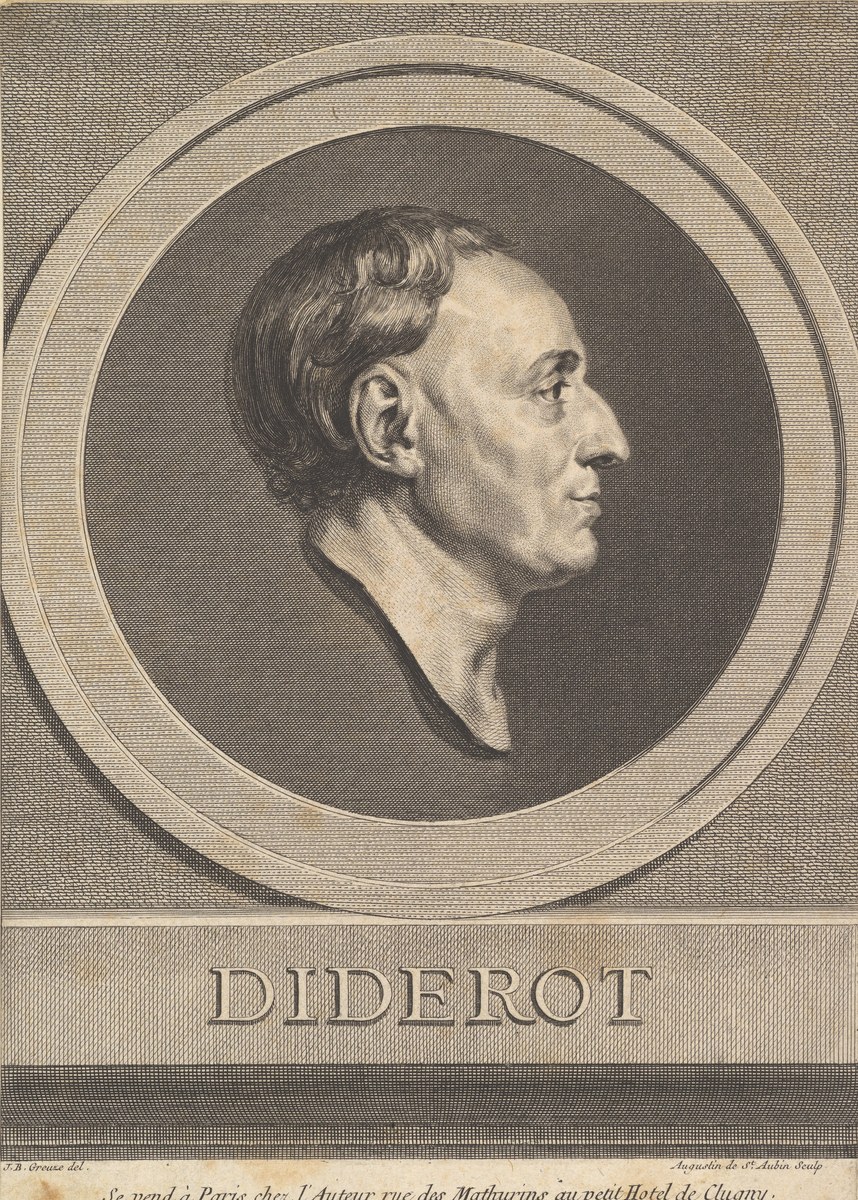
Augustin de Saint-Aubin after Jean-Baptiste Greuze, Portrait of Denis Diderot, 1766, engraving, The Metropolitan Museum of Art, Harris Brisbane Dick Fund, 1953 (53.600.189), public domain · Engraved portrait of Denis Diderot made in 1766, in his lifetime, by Augustin de Saint-Aubin after a drawing by Jean-Baptiste Greuze (the print is lettered 'J.B. Greuze del.' and 'Augustin de St Aubin Sculp', with the name DIDEROT on the plinth); Metropolitan Museum of Art, New York, accession 53.600.189, Harris Brisbane Dick Fund, 1953. The museum's Open Access record lists the work as public domain. The sheet is 19 x 13 cm; the museum image is 2,780 x 4,000 pixels, cropped to the plate area and downscaled once to 858 x 1,200 pixels; nothing was upscaled. Shown as a later engraving after another artist's drawing, not as a documented sitting. Caveat: the museum's web pages were behind an anti-bot challenge, so the public domain status was read from its Open Access API record. · Public domain (1766 engraving; Metropolitan Museum of Art Open Access, CC0)
philosopher · Early Modern
Denis Diderot
1713–1784
Known For
Not yet included in personality matching — the documented evidence doesn't yet cover enough of the personality model. Everything else on this page is fully available.
Trait Constellation
Key Achievements
He edited the Encyclopedie, first with d'Alembert and, after d'Alembert's 1758 resignation, alone, seeing the 17 volumes of text through to 1765 and the volumes of plates to 1772 despite a suspended licence and a royal ban, and wrote nearly six thousand of its articles himself.
He was also a philosopher and writer whose Lettre sur les aveugles (1749) led to three months in Vincennes prison and whose D'Alembert's Dream and Rameau's Nephew, left unpublished in his lifetime, are counted among the masterpieces of Enlightenment thought.
From 1759 he wrote reviews of the Paris art exhibitions for Grimm's Correspondance litteraire, work the Stanford Encyclopedia of Philosophy credits with inventing the art critic, and he also wrote influential essays on the theory of drama.
Moments That Reveal Them
In 1764 he discovered that the publisher Le Breton had cut and altered his articles in the proofs after he had approved them, and wrote that his work had been 'massacred'; his daughter recalled that he nearly abandoned the project, but the final volumes were completed.
The episode is consistent with a capacity to keep a very large editorial project going after a serious setback. Persistence
In 1759 Grimm invited him to write about the biennial art exhibitions at the Louvre for the Correspondance litteraire, and he went on to write a series of Salons, combining the eye of the connoisseur with philosophical argument.
The sustained series is consistent with a strong sensitivity to how visual art represents human experience. Aesthetic Sensitivity
Turning Points
In 1749 he was imprisoned at Vincennes for three months after the Lettre sur les aveugles; on his release in November he was already working on the project that became the Encyclopedie, whose Prospectus appeared in 1750 and which occupied him for most of the next two decades.
The sequence is consistent with an unconventional thinker who kept pursuing his intellectual aims after official punishment. Independent Thinking
Similar People
People whose overall profiles resemble theirs.


Abraham Lincoln

Ada Lovelace

Benjamin Franklin

Charles Darwin

Sor Juana Inés de la Cruz
Opposite Profile
Not a rival — a different profile shape worth a look.

Otto von Bismarck
Sources
- Denis Diderot (Q448), verified live via the Wikidata API (2026-11-04): label 'Denis Diderot', description 'French Enlightenment philosopher writer and encyclopedist (1713-1784)', born 5 October 1713, died 31 July 1784 (the item also lists a 30 July death date), Korean label 드니 디드로. Orientation only; not used as support for any row.
- Stanford Encyclopedia of Philosophy, 'Denis Diderot' (Life and Major Writings section read in full, about 4,500 words). CANONICAL SIGNIFICANCE SOURCE: presents the Encyclopedie, which he edited with d'Alembert from 1750 and saw to completion in 1765 (plates to 1772), as arguably the most transformative work of the French Enlightenment; records the 1749 Vincennes imprisonment after the Lettre sur les aveugles, d'Alembert's resignation in 1758, his own authorship of nearly six thousand articles, the unpublished masterpieces (D'Alembert's Dream, Rameau's Nephew), the Salons as the invention of the art critic, and his contributions to Raynal's global history; also states that he was by nature a writer and thinker, not a political activist.
- University of Chicago, ARTFL Encyclopedie Project, 'The "18th" Volume: Description' (page read in full, about 1,300 words, by Liz Selbst, drawing on Douglas Gordon, John Lough and Arthur Wilson). Describes the 284 pages of corrected proofs of 46 articles that the publisher Le Breton altered or censored after Diderot had approved them, Diderot's 1764 letter saying his work had been 'massacred', and the scholarly debate on how far the cuts changed the whole work (just over three percent of the pages of the last ten volumes by this count). INDEPENDENT / ADVERSARIAL on the publisher; also shows Diderot's proof-reading marks.
- John R. Pannabecker, 'Diderot, the Mechanical Arts, and the Encyclopedie: In Search of the Heritage of Technology Education', Journal of Technology Education 6(1), 1994, Virginia Tech (article read in the sections on the publishing venture, the method and the mechanical arts, about 5,000 words). Scholarly assessment: well over one hundred authors for the 17 text volumes, about 2,900 plates, Diderot's method of describing each art, his aim to publish trade secrets, and a critical caveat that his framework was impersonal and the Encyclopedie often did not present the most advanced technology of its time.
- Lehigh University Libraries, Special Collections online exhibit 'Daring Knowledge: Diderot's Encyclopedie', page 'Mechanical Arts' (page read in full, about 350 words). Notes that Diderot examined mechanical and liberal arts alike, that the processes shown were not always the most recent, and quotes his article 'Encyclopedia' attacking artisans who keep trade knowledge secret.
- Encyclopaedia Britannica, eleventh edition (1911), 'Diderot, Denis' (read in full via Wikisource, about 4,000 words, by John Morley). Dated and openly critical older account: praises his versatility, his workshop study and proof-correcting labour on the Encyclopedie and the Salons, but judges the plays and Jacques le fataliste weak and says he left no single masterpiece; read as a contrast to the modern entries. Its moral and personal commentary on his private life is not used.
- Metropolitan Museum of Art, object record 53.600.189, 'Portrait of Denis Diderot', engraving by Augustin de Saint-Aubin, 1766, third state, inscribed 'J.B. Greuze del.' (read through the museum's Open Access API record, which lists public domain status; the museum's web pages were bot-walled). Used for the portrait only, not for any trait row.