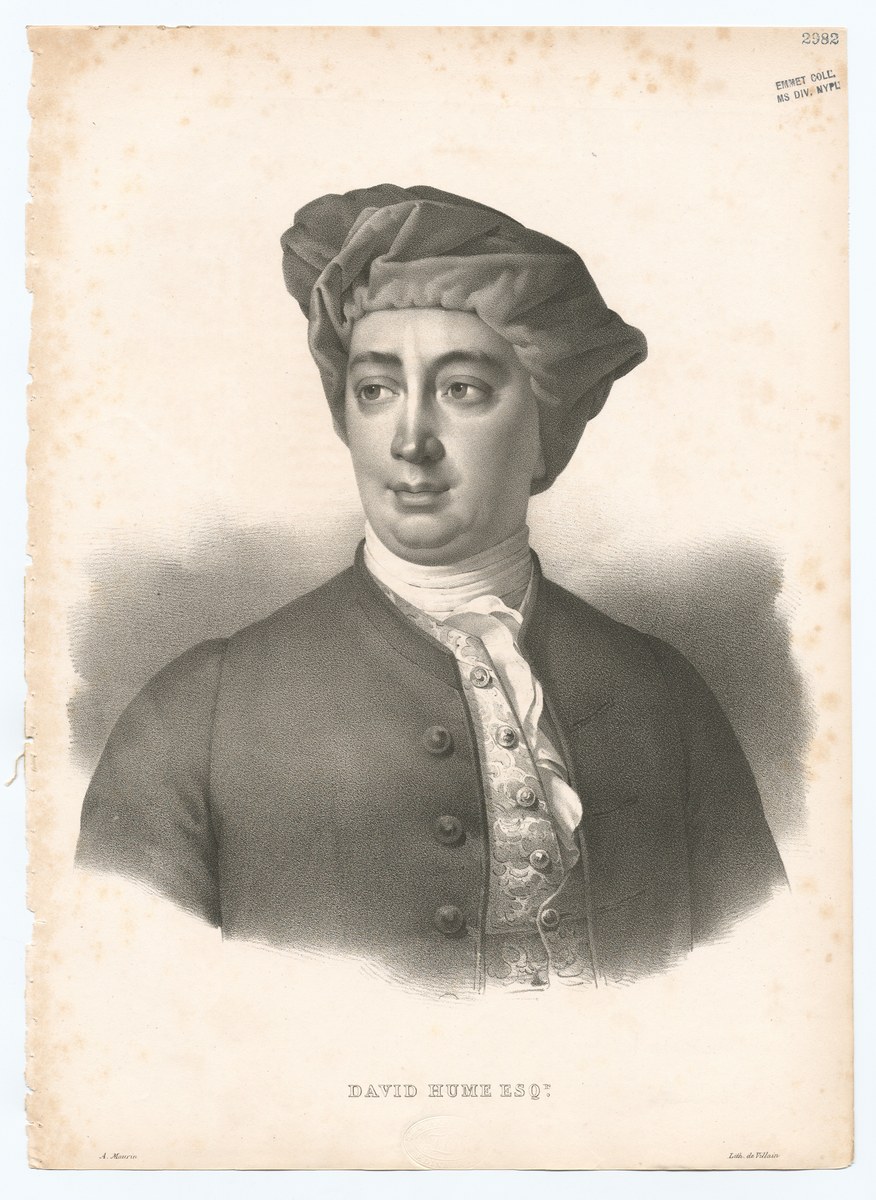
A. Maurin (lithograph), printed by Villain, 'David Hume Esqr.', c. 1820, lithograph, New York Public Library, Emmet Collection of Manuscripts Etc. Relating to American History (EM2982), public domain · Lithographic portrait lettered 'DAVID HUME ESQr.' with 'A. Maurin' at lower left and 'Lith. de Villain' at lower right, an early nineteenth-century French print made well after Hume's death; held by the New York Public Library (Emmet Collection of Manuscripts Etc. Relating to American History, item EM2982). The scan was downscaled once from 3,528 x 4,831 pixels to 876 x 1,200 pixels; nothing was upscaled. Shown as a later print depiction, not as a documented sitting. Caveat: the New York Public Library item page was behind an anti-bot challenge, so the museum-side record could not be opened; the date 1820 is as transcribed on the Wikimedia Commons file page from the library record, and the basis rests on the age of the print (the lithographer Antoine Maurin and the printer both lived and worked in nineteenth-century France, so the print is far older than 1931 whatever its exact year). · Public domain (early nineteenth-century lithograph; New York Public Library scan)
philosopher · Early Modern
David Hume
1711–1776
Known For
Not yet included in personality matching — the documented evidence doesn't yet cover enough of the personality model. Everything else on this page is fully available.
Trait Constellation
Key Achievements
He set out to apply an experimental method of observation to the mind and morals in A Treatise of Human Nature (1739-40) and the two Enquiries, work that the Stanford Encyclopedia of Philosophy and the National Galleries of Scotland place at the centre of the Scottish Enlightenment.
He wrote the six-volume History of England (1754-62), which the Internet Encyclopedia of Philosophy says gave him a reputation as a historian equal to, if not above, his reputation as a philosopher.
His essays on money and trade in Political Discourses (1752) made an empirical argument against mercantilism that Econlib calls a building block of classical economics.
Moments That Reveal Them
When opponents circulated lists of 'dangerous propositions' from the Treatise during his 1744-45 bid for the Edinburgh chair of moral philosophy, he published a point-by-point anonymous reply, the Letter from a Gentleman; 12 of the 15 city ministers still voted against him and he withdrew.
This episode is consistent with answering critics in print and then stepping back rather than forcing an open confrontation. Conflict Tolerance
After the Treatise drew little notice, he judged that its style rather than its content was at fault and recast Book I as the shorter Enquiry concerning Human Understanding (1748) and Book III as the Enquiry concerning the Principles of Morals (1751).
This is consistent with changing the form of the work, not its aim, when a first approach failed. Adaptability
Turning Points
In 1752, shut out of university posts, he became librarian of the Advocates Library in Edinburgh, which the Stanford Encyclopedia says gave him the access he used to begin a career as a historian; the first volume of his History of England followed in 1754.
This is consistent with using whatever post was available to equip a new line of work. Resourcefulness
Similar People
People whose overall profiles resemble theirs.


Alan Turing

Ibn Khaldun

Leonardo da Vinci

Aristotle

Benjamin Franklin
Sources
- David Hume (Q37160), verified live via the Wikidata API (2026-11-05): label 'David Hume', description 'Scottish philosopher, economist, and historian (1711-1776)', born 26 April (Old Style) / 7 May 1711, died 25 August 1776, citizenship Kingdom of Great Britain, Korean label 데이비드 흄. Orientation only; not used as support for any row.
- Stanford Encyclopedia of Philosophy, 'David Hume' (Life and Works section read in full, about 1,500 words). CANONICAL SIGNIFICANCE SOURCE: gives the Treatise of Human Nature (1739-40), the Enquiries, the Essays and Political Discourses, the six-volume History of England (1754-62), his unsuccessful bids for the Edinburgh (1745) and Glasgow (1751) chairs, the Advocates Library post from 1752, his repeated revision of his works to the end of his life and the posthumous Dialogues concerning Natural Religion (1779).
- Internet Encyclopedia of Philosophy, 'David Hume' (Life section and the history section read in full, about 4,000 words). Independent scholarly account with Hume's own letters quoted as evidence: the 1744-45 chair candidacy and the 'Letter from a Gentleman', the rewriting of the Treatise as the Enquiries, the reception and later revision of the History, the withdrawn essays of 1756-57 and the held-back Dialogues; states that in his own day he had at least as much impact as a historian as a philosopher.
- Encyclopaedia Britannica, 'David Hume' by Maurice Cranston (public-web portion read, about 2,300 words; the rest sits behind a paywall and was not opened). Early life, the La Fleche years, the Treatise (with a critical verdict that it is oversubtle, confusing and marred by willful extravagance), the 1744 chair bid, the wandering years as tutor and secretary to earn leisure for study, and the 1748 and 1751 rewritings.
- Library of Economics and Liberty (Econlib), 'David Hume', by David R. Henderson (entry read in full, about 600 words). Hume's essays on money and trade in Political Discourses as an empirical argument against mercantilism and a building block of classical economics; also records an error (his 'creeping inflation' notion) and that Adam Smith ignored his price-specie-flow argument. Independent economist's assessment with a critical note.
- Adam Smith, 'Letter from Adam Smith, LL.D. to William Strahan, Esq.' (Kirkaldy, 9 November 1776), account of Hume's last illness, as reproduced on Econlib (about 4,500 words read of the letter). Near-contemporary eyewitness account by a close friend, admiring in tone; used only for documented work habits and conversation in his last months.
- The Scotsman, 'Edinburgh University renames David Hume tower over racist comments', by Elsa Maishman, 13 September 2020 (article read in full, about 600 words). COUNTER-VOICE: reports the university statement and the student petition on Hume's remarks on race, and the historian Felix Waldmann's evidence that Hume was involved in a slave-trade transaction; used as critical context for the profile, not scored as a trait.
- National Galleries of Scotland, 'David Hume, 1711 - 1776. Historian and philosopher', by Allan Ramsay, 1766 (PG 1057), collection record read in full. Holder's statement that Hume was the most influential figure of the Scottish Enlightenment, a sceptic who set himself to scrutinise religious belief, morals and the mind by experience and observation; also records the 1753 footnote on race and the public debate about it. Used for significance and as the holder record for the discarded painting route.