Sequoyah
93% Profile Match
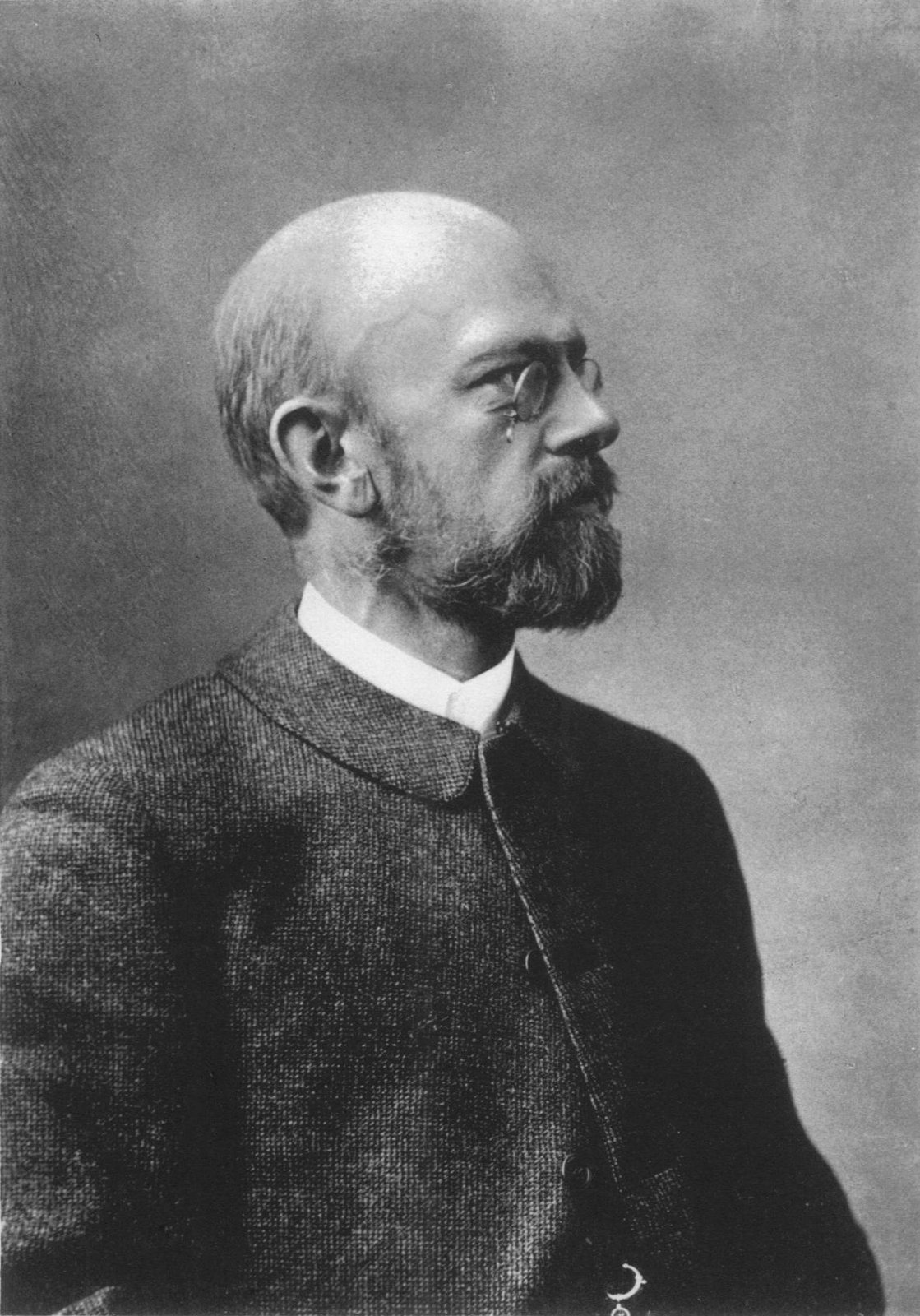
Photograph of David Hilbert, frontispiece of the American Journal of Mathematics vol. 29 (1907); photographer not credited · Frontispiece portrait of David Hilbert, American Journal of Mathematics, volume 29 (Johns Hopkins Press, Baltimore, 1907); digitised page also at the Internet Archive (sim_american-journal-of-mathematics_1907_29); file via Wikimedia Commons 'David Hilbert, 1907.jpg' · Public domain (published in the United States in 1907)
mathematician · 20th Century
1862–1943
Not yet included in personality matching — the documented evidence doesn't yet cover enough of the personality model. Everything else on this page is fully available.
In 1900 Hilbert addressed the International Congress of Mathematicians in Paris on 'Mathematical Problems', arguing that open problems are a sign of a science's vitality. The list of problems that followed, known as Hilbert's problems, included the continuum hypothesis, the well-ordering of the reals and the Riemann hypothesis, and many were solved during the twentieth century.
Hilbert's Grundlagen der Geometrie (1899) set geometry in a formal axiomatic framework and, in MacTutor's account, helped spread the axiomatic approach through twentieth-century mathematics. From around 1900, and fully from 1921, he pursued what became known as Hilbert's programme: to formalise mathematics and prove it consistent by finitary methods, a goal that Godel's 1930-31 results are generally taken to show cannot be reached.
In 1888 Hilbert proved the finite basis theorem of invariant theory for any number of variables by an abstract method that showed a finite basis exists without constructing one. In 1897 he published the Zahlbericht, a report on algebraic number theory requested by the German Mathematical Society that, according to MacTutor, contains the ideas of what is now class field theory.
Hilbert's work on integral equations around 1909 led directly, in Irving Kaplansky's words quoted by MacTutor, to twentieth-century research in functional analysis, and laid the basis for the infinite-dimensional spaces later called Hilbert spaces, which are used in analysis and quantum mechanics.
When Hilbert submitted his basis-theorem paper to Mathematische Annalen in 1888, the journal's referee for invariant theory, Paul Gordan, objected to its non-formal presentation. Hilbert, then an assistant lecturer, wrote to Felix Klein that he would not alter or delete anything unless a definite and irrefutable objection to his reasoning were raised. Klein had the paper published unchanged.
Holding to an unconventional method against the field's recognised expert, with only a demand for a definite objection, is consistent with independent thinking; the account rests on letters quoted by MacTutor. Independent Thinking
In November 1915 Hilbert and Einstein were working on the gravitational field equations at the same time. Hilbert's first proofs, stamped 6 December 1915, did not contain generally covariant field equations. Historians Renn and Stachel document that he then altered the proofs in his own hand, adding an acknowledgement of Einstein's contribution and removing the word 'new' for his equations, and by mid-February 1916 had a reworked paper in press. Whether he or Einstein should be credited first is still debated among historians.
Revising a paper's claims after seeing a rival's conclusive result is consistent with updating a position on new evidence; the historians differ on how much Einstein's complaint, rather than Hilbert's own reworking, drove the changes. Belief Updating
In 1902 the University of Berlin offered Hilbert Lazarus Fuchs's chair. He declined, but only after using the offer to bargain with Gottingen, which then created a new chair that brought his friend Hermann Minkowski to the university. Hilbert stayed at Gottingen for the rest of his career.
Turning a rival offer into a post for a close colleague is consistent with a preference for working alongside collaborators; MacTutor is the only source here for the episode. Collaboration
People whose overall profiles resemble theirs.



Not a rival — a different profile shape worth a look.