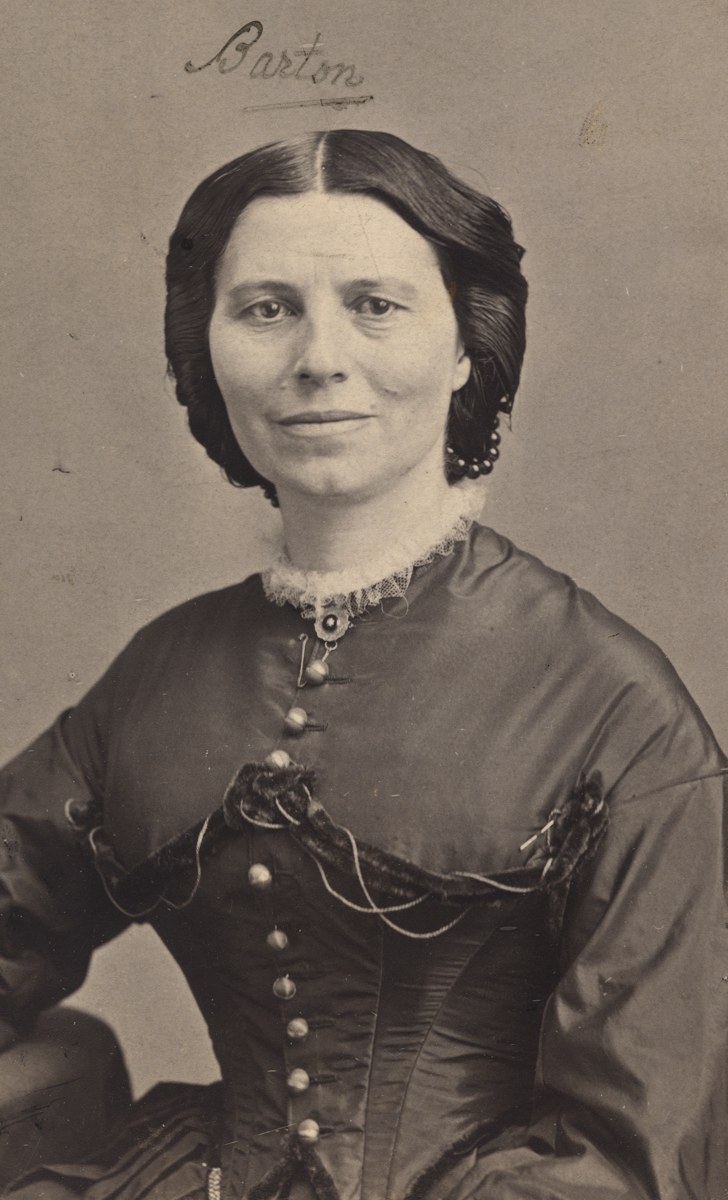
Photo: Mathew B. Brady, about 1865 (National Portrait Gallery, Smithsonian Institution, CC0) · Albumen silver print of Clara Barton by Mathew B. Brady, about 1865, National Portrait Gallery, Smithsonian Institution (accession NPG.2013.2; credit line 'acquired through the generosity of Elizabeth A. Hylton'), opened via the Wikimedia Commons file page, whose description states that the National Portrait Gallery 'has explicitly released this digital image under the CC0 license' and links the NPG object page. The NPG page itself could not be opened (bot-verification wall), so the CC0 statement is read from Commons quoting the institution; independently the photograph was made about 1865 by a photographer who died in 1896, so it is public domain by age in any case. The companion Commons record for the same object uses a public-domain-by-age tag, so no conflicting notice was found. Original file 2747 x 4529 (tight crop of a carte-de-visite style print with the sitter's name written above); saved downscaled only to 728 x 1200, not cropped. Image viewed: a woman with centre-parted dark hair in a dark silk dress with a lace collar. · Public Domain
nurse · 19th Century
Clara Barton
1821–1912
Known For
Not yet included in personality matching — the documented evidence doesn't yet cover enough of the personality model. Everything else on this page is fully available.
Trait Constellation
Key Achievements
She founded the American Red Cross in 1881 and led it until 1904, and her 'American amendment' extended Red Cross relief from war to peacetime disasters such as floods and famines.
At the start of the Civil War she gathered and carried supplies to Union soldiers and nursed the wounded near the front, and in 1864 was appointed superintendent of nurses for the Army of the James.
In 1865 she set up, with Lincoln's permission, an office to trace missing soldiers; the Red Cross credits it with reconnecting more than 20,000 soldiers with their families.
Moments That Reveal Them
As Red Cross president she reportedly made all decisions and dispensed all funds herself, to the point that even loyal staff privately called her 'the Queen', and by 1904 members of the executive council charged her with authoritarianism and forced her resignation.
This is consistent with difficulty sharing authority with colleagues. Collaboration
After returning from Europe in 1873 she campaigned for years, with pamphlets, lectures and a meeting with President Hayes, until the American Red Cross was founded in 1881 and the Geneva Convention joined in 1882.
This is consistent with sustained effort toward a single long-term goal. Persistence
Turning Points
In 1861, when the Civil War began, she left her Patent Office post to collect and carry supplies to Union soldiers, starting a career in relief work that continued for more than forty years.
This is consistent with moving on her own initiative from a clerical post to relief work. Proactive Agency
Similar People
People whose overall profiles resemble theirs.


Miriam Makeba

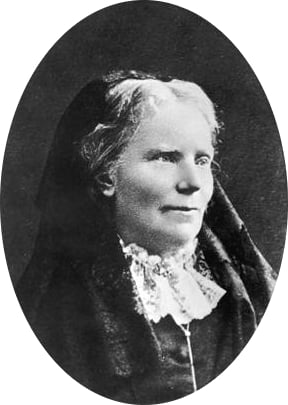
Elizabeth Blackwell

Malala Yousafzai

Aung San Suu Kyi

Nelson Mandela
Sources
- Clara Barton (Q188039), verified live via the Wikidata API (2026-10-24): English label 'Clara Barton', description 'American Civil War nurse (1821-1912)', Korean label 클라라 바턴, born 1821-12-25, died 1912-04-12. Orientation only; not used as support for any row.
- Encyclopaedia Britannica, 'Clara Barton' (britannica.com; read through an Internet Archive copy, full article): founder of the American Red Cross; teaching from age 15 and the free school at Bordentown, from which she resigned rather than serve under a male principal; the Patent Office; her 'characteristic initiative' at the outbreak of the Civil War in securing supplies and nursing the wounded; the 1864 appointment as superintendent of nurses for the Army of the James; the 1865 bureau of records for missing men; relief work in Europe during the Franco-German War; her successful campaign after 1873 for the United States to sign the Geneva Convention; the 1881 founding of the American Association of the Red Cross and her presidency until 1904; her 'American amendment' extending relief to peacetime calamities; the Spanish-American War work at 77; the charges of authoritarianism from the executive council and the forced resignation in 1904. CANONICAL SIGNIFICANCE SOURCE.
- American Red Cross, 'Clara Barton' (redcross.org/about-us/who-we-are/history/clara-barton.html), read in full: the organisation's own biography; early teaching, work at the Patent Office, nursing care and supplies in the Civil War, the 1865 Office of Missing Soldiers that helped reconnect more than 20,000 soldiers with families, the 1869 trip to Switzerland and volunteering with the International Committee in the Franco-Prussian War, the founding on 21 May 1881, her 23-year presidency until 1904, the 'American Amendment' of 1884 enabling peacetime disaster relief, and the 1896 relief mission in Turkey and Armenia. The founder's own organisation, laudatory and silent on the 1904 dispute; her vegetarianism and private life are not used.
- National Women's History Museum, 'Clara Barton' by Debra Michals (womenshistory.org biography, 2015), read in full: teaching from 18, the free school at Bordentown and her resignation on finding a man hired at twice her salary, her recording-clerk post at the Patent Office and the later reduction of her position, her supply work from 1861, official permission in 1862 to take supplies to battlefields, her 1864 appointment as head nurse for a unit though she had no formal medical training, the postwar search for missing soldiers, her pamphlets, lectures and meeting with President Hayes in building support for an American Red Cross society, the 1881 founding, the 1882 accession, and the National First Aid Association of 1904. A museum biography compiled from standard reference works; the passage on her father's phrenologist and her shyness is not used.
- Geoffrey C. Ward, 'Queen Barton', American Heritage 39:3 (April 1988; americanheritage.com), read in full: a review essay on Elizabeth Brown Pryor's Clara Barton: Professional Angel, based on Barton's 35-volume diary. Credits her courage and resourcefulness at the front (for instance supplying tobacco and whiskey as well as bandages, and holding the operating table steady at Antietam), but reports that she exaggerated her wartime accounts, wrote a flattering biographical sketch of herself, made all decisions and dispensed all funds, was called 'the Queen' and 'the Great I Am' by her own staff, preferred assistants who were 'meek, patient, faithful', and in 1900-1904 faced dissidents led by Mabel Boardman who charged her with being egocentric, capricious and careless with finances; a Senate probe in 1904 'fully exonerated' her. A balanced popular-history review of a critical archival biography. The reviewer's remarks on her family, romance and spiritualism are not used.
- Linda Simon, 'Biography brings a secular saint down to earth', Christian Science Monitor (13 January 1988), read in full: a review of Pryor's Clara Barton: Professional Angel by a Harvard writing teacher, describing the biography as the first to 'ask sophisticated questions' of Barton and portraying her as steely, egotistical, hard-driving and often contentious, but crediting her masterful organising and fundraising and noting that detractors disputed her fiscal dealings; mentions her efforts to gain publicity for the Red Cross, which exasperated co-workers. The review's account of her depression and breakdowns is not used. Used as the independent critical counter-voice; Pryor's book itself was not opened.
- Central Connecticut State University Library digital-history exhibit, 'The Origins of the Red Cross: National Organization' (library.ccsu.edu, Digital History 511, 2016), read in full: Barton's role as founder of the American Red Cross in 1881 and its leader for 23 years; the progressive-era frustration with her 'egotistical leadership style'; the faction led by Mabel Boardman; the financial accusations and Barton's 1904 resignation; her later National First Aid Association. A graduate-class exhibit; used only as a second, short account of the 1904 dispute.
- Wikimedia Commons file page for the National Portrait Gallery (Smithsonian) photograph 'Clara Barton by Mathew B. Brady, c. 1865, albumen silver print' (NPG.2013.2; wikitext and API record) and the companion Commons record 'NPG 2013 2 Barton.tif'; the NPG object page itself (npg.si.edu/object/npg_NPG.2013.2) is behind a bot-verification wall and could not be opened. Checked for the portrait's rights; not used for scoring.