Leonardo da Vinci
93% Profile Match
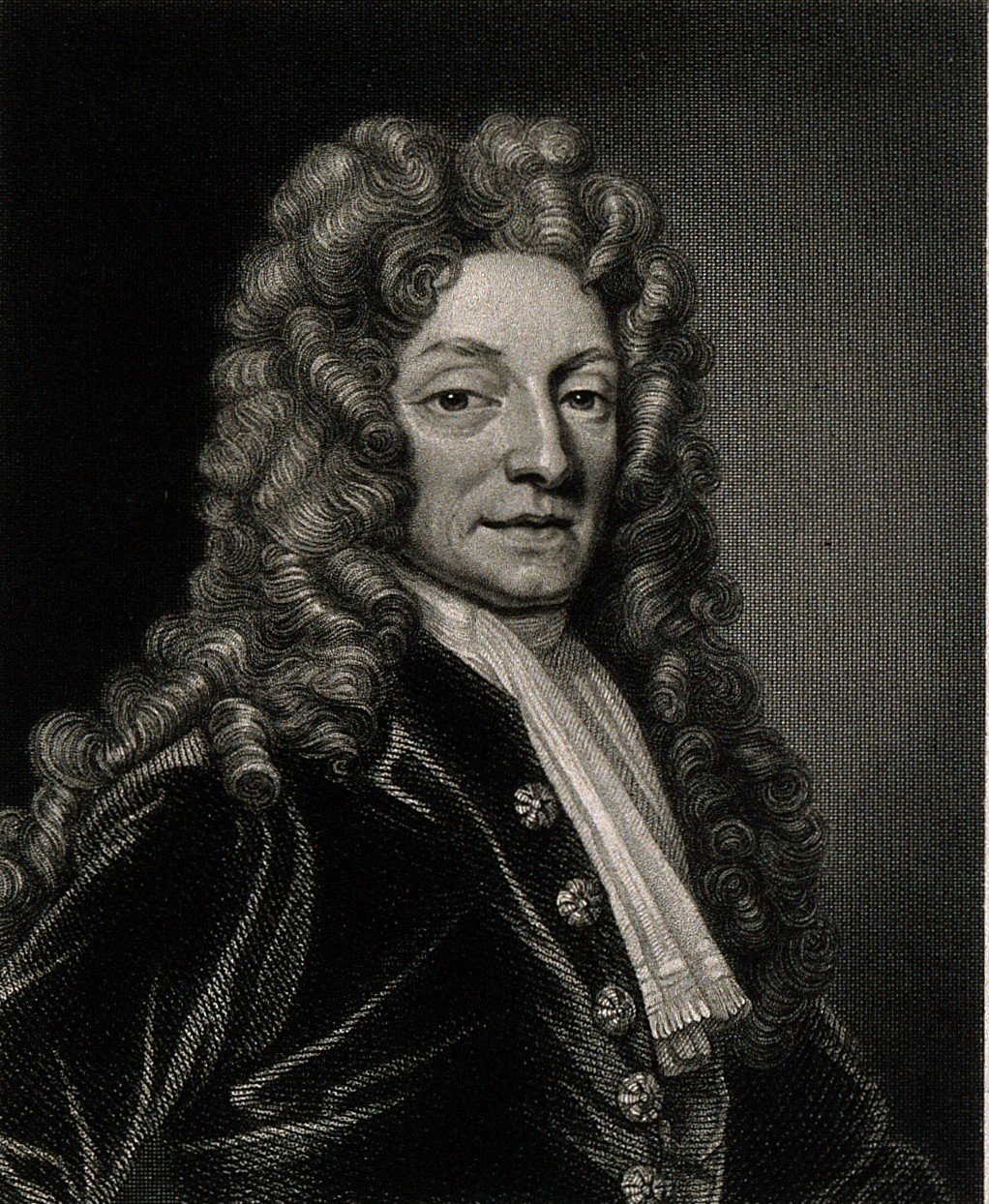
Edward Scriven (1775-1841), line engraving after Godfrey Kneller (1711 portrait), dated 1827 in the Wellcome catalogue (no imprint or publisher on the sheet or in the record); digital image Wellcome Collection, CC BY 4.0, via Wikimedia Commons; cropped to the plate and saved as JPEG at q85 (no upscaling) · Wellcome Collection, Iconographic Collections (V0006656EL; Library reference ICV No 6871L): line engraving by Edward Scriven after Godfrey Kneller's 1711 portrait, via Wikimedia Commons · CC BY 4.0 (Wellcome digitization); engraving public domain
The Royal Society's minutes show Wren bringing work in several fields in the early 1660s: a letter on his hypothesis about Saturn, dated 1 October 1661, and a description of a weather-clock registered on 9 December 1663. On 1 February 1665 he presented observations of the comet of 1664-65 with a theory, and his surviving diagram works out the comet's path by a geometric construction.
On 29 April 1663 Wren showed the Royal Society his model of the theatre to be built at Oxford and was asked to write out a description of its whole frame for the Society's archives. Evelyn's diary records that the theatre's opening ceremony took place on 9 July 1669.
Wren was appointed surveyor-general of the repairs of St Paul's on 30 July 1669, and in the same year became Surveyor-General of the King's Works, a post from which he was dismissed in 1718. The king approved the Warrant design for a new cathedral on 14 May 1675, and five days later the commissioners ordered work to begin on the foundations of its eastern part; Geraghty concludes that by 18 June, when the first contracts were signed, Wren had already reworked the plan of the choir and crossing.
On 27 August 1666, six days before the Great Fire began, Wren joined Evelyn, the Bishop of London and others to survey Old St Paul's. Evelyn's diary says that he and Wren, against Chicheley and Pratt, who thought the nave's outward lean original, plumbed the uprights in several places and insisted that the steeple needed a new foundation; after 'much contest' their offer to bring in a plan and estimate for a domed church was accepted.
Taking plumb-line measurements at several points while contesting colleagues' reading of the lean is consistent with the profile's analytical-rigor score; the account comes from Evelyn, a friend who took part in the survey, so it is a single, friendly perspective. Analytical Rigour
Within days of the Great Fire, Wren drew a scheme for replanning the City, which was shown to Charles II by 10 or 11 September 1666 (scholars differ by a day); it survives in two versions at All Souls College, and Hebbert says it came with a written description. Evelyn presented his own plan on 13 September, and Henry Oldenburg reported that the King showed much approbation, but Wren's streets did not follow existing alignments and the scheme would have required redefining property titles; it was not adopted, and the City was rebuilt largely on its old lines under the Rebuilding Act signed on 8 February 1667.
How quickly he responded sits alongside the profile's proactive-agency score, though nothing shows whether the plan was requested and its mismatch with existing property lines keeps this a tentative reading. Proactive Agency
In 1666 Hebbert describes Wren as still Savilian Professor of Astronomy at Oxford, with early success in mathematics and astronomy behind him. On 30 July 1669 he was appointed surveyor-general of the repairs of St Paul's, and Geraghty gives 1669 as the year he became Surveyor-General of the King's Works, whose office he then headed for about fifty years.
A move from astronomy and experiment to a building career is consistent with the profile's cross-domain-range score; Geraghty argues that his experimental training shaped his draughtsmanship, but the sources do not say why he changed course. Cross-Domain Range
People whose overall profiles resemble theirs.