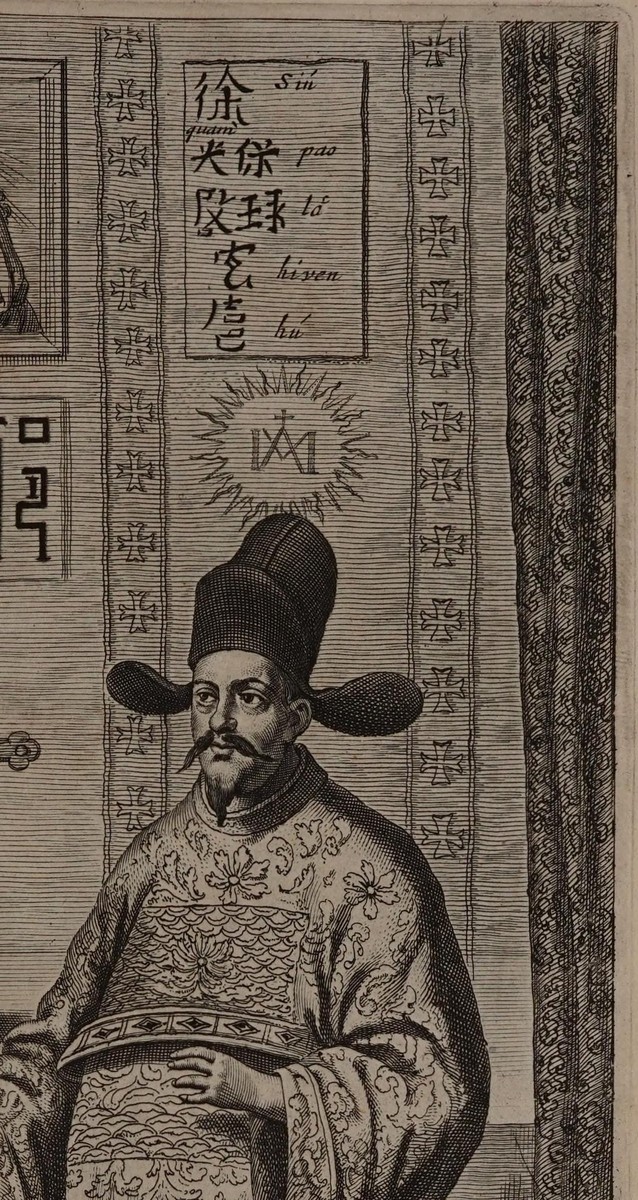
Engraver unknown, in Athanasius Kircher, China monumentis, Amsterdam, 1667. Digitised by the Wellcome Collection (https://wellcomecollection.org/works/y35ztr9n; Internet Archive item b33551364) · Engraved plate in Athanasius Kircher, China monumentis (Amsterdam: Jansson van Waesberge and Weyerstraet, 1667), showing Matteo Ricci and, to the right, Xu Guangqi named in Chinese characters in the cartouche above him. Taken from the Wellcome Collection's digitised copy (Internet Archive item b33551364, leaf 169). The right-hand figure with the name cartouche was cropped from the library's 3788 x 5708 pixel scan and downscaled to 638 x 1200, with no upscaling and no retouching. A posthumous European print, not a portrait from life; the engraver is not named. · Public domain (Wellcome Collection item-level Public Domain Mark; a book published in 1667)
핵심 특성
주요 업적
예수회 사제 마테오 리치와 함께 1607년 유클리드 『원론』 앞 여섯 권을 중국어로 옮기고 기하 개념을 나타내는 중국어 용어를 만들어 중국 수학에 정착시킨 명나라 학자이다. 브리태니커와 맥튜터는 그를 유럽 서적을 중국어로 번역한 최초의 중국인으로 소개한다.
서양 방식의 일식 예측이 일부 기준에서 경쟁 방식을 앞선 뒤 1629년 중국 역법 개혁을 맡아 예수회 천문학자들을 이끌었으나 1633년 그가 세상을 떠날 때까지 개혁은 끝나지 않았다. 현대 천문학자들은 서양 방식의 예측이 식분과 지속 시간에서는 나았지만 모든 시각에서 낫지는 않았다고 평가한다.
농지 제도, 수리, 농기구, 작물, 양잠, 구황을 다룬 60권의 농업 백과 『농정전서』를 편찬했다. 그가 세상을 떠났을 때 책은 미완이었고 황제가 유고를 구하자 그의 원고가 바쳐졌으며, 진자룡이 고친 판본이 1639년에 간행되었다.
삶의 장면들
유클리드 번역에서 리치가 라틴어 원문을 구두로 설명하면 서광계가 이해한 내용을 받아 적었고, 점·곡선·평행선·예각처럼 중국어에 대응어가 없던 개념은 그가 새 용어를 만들었다.
이는 언어의 장벽을 넘는 긴밀하고 지속적인 협업과 새 분야에 필요한 어휘를 직접 만드는 태도와 일치한다. 협업 성향
황제가 일식 예측에 실패한 천문관을 처벌하려 하자 서광계는 곽수경의 방법도 한 번 실패한 적이 있으며 역법은 시간이 지나면 어긋나므로 때맞춰 고쳐야 한다고 답했고, 황제는 예수회 선교사들에게 역법을 계산하게 하고 서광계를 감독으로 삼았다.
이는 책임 추궁 대신 기술적 해법을 주장하고 회의적인 권위자를 설득해 이를 받아들이게 한 모습과 일치한다. 설득력
전환점
1629년 6월 21일 일식을 두고 벌인 정부 주관 경쟁에서 서양 방식의 예측이 중국·이슬람 방식과 견주어 좋은 결과를 내자 서광계는 역법 개혁의 책임자로 임명되어 요하네스 테렌츠, 자코모 로, 아담 샬과 함께 작업을 이끌었다.
이는 유럽 천문학에 대한 오랜 공부가 대규모 과학 사업의 주도적 역할로 이어진 전환과 일치한다. 숙련 지향
비슷한 인물
전체적인 프로필이 이 사람과 닮은 사람들이에요.
출처
- Xu Guangqi (Q420427), verified live via the Wikidata API (2026-11-04): English label 'Xu Guangqi', description 'late-Ming-dynasty Chinese politician, scholar, lay Catholic leader and Servant of God', Korean label 서광계, born 1562 (two dates recorded, 24 April and 4 May), died 8 November 1633. Orientation only; not used as support for any row.
- Wikipedia, 'Xu Guangqi' (English article, read as orientation only). Not counted as a substantive source and not used as support for any row or card.
- Encyclopaedia Britannica, 'Xu Guangqi' (short entry by the Britannica editors, about 200 words), read in full. CANONICAL SIGNIFICANCE SOURCE: Ming-dynasty official and the most influential Chinese convert to Christianity before the 20th century; he obtained the jinshi degree in 1604 and studied with Matteo Ricci; he was the first of his countrymen to translate European books into Chinese, translating with Ricci Western books on mathematics, hydraulics and geography, the most famous being Euclid's Elements (Jihe yuanben), which exerted a great influence on Chinese mathematics; in 1629 the Western method, which he represented, proved most accurate in a government competition to predict a solar eclipse. The entry is brief and its facts overlap with the MacTutor biography, so it is not an independent check.
- J. J. O'Connor and E. F. Robertson, 'Xu Guangqi', MacTutor History of Mathematics Archive, University of St Andrews (2003), read in full: a history-of-mathematics biography of his translations with Ricci (the first six books of Euclid's Elements in 1607, the oral-then-written method, the new Chinese geometric terms), the calendar reform after the 1629 eclipse contest, and a critical passage that he talked down the Chinese mathematical tradition and that most Chinese mathematicians stayed with their traditional approach. It also discusses his advice on Western artillery, which is not used here.
- History of the Ming (Ming shi, compiled 1739), juan 251, biography of Xu Guangqi, read in the Chinese Wikisource transcription (flagged there as only partly proofread): a near-contemporary official account saying that he learned astronomy, calendrical mathematics and firearms from Ricci and then read widely on military affairs, agricultural colonies, salt policy and irrigation; that he argued the emperor should revise the calendar rather than punish the astronomers; that he submitted a series of astronomical treatises and tables in the early 1630s; that on his death the officials said he left no surplus wealth; and that the emperor asked for his surviving manuscripts, which his son presented as the 60-juan Nongzheng quanshu. An official dynastic history, so its judgements are retrospective.
- Biographical Dictionary of Chinese Christianity (BDCC), 'Xu Guangqi', reproduced with permission from the Dictionary of Asian Christianity (Eerdmans, 2001), read in full: a Catholic reference entry recording his meetings with Ricci, his joint translations (mathematics, hydraulics, geography, astronomy), his study with Sabatino de Ursis, and the 1629 commission to revise the calendar with the help of Johann Terrenz, Giacomo Rho and Adam Schall; it also records his defence of the Jesuits in 1616 and his baptism, which are religious and are not scored here. The entry is written from the Church's viewpoint.
- Sperello di Serego Alighieri and Elisabetta Corsi, 'The Eclipse of 21 June 1629 in Beijing in the Context of the Reform of the Chinese Calendar', Journal of Astronomical History and Heritage 23(2), 327-334 (2020; arXiv 2006.16766), read in full: two astronomers compare the Chinese, Muslim and Jesuit forecasts as reported by Xu Guangqi with a NASA reconstruction, find that none was accurate, that the Western method did best on magnitude and duration (a 3-2 result against the traditional method) and that Xu probably used this and the correct 1610 forecast to persuade the emperor; they also cite a 2007 study by Lu that finds the Western method worse. An independent modern check on the central calendar episode.
- Chinese Moment, 'Nongzheng quanshu 農政全書 Whole Book on Agricultural Activities' (online Chinese-culture reference page; the author is not named on the page), read in full: describes the 60-juan encyclopedia compiled by Xu Guangqi, its twelve sections (agricultural roots, field systems, agricultural matters, water conservancy, tools, planting, silk, trees, livestock, fabrication, and disaster relief with medicinal herbs in juan 43-60), his other agricultural treatises (cotton, sweet potato, bamboo and others), and that it was not completed in his lifetime and was revised by Chen Zilong and first printed in 1639. A secondary web page of undetermined authorship, used only for the structure and publication history.
- Wellcome Collection copy of Athanasius Kircher, China monumentis (Amsterdam: Jansson van Waesberge and Weyerstraet, 1667), Internet Archive item b33551364, item-level Creative Commons Public Domain Mark; the engraved plate near the start of Part II shows Matteo Ricci and, in Chinese characters above him, Xu Guangqi. Opened for the portrait only; the book text was not read.