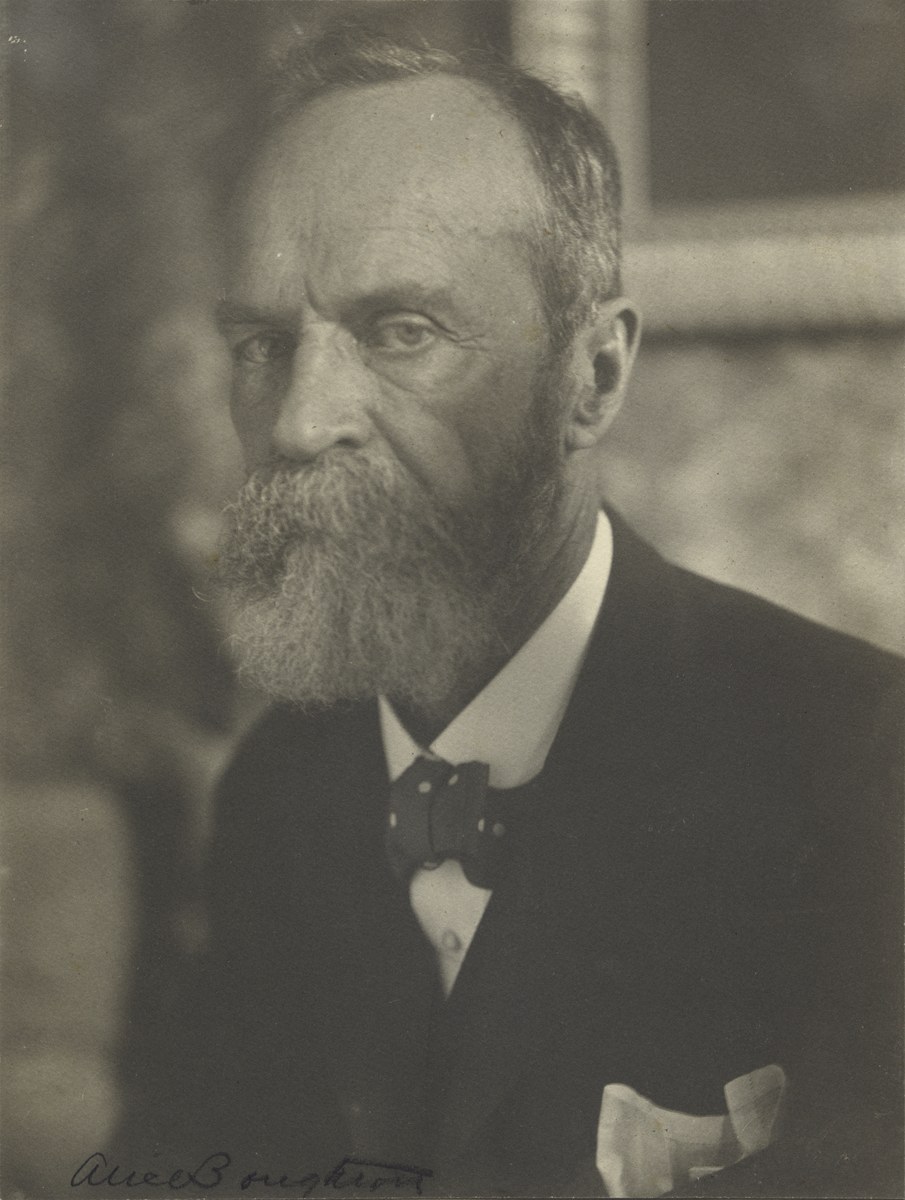
Alice M. Boughton, William James, c. 1907, platinum print, National Portrait Gallery, Smithsonian Institution (NPG.87.37), CC0 · Portrait photograph (platinum print) of William James by Alice M. Boughton, about 1907, National Portrait Gallery, Smithsonian Institution (object NPG.87.37). The Smithsonian Open Access record for the object states 'Restrictions & Rights: CC0', and its image media carry the usage access value CC0; the photographer (1866-1943) is long dead. The file is the Wikimedia Commons crop of the Smithsonian's own scan (the Commons page cites the NPG, the CC0 release and the creator's death year), downscaled only, from 4711 x 6245 to 905 x 1200 pixels; no upscaling. The NPG object web page itself blocks scripted requests, so the rights statement was read from the Smithsonian Open Access API record. · CC0 (Smithsonian Open Access); photographer died 1943
철학자 · 19세기
윌리엄 제임스
1842–1910
주요 업적 분야
아직 성격 매칭에 포함되지 않았습니다 — 기록된 근거가 성격 모델 전체를 다루기에는 충분하지 않습니다. 이 페이지의 다른 모든 내용은 자유롭게 확인하실 수 있습니다.
핵심 특성
주요 업적
그는 12년에 걸쳐 쓴 《심리학의 원리》(1890)로 이 분야의 기초를 놓았고, 1875~76년에는 하버드 휴턴 도서관이 미국 최초의 심리학 대학원 강의라고 설명하는 과목을 가르쳤으며, 1890년에는 기금을 모아 하버드의 심리학 실험실(데인 홀)을 갖추었다.
그는 1898년의 공개 강연과 1907년의 저서 《실용주의》로 실용주의를 널리 알렸다. 이 책은 관념을 실제 결과로 평가했으며, 스탠퍼드 철학 백과사전은 그를 찰스 퍼스와 함께 실용주의 전통의 창시자로 꼽는다.
그는 1901~02년 에든버러에서 기퍼드 강연을 했고 이는 《종교적 경험의 다양성》(1902)으로 출간되었으며, 1884년에는 미국심령연구협회의 창립에 참여했다.
삶의 장면들
그는 미국심령연구협회의 영매 조사 위원회를 이끌며 강신회에 참석했고, 많은 영매가 명백한 사기로 보였음에도 레오노라 파이퍼를 계속 연구해 그녀를 모든 까마귀가 검지는 않음을 보여 주는 '흰 까마귀'라고 불렀다.
관습적인 동료들은 영매를 찾아다니는 교수를 경계했다고 산타야나가 기록하지만, 이는 인기 없는 문제에 대한 지속적인 호기심과 부합한다. 호기심
그는 훗날 자신의 에세이 「믿으려는 의지」를 '믿을 권리'라고 불렀어야 했다고 말하며, 특정한 상황에서 특정한 믿음을 정당화하려 했을 뿐 믿음을 의지로 만들 수 있다는 주장이 아니었다고 해명했다. 퍼스는 이 글을 매우 과장된 표현이라고 평한 바 있다.
비판을 받고 자신의 입장을 다시 설명하려는 태도와 부합하지만, 변화의 대부분은 같은 주장을 명확히 한 것에 가깝다. 입장 수정 성향
전환점
1872년 하버드에서 비교해부학과 생리학을 가르치기 시작한 그는 엘리엇 총장에게 새로운 분야인 '정신 과학'으로 옮기게 해 달라고 요청했고, 1875~76년에 미국 최초의 심리학 대학원 강의를 개설한 뒤 1878년부터 철학 쪽으로 옮겨 갔다.
관심이 바뀜에 따라 확립된 분야에서 새로 떠오르는 분야로 넘어가려는 의지와 부합한다. 분야 횡단성
비슷한 인물
전체적인 프로필이 이 사람과 닮은 사람들이에요.


에이다 러브레이스

벤저민 프랭클린

소르 후아나 이네스 데 라 크루스

앨런 튜링

힐데가르트 폰 빙엔
출처
- William James (Q125249), verified live via the Wikidata API (2026-11-01): label 'William James', description 'American philosopher, psychologist, and pragmatist (1842-1910)', born 11 January 1842, died 26 August 1910, citizenship United States, Korean label present. Orientation only; not used as support for any row.
- 'William James', Stanford Encyclopedia of Philosophy, read in full. CANONICAL SIGNIFICANCE SOURCE: a scholarly overview that presents James as an original thinker across physiology, psychology and philosophy whose Principles of Psychology (1890) influenced Husserl, Russell, Dewey and Wittgenstein and whose late works (Pragmatism 1907, A Pluralistic Universe 1909, Essays in Radical Empiricism 1912) set out his mature views; gives a dated timeline (Harvard teaching from 1872, psychology from 1874-75, the twelve-year writing of the Principles, the 1898 pragmatist lecture, the 1901-02 Gifford Lectures), quotes his own letter calling the manuscript a 'loathsome, distended, tumefied, bloated, dropsical mass', records his later wish to have titled 'The Will to Believe' 'the right to believe', and records Russell's praise of his 'large tolerance and humanity' and his criticisms of Spencer, Hegel, Royce and Wundt. Scholarly reference; the praise is retrospective.
- 'Pragmatism', Stanford Encyclopedia of Philosophy, read (the passages on James): says pragmatism gained prominence through James's 1898 public lectures and his 1907 book Pragmatism, which presented the method through examples and as a 'mediating philosophy' between tough-minded and tender-minded temperaments; records that Peirce and James split over truth, that Peirce renamed his own view 'pragmaticism', that Peirce called 'The Will to Believe' 'a very exaggerated utterance', and that Russell argued James's account of truth commits him to the truth of 'Santa Claus exists', a reading the article calls unfair. Used as the independent, critical voice on James's pragmatism.
- 'William James', in the Encyclopedia of Philosophy / Dictionary of the History of Ideas reference set (Gale), via Encyclopedia.com, read in part (the first 200,000 characters of a 265,000-character compilation of several entries; the final section was not read): early training under Wyman and Agassiz, M.D. 1869 never practised, Harvard teaching of physiology from 1873, psychology from 1875 and philosophy from 1879, Harvard resignation 1907; the Principles of Psychology (1890) as his major work; Talks to Teachers (1899); Varieties (1902); Pragmatism (1907); students and colleagues including Santayana, Stein, Munsterberg and Hall; records that he tired of laboratory work and recruited Munsterberg to run experiments at Harvard, that he served as president of the Society for Psychical Research for two years and 'refused to dismiss data' that conflicted with theory, that the James-Lange theory drew heavy criticism and was modified several times, and critical assessments (Lovejoy's 'Thirteen Pragmatisms', Russell, Barzun on lack of system, charges of contradiction between tough-minded and tender-minded strands). Multi-author reference; mixed praise and criticism.
- 'William James: Life is in the transitions', online exhibition by Linda Simon, Houghton Library, Harvard (Internet Archive capture of the former Harvard Library pages), read: Introduction, Harvard Professor, Psychical Research and Touching Bottom pages. Archive-based narrative: at the start of a 34-year Harvard career James taught comparative anatomy and physiology, asked President Eliot to let him move into the new field of 'mental science', and in 1875-76 offered what the exhibition calls the first graduate course in psychology taught in America; accepted a Holt contract in 1878 to write a psychology textbook and warned it might take two years, 'It took twelve'; involved in the London Society for Psychical Research from 1882, helped found the American Society for Psychical Research in 1884, headed its committee investigating mediums and attended seances, and called the medium Leonora Piper his 'white crow'. The exhibition's account of his 1860s-1870 health and vocational crisis is deliberately not used for scoring. Curated institutional narrative from the Houghton holdings; admiring in tone.
- William James, letter of 19 October 1895 to the editor of Science disputing G. Stanley Hall's account of the origin of Harvard's experimental psychology, in 'Letters on the origins of American psychology laboratories' (Classics in the History of Psychology, York University), read: James gives his own dated account (instruction in experimental psychology from 1874-75 or 1876, a laboratory in two rooms of the Scientific School building, a 1890 fund-raising of several thousand dollars to fit out Dane Hall, Herbert Nichols appointed assistant in 1891, Munsterberg director in 1892); the same issue carries rebuttals by Ladd, Baldwin and Cattell of Hall's claims about their own laboratories. Primary, self-authored; used only for dated facts about the laboratory and one public act of correction, never as sole support.
- George Santayana, 'William James', chapter III of Character and Opinion in the United States (1920), Project Gutenberg edition, read in full: a former pupil and Harvard colleague's portrait: praises James's 'fresh imagination and vitality', his gift for 'evoking vividly the very life of the mind' and his break with false conventions; criticises him as too impulsive for 'exact sympathy', an impressionistic reader of other thinkers' theories whose 'intuition outran his patience', and a man who 'had no system in particular'; records that Harvard colleagues and the public were wary of a professor who 'dabbled in hypnotism' and 'frequented mediums', and that he would stop in a lecture to ask what he had been talking about. Independent, partly admiring and partly critical, written a decade after his death by a philosopher who disagreed with him.
- 'William James', platinum print by Alice M. Boughton, about 1907, National Portrait Gallery, Smithsonian Institution (object NPG.87.37), read via the Smithsonian Open Access API record, for the portrait review only. Not used for any row.