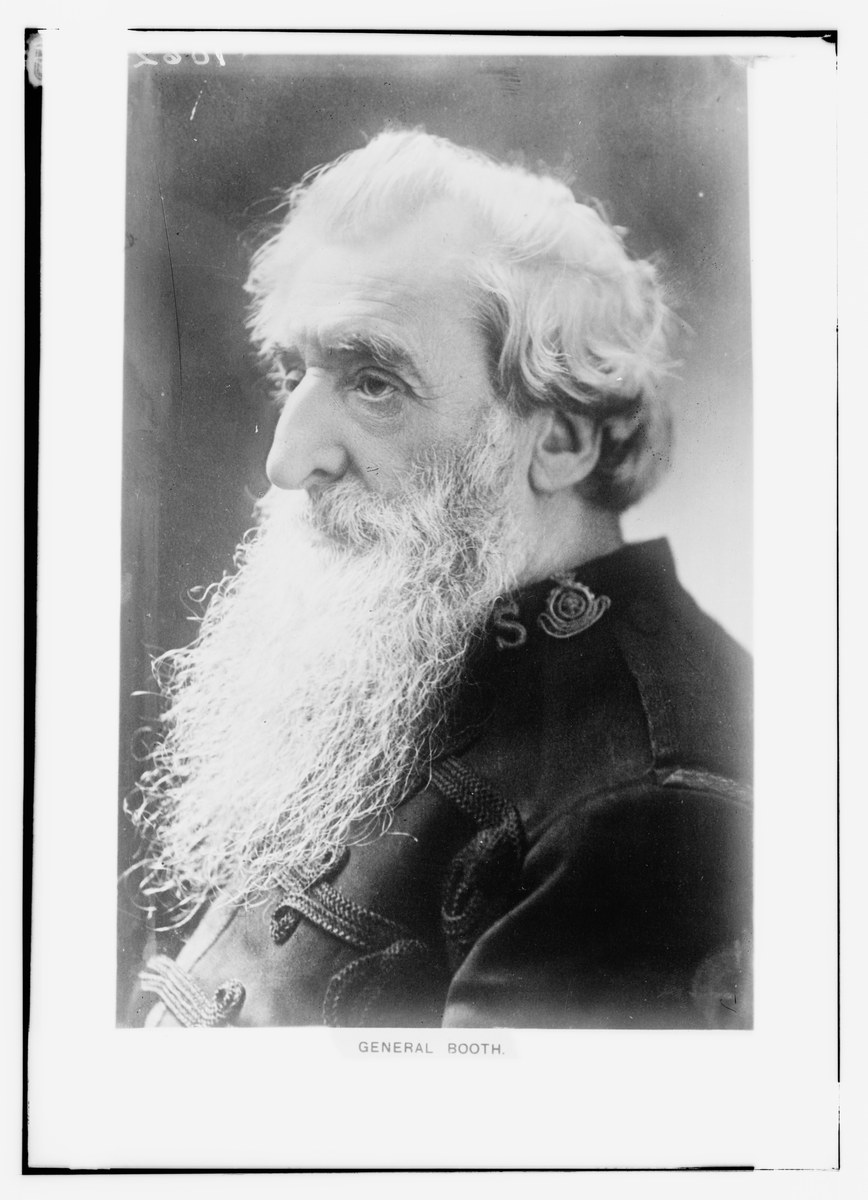

Bain News Service, Library of Congress, George Grantham Bain Collection (ggbain.05091); photographer not credited; date not recorded (before 1912) · Library of Congress, Prints and Photographs Division, George Grantham Bain Collection, glass negative captioned 'Gen. Booth', digitised as ggbain.05091 and hosted on Wikimedia Commons: publisher Bain News Service, photographer not credited, no date recorded; the Bain collection runs from about 1900 to the early 1920s and Booth died in 1912, so the negative was made within his lifetime. The Library states no known restrictions on publication for the Bain collection and the Commons page quotes that statement; the Library's own item page could not be opened (bot protection, HTTP 403), so the statement was verified through Commons. Original 4235 x 5854; downscaled once to 868 x 1200 (no upscaling). The Wikidata image (Salvation Army website photo, unknown photographer, 200 x 282, rights rationale by inquiry email) was not used. · Public domain (US); Library of Congress: no known restrictions on publication
종교 지도자 · 19세기
윌리엄 부스
1829–1912
주요 업적 분야
아직 성격 매칭에 포함되지 않았습니다 — 기록된 근거가 성격 모델 전체를 다루기에는 충분하지 않습니다. 이 페이지의 다른 모든 내용은 자유롭게 확인하실 수 있습니다.
핵심 특성
주요 업적
1860년대 중반 아내 캐서린과 함께 런던 동부에 기독교 선교회를 세우고, 총사령관으로서 1878년 이를 구세군으로 개칭해 군대식 계급, 제복, 규율을 갖춘 조직으로 만들었다.
구세군이 1880년 미국, 1881년 호주, 유럽 대륙과 인도로 퍼져 가는 동안 총사령관으로서 널리 순회하며 1912년 세상을 떠날 때까지 이끌었다.
1890년 『가장 어두운 잉글랜드와 그 탈출구』를 펴내 도시·농장 식민지, 구제의 집, 빈민 은행과 변호사 등 열 가지 계획을 제시했고, 대중의 기부가 모여 계획의 상당 부분이 실행되었다.
삶의 장면들
베그비는 마일엔드 웨이스트에서 야유하는 화이트채플 군중에 둘러싸인 부스가 맞서 소리치고 찬송을 이끌어 소란을 잠재웠다는 목격자의 말을 인용한다.
이는 적대적인 군중 속에서도 직접 설교하려는 태도와 일치하지만, 호의적인 회고 한 건에 의존한 기록이다. 갈등 감내
베그비에 따르면 '가장 어두운 잉글랜드' 기금을 둘러싼 의혹 후 조사위원회가 1892년 12월 자금이 공표된 목적에만 쓰였다고 보고했으며, 푸트 같은 비판자는 그의 통제를 전제적이라 묘사했다.
이는 공개적 압박 속에서 회계 조사를 받아들인, 개인이 중심이 되어 이끄는 중앙집권적 조직의 모습과 일치한다. 주도 성향
전환점
1861년 부스는 순회 전도에 뜻대로 쓰이지 못하던 감리교 신연합을 떠났고, 『영국인명사전』의 표현대로 교단의 권위에 복종하기보다 결별해 독립 부흥사가 되어 1865년 런던 동부 선교를 시작했다.
이는 설교 방식을 제약하는 교단에 남기보다 독립적인 선교를 택한 모습과 일치한다. 자율성 욕구
비슷한 인물
전체적인 프로필이 이 사람과 닮은 사람들이에요.


마하트마 간디

왕가리 마타이

아웅산 수치

마틴 루터 킹 주니어

이순신
출처
- William Booth (Q309882) -- verified live via the Wikidata API (2026-10-24): English label 'William Booth', description 'British Methodist preacher (1829-1912)', born 1829-04-10, died 1912-08-20, citizenship United Kingdom, Korean label '윌리엄 부스', P18 image 'William-Booth-c1900.jpg'. Orientation only; not used as support for any row.
- Encyclopaedia Britannica, 11th edition (1911), entry 'Booth, William' (Wikisource transcription), read in full: founder and 'general' of the Salvation Army; Wesleyan local preacher, then Methodist New Connexion minister, left in 1861; organised the East London Christian Mission in 1864 which became the Salvation Army in 1878; methods (open-air meetings, popular tunes, converts as daily witnesses); quasi-military 'Orders and Regulations'; early violent opposition and fines and imprisonment of followers; spread to the United States (1880), Australia (1881) and beyond; In Darkest England and the Way Out (1890) with its ten expedients, money liberally subscribed; later royal and civic recognition. CANONICAL SIGNIFICANCE SOURCE. Contemporary reference entry written in his lifetime, sympathetic.
- The Salvation Army UK and Ireland, 'Our history' page (salvationarmy.org.uk), read in full: the movement began in East London in 1865 when William and Catherine Booth took preaching to the streets, the Christian Mission with Booth as General-Superintendent, the 1878 name change and quasi-military structure, the 'soup, soap and salvation' practical doctrine, and the range of social services. Self-description by the organisation he founded; admiring and used only for chronology and the organisation's own account of its work.
- Bruce L. Edwards, 'William Booth' (EBSCO Research Starters, History, 2024), read in full: early life and conversion, the 1865 Whitechapel mission, the military metaphor (general, ranks, uniforms, flags, band), the 1878-1890 growth, the statement that his 'increasingly rigid, authoritarian manner' alienated many within the ranks and that his public power alarmed outsiders, the 1890 manifesto and the controversy and charges of socialism, Huxley as a secularist counterpoint, and an annotated bibliography that characterises Begbie as written as a tribute and Hattersley as more candid about the Booths. A modern encyclopaedic overview that is balanced and names criticism.
- Harold Begbie, 'The Life of General William Booth, the Founder of the Salvation Army' (Macmillan, New York, 1920, two volumes), full-text scans read selectively on the passages cited: the Mile End Waste open-air preaching and a convert's account of him; his 1855-era letters; the origins of the social scheme; the 1890 manifesto and its conflicting reception; the 1892 Committee of Inquiry into the Darkest England fund (about 129,000 pounds subscribed by 1892, doubts about personal benefit and accounts, the committee finding the funds had been spent only on the declared objects); quoted contemporary critics (Randall Davidson on his autocratic control; Huxley's attack; W. T. Stead's reproof to Railton); the motor-car campaigns of his old age. Begbie was a devoted admirer (EBSCO calls the work a tribute); the book is used for documented episodes and quoted documents, not for its praise, and no family or health passages are used.
- Edward Harold Begbie, 'Booth, William', Dictionary of National Biography, 1927 supplement (Wikisource transcription), read in full: poverty and pawnbroker apprenticeship, 1844 conversion, break with the Methodist New Connexion in 1861 'rather than submit to the authority of his church', the 1878 'volunteer army' to 'salvation army' change and the military titles he at first resisted, the 1890 book largely written by W. T. Stead, Huxley's attack, and a markedly more critical character assessment than Begbie's biography (a 'timorous administrator' using his autocracy to safeguard spiritual work, hostile to science and sport, willing to court wealthy donors, with Bramwell the real organiser). Same author as the biography so not fully independent; the passages on ancestry and speculation about racial character are deliberately NOT used.
- G. W. Foote, 'Salvation Syrup; or, Light on Darkest England' (1891 freethinker's pamphlet, Project Gutenberg eBook 39120), read in the passages on organisation and finance: a secularist critic's charge that Booth held 'despotic' unchecked control over a body of followers whose daily lives were regulated, that the scheme's proposed farm and over-sea colonies would be despotic rather than co-operative, and that W. T. Stead wrote much of the manifesto. Adversarial, partisan and of its time; used only as the contemporary counter-voice on authority and governance, not for factual claims about his character.
- Wikimedia Commons file page 'Gen. Booth LCCN2014685085.jpg' (wikitext and image record), checked for the portrait: Library of Congress, Prints and Photographs Division, George Grantham Bain Collection glass negative, publisher Bain News Service, photographer not credited, no date recorded; the file page quotes the Library's statement of no known restrictions on publication. Original 4235 x 5854. Not used for any scoring.