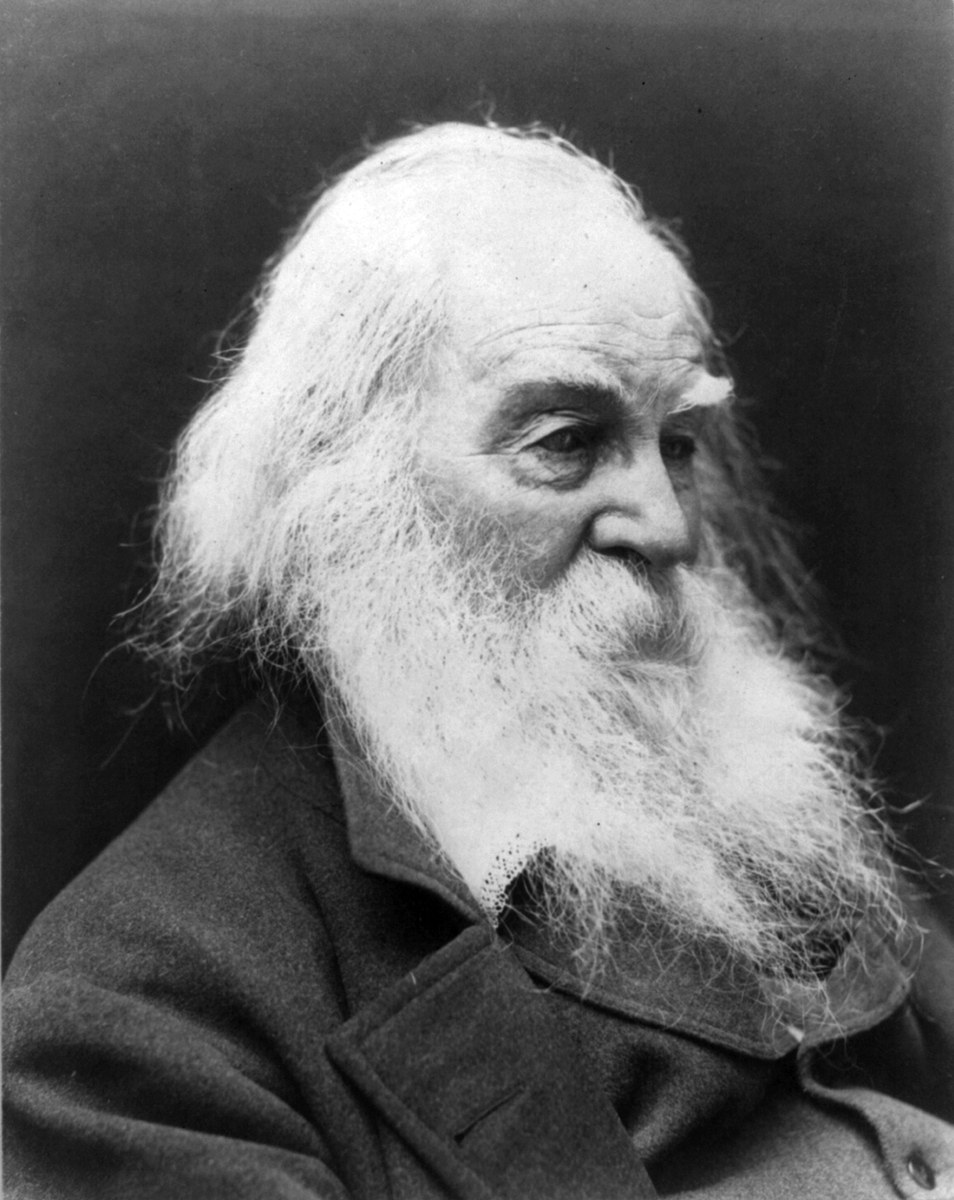

Photo: George C. Cox, 1887, Library of Congress Prints and Photographs Division (public domain) · Wikimedia Commons, 'Walt Whitman by George C. Cox cph.3b20763.jpg' -- photograph of Walt Whitman by George C. Cox, 1887, the Library of Congress Prints and Photographs record cph.3b20763 (Commons source field {{LOC-image|id=cph.3b20763}}). Uploaded to Commons 6 February 2013 (SHA-1 15638c65 matches the downloaded file). Original 1188 x 1494 pixels (grayscale scan, 760,410 bytes); saved here downscaled once to 954 x 1200 pixels, no crop, never upscaled. The unrestored LOC scan was chosen over the featured restoration so that no restorer attribution applies. · Public domain (published 1887 in the United States, before 1930; photographer George C. Cox died in 1903, so the term of life plus 70 years has also expired)
시인 · 19세기
월트 휘트먼
1819–1892
주요 업적 분야
아직 성격 매칭에 포함되지 않았습니다 — 기록된 근거가 성격 모델 전체를 다루기에는 충분하지 않습니다. 이 페이지의 다른 모든 내용은 자유롭게 확인하실 수 있습니다.
핵심 특성
주요 업적
1855년 출판사를 구하지 못한 그는 자비로 시 열두 편을 담은 『풀잎』 초판을 찍었습니다. 운율과 각운이 없는 새로운 자유시 형식이었고, 에머슨은 이를 미국이 내놓은 "가장 놀라운 재치와 지혜의 작품"이라 평했습니다. 브리태니커는 이 시집을 미국 문학사의 이정표로 꼽습니다.
그는 평생 이 시집을 고치고 늘려 나갔습니다. 『풀잎』이라는 제목의 책이 아홉 권 나왔고, 휘트먼 아카이브는 그중 여섯 권을 정식 개정판으로 봅니다. 1881년판에서 시 293편의 최종 순서가 정해졌습니다.
남북전쟁 시기 워싱턴에서 쓴 시를 모은 『북소리』(1865)에는 링컨 추모시 「지난봄 앞뜰에 라일락이 피었을 때」가 실렸습니다. 포에트리 파운데이션은 파운드, 윌리엄스, 긴즈버그를 그의 영향을 받은 후대 시인으로 꼽습니다.
삶의 장면들
1855년 그는 집을 팔아 첫 『풀잎』의 인쇄 비용을 마련했고, 로메 형제와 함께 활자체와 판형을 정했습니다. 직접 열 쪽가량의 활자를 짜 넣었고 그해 봄 대부분의 아침을 브루클린 인쇄소에서 교정쇄를 보며 보냈습니다.
출판사가 나서지 않자 스스로 길을 만들었고 책이 만들어지는 방식에도 신경 썼던 면모와 부합합니다. 선제적 행동력
1856년판에서 그는 에머슨의 사적인 편지를 허락 없이 실었고, 초판에 대한 서평 아홉 편도 함께 실었습니다. 그중 두 편은 서명 없이 그가 직접 쓴 글이었고, 어리둥절해하거나 부정적인 평도 나란히 실었습니다.
에너지 넘치는 자기 홍보가였고 그 홍보가 호의를 잃는 대가를 치르기도 했음과 부합하며, 비판적인 평까지 싣는 태도는 공개적 논쟁을 견디는 면모를 보여 줍니다. 설득력
전환점
1855년 이전 그는 인쇄공, 교사, 기자, 편집자로 일하며 문학적 가능성이 거의 보이지 않는 감상적인 이야기와 시를 발표했습니다. 1855년 봄 그는 완전히 새로운 문체의 첫 『풀잎』을 찍어 냈습니다.
이전의 관습적인 글쓰기를 버리고 자기만의 형식을 택한 창작상의 전환과 부합합니다. 창의적 독창성
비슷한 인물
전체적인 프로필이 이 사람과 닮은 사람들이에요.
출처
- Walt Whitman (Q81438) -- verified live via the Wikidata API (2026-10-22): English label 'Walt Whitman', description 'American poet, essayist and journalist (1819-1892)', born 31 May 1819, died 26 March 1892, citizenship United States, Korean label present. Orientation only; not used as support for any row.
- Poetry Foundation, 'Walt Whitman' (biography page, poetryfoundation.org) -- read in full: Leaves of Grass (1855, 1891-2) as his monumental work, regarded with Emily Dickinson as one of America's most significant nineteenth-century poets, an influence on later poets including Ezra Pound, William Carlos Williams and Allen Ginsberg; self-published first edition of twelve poems that underwent eight subsequent editions as he expanded and revised it; Emerson's 'most extraordinary piece of wit and wisdom' verdict; his own enthusiastic review; critics' unease at style and subject (citing The Longman Anthology of Poetry on abandoning regular metre and rhyme); dismissal from the Department of the Interior after publication; warmer reception in England; Civil War clerking and hospital visits leading to Drum-Taps (1865) with the Lincoln elegy. CANONICAL SIGNIFICANCE SOURCE (his primary historical contribution). Institutional, admiring in tone; the 'first writer of a truly American poetry' line was not used as a card claim.
- Britannica, 'Walt Whitman' by Alexander Norman Jeffares (last updated 8 September 2026) -- read in full: printer, schoolteacher, journalist and editor before 1855; sentimental early stories and poems that 'showed almost no literary promise'; unable to find a publisher, he sold a house and printed the first Leaves of Grass at his own expense with no author or publisher name on the title page; the financial failure of the 1856 edition; the greatly enlarged 1860 edition from a Boston publisher bankrupted by the Civil War; Civil War hospital visiting; his June 1865 dismissal from the Interior Department because the Secretary thought the book indecent; and its verdict that the book is a landmark of American literature written in a new form of free verse. Independent reference biography; the passage on the 1860 Calamus poems' private meaning was not used.
- Walt Whitman Archive (University of Nebraska-Lincoln), encyclopedia entry ''Leaves-Droppings' [1856]' by John Reitz -- read in full (via an Internet Archive copy, because whitmanarchive.org refuses automated requests): the appendix to the 1856 edition that printed Emerson's private letter without his permission, followed by Whitman's own 3,800-word reply that 'baldly exaggerates' the first edition's popular success; nine reviews of the 1855 book of which two (from the Brooklyn Daily Times and the American Phrenological Journal) were written, though unsigned, by Whitman himself; his inclusion of puzzled, mixed and flatly negative reviews; and the scholar's judgement that it shows the 'shamelessness and skill' of his early promotion. Scholarly encyclopedia entry; critical as well as factual.
- Walt Whitman Archive, encyclopedia entry 'Rome Brothers, The' by Jan Whitt -- read in full (via an Internet Archive copy): as a printer and editor Whitman placed high demands on those who worked in publishing and had assessed Brooklyn printers three years earlier; the Rome brothers printed 800 copies of the 1855 edition while letting him supervise, consult on typeface, ink, paper and layout, and set about ten pages of type himself; he selected a typeface from Scotland (12 pages of Preface in 10-point, 83 pages of poems in 12-point), came to the shop most mornings that spring to work on proofs, and wrote the Preface there. Scholarly encyclopedia entry built on standard biographies.
- Walt Whitman Archive, encyclopedia entry 'Leaves of Grass, 1891-92 edition' by R. W. French -- read in full for the editions record (via an Internet Archive copy): the authentic editions Whitman compiled were 1855, 1856, 1860, 1867, 1871 and 1881; the 1891-92 'Deathbed edition' is strictly an impression reprinting the 1881 text with twenty-three minor revisions (spelling, punctuation) and annexes; in 1881 the 293 poems, seventeen of them new, were given their final order and the 'clusters' extensively revised since the 1860 edition were fixed; later poems were issued as annexes (Sands at Seventy, Good-Bye my Fancy) rather than integrated. Scholarly bibliographic account; it corrects the common 'deathbed edition' framing.
- [Rufus W. Griswold, unsigned], review of Leaves of Grass (1855), The Criterion, 10 November 1855, as transcribed by the Walt Whitman Archive (anc.00016; via an Internet Archive copy) -- read in full: a hostile contemporary review that calls the book 'a mass of stupid filth' and deplores its disregard of 'decencies'. Hostile counter-voice used only to show how strongly the work was resisted; its insults and allegations about the author were not used for any row.
- [Charles Eliot Norton, unsigned], review of Leaves of Grass (1855), Putnam's Monthly, September 1855, as transcribed by the Walt Whitman Archive (anc.00011; via an Internet Archive copy) -- read: a sceptical contemporary review calling the poems 'a curious and lawless collection', 'neither in rhyme nor blank verse, but in a sort of excited prose broken into lines', with slang and 'terms never before heard or seen', while quoting the Preface so that 'the writer' states his own theory. Independent critical voice that nevertheless documents the formal novelty.
- [Walt Whitman, unsigned], 'Walt Whitman and His Poems', The United States Review, September 1855, as transcribed by the Walt Whitman Archive (anc.00176; via an Internet Archive copy) -- opening read: an unsigned review of his own book that opens 'An American bard at last!' and presents the author as 'one of the roughs'; the Archive lists it under Whitman's name with the note 'unsigned in original'. Self-authored promotion, used only as direct evidence of the promotional behaviour, never as evidence of the poems' quality.
- [George Eliot, unsigned], 'Transatlantic Latter-Day Poetry', The Leader, 7 June 1856, as transcribed by the Walt Whitman Archive (anc.00027; via an Internet Archive copy) -- opening read: a British review of the 1855 book that calls the author 'one of the most amazing, one of the most startling, one of the most perplexing, creations of the modern American mind', says he is 'no fool' though 'abundantly eccentric', and observes that the book contains much that can be fairly ridiculed. Independent, mixed contemporary voice.
- PBS American Experience, 'Walt Whitman and the Civil War' -- read in full: Whitman went to Washington in December 1862 looking for his wounded brother; made hospital rounds as a volunteer with small gifts and by listening, soliciting donations and funding them partly from his clerk's salary; published newspaper pieces on the hospitals; finished Drum-Taps in 1865 and added the Lincoln poem and then 'When Lilacs Last in the Dooryard Bloom'd'; the hospital years gave him purpose and new inspiration for his art. Public-television history feature; admiring in tone. Used only for the Drum-Taps background, not for any behavioural row (the hospital visits are care work, not scored).
- Brown Alumni Magazine, 'Song of Himself' (2007) -- read in full: Brown's John Hay Library holds Whitman's own copy of the 1855 Leaves of Grass with anonymous galley-proof reviews pasted in ('An American bard at last!'), which scholars believe he wrote, and a broadside of Emerson's letter printed in the New York Tribune without Emerson's permission; Brown owns one copy of each of the nine lifetime editions. Short magazine item citing a librarian's belief, so it only corroborates the Archive.