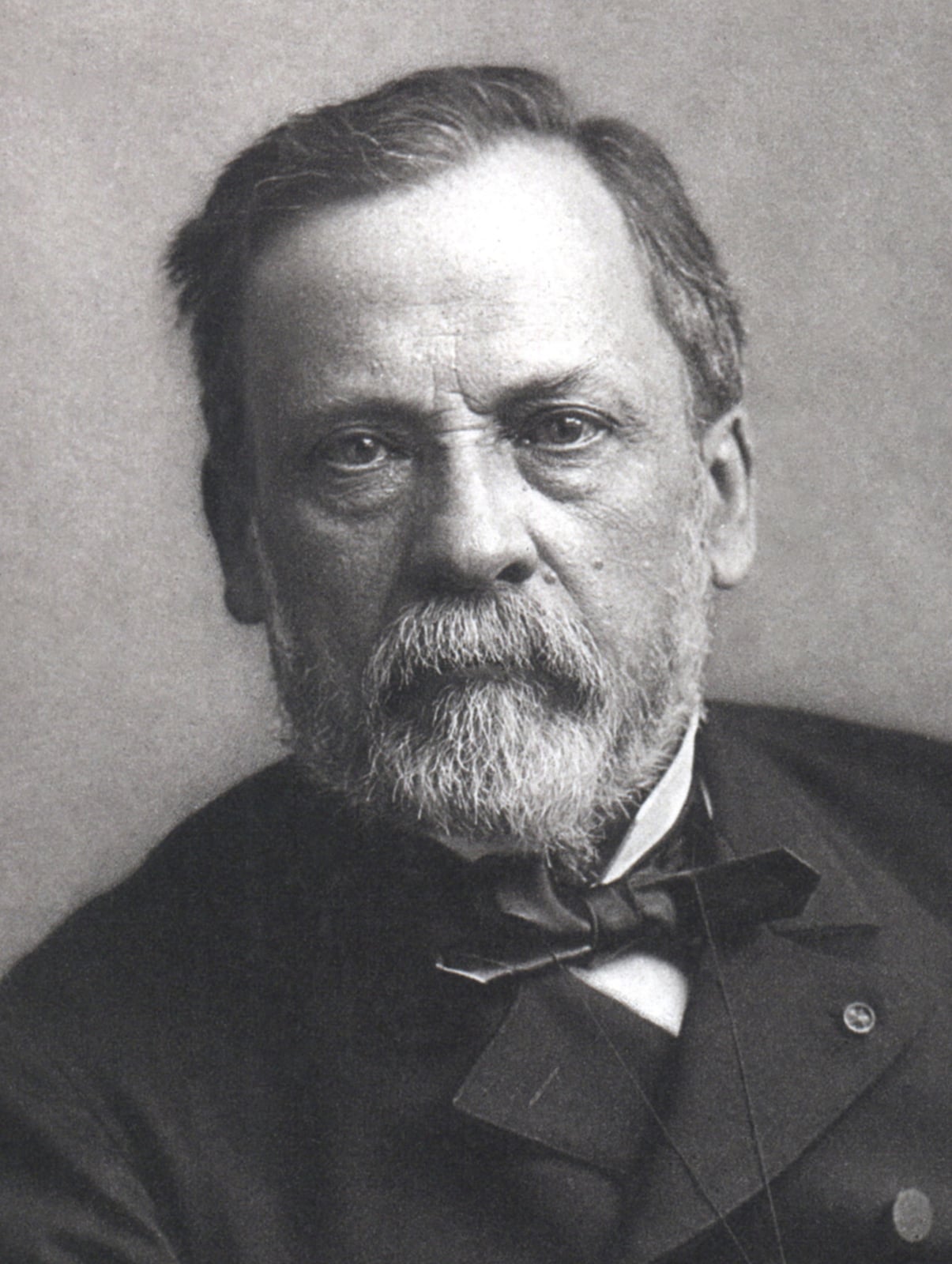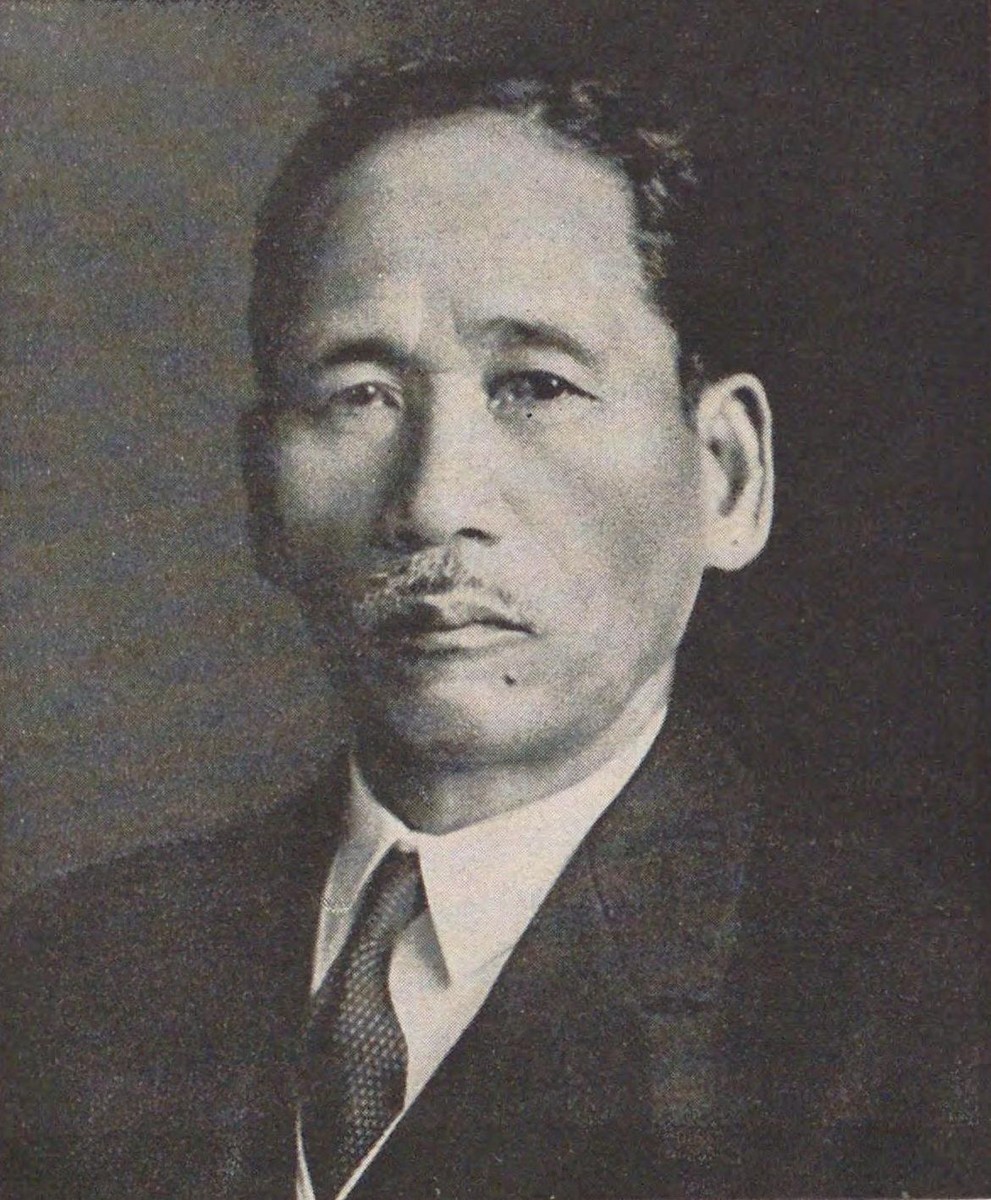

Photographer unknown, published 1942 in Horikawa Toyonaga, Kindai Nihon no kagakusha vol. 2. Source: Portraits of Modern Japanese Historical Figures, National Diet Library, Japan (https://www.ndl.go.jp/portrait/) · Portrait photograph of Umetaro Suzuki, photographer unknown, published in the book Kindai Nihon no kagakusha (Scientists of Modern Japan), volume 2, by Toyonaga Horikawa (Jinbunkaku, Tokyo, 1942), as reproduced in the National Diet Library's digital exhibition 'Portraits of Modern Japanese Historical Figures' (entry for SUZUKI Umetaro, source item NDL Digital Collections pid 1793218). The library's entry names the sitter, and the source book contains a biography chapter on him. The file is the library's published image (1171 x 1418 pixels) downscaled to 991 x 1200 with no cropping and no upscaling; it is a halftone book reproduction, so the grain is that of the print. · Public domain (declared by the National Diet Library for all images in 'Portraits of Modern Japanese Historical Figures'; the photograph was published in Japan in 1942)
과학자 · 20세기
스즈키 우메타로
1874–1943
주요 업적 분야
아직 성격 매칭에 포함되지 않았습니다 — 기록된 근거가 성격 모델 전체를 다루기에는 충분하지 않습니다. 이 페이지의 다른 모든 내용은 자유롭게 확인하실 수 있습니다.
핵심 특성
주요 업적
1910년 쌀겨에서 각기병을 막는 물질을 추출해 아베리산(후에 오리자닌, 오늘날 비타민 B1과 연관됨)이라 이름 붙이며 일본 비타민 연구의 토대를 놓은 일본의 농예화학자이다. 학자들은 그의 추출물이 순수한 티아민은 아니었고 발견의 공로를 둘러싼 논쟁이 남아 있다고 지적한다.
1917년부터 이화학연구소(리켄) 화학부장을 맡았으며, 그의 연구실에서 제자 다카하시 가쓰미가 1922년 간유에서 정제한 비타민 A가 '리켄 비타민'이 되어 양차 대전 사이 리켄 연구비의 절반을 충당했다.
1924년 일본농예화학회의 초대 회장이 되었고 많은 뛰어난 과학자를 길러냈으며 1943년 문화훈장을 받았다.
삶의 장면들
그는 1910년 12월 13일 도쿄화학회에서 아베리산 논문을 발표했고, 각기병을 전염병으로 보던 의사들이 신문까지 동원해 이를 공격하자 연구실로 돌아가 결과를 확인하고 추가 연구를 발표했다.
이는 적대적인 비판 속에서도 논란이 된 결과를 고수하고 더 많은 실험으로 답한 연구자의 면모와 일치한다. 끈기
1918년 쌀값 폭동 이후 쌀이 청주 양조에 쓰이는 것을 우려한 그는 쌀이 아닌 재료로 합성 청주를 만들고자 했고, 이는 훗날 리켄이 '리켄슈'로 생산했다.
이는 국가적 식량 문제를 연구 과제로 삼은 화학자의 면모와 일치한다. 영향 창출 동기
전환점
1915년 그는 각기병 연구를 중단하고 전시 봉쇄로 수입이 끊긴 살바르산의 합성에 힘을 쏟으라는 명령을 받았고, 2년 뒤 새로 설립된 리켄의 주임연구원이 되어 그의 연구실의 비타민 연구가 산업 제품군으로 이어졌다.
이는 대학의 연구 과제에서 산업에 응용되는 화학으로 옮겨 간 연구 경력과 일치한다. 분야 횡단성
비슷한 인물
전체적인 프로필이 이 사람과 닮은 사람들이에요.
출처
- Umetaro Suzuki (Q3369717), verified live via the Wikidata API (2026-11-02): English label 'Umetaro Suzuki' (with macron), description 'Japanese agricultural chemist (1874-1943)', Korean label 스즈키 우메타로, birth 7 April 1874 and death 20 September 1943, citizenship Japan. Orientation only; not used as support for any row.
- RIKEN, 'Historical Figures: Umetaro Suzuki' (institutional history page), read in full. CANONICAL SIGNIFICANCE SOURCE: founder of vitamin research in Japan whose most important achievement was the isolation from rice bran of what he named Oryzanin, or vitamin B1, essential for the treatment of beriberi; from 1917 Director of the Chemistry Division of the RIKEN Foundation, where he developed 'RIKEN Vitamin' and the synthetic sake 'RIKEN-Shu', providing RIKEN with an important source of income; he applied his expertise to agricultural chemistry and biochemistry and mentored a great many leading scientists; one of RIKEN's 'Three Taros'. Institutional history written by the employer he helped fund, so its tone is admiring.
- RIKEN Research News, 'Chemists at the front of RIKEN elixir of health and wealth' (3 June 2016), read in full: Suzuki studied under Emil Fischer in Germany, who urged him to focus on research pertinent to Japan; he returned in 1906 thinking about rice and beriberi; he named the anti-beriberi nutrient aberic acid; after the 1918 rice-price riots he set out to make a synthetic sake; as director of RIKEN's chemistry division he set his student Katsumi Takahashi the task of purifying vitamin A, which Takahashi achieved in 1922; sales of RIKEN Vitamin, a venture President Okochi invested in from 1927, covered half of RIKEN's research budget between the wars; he continued with vitamins B6, C, D and E until his death and received the Order of Culture in 1943. Institutional magazine story; admiring, and it credits the commercial strategy to Okochi.
- Japan Patent Office, 'Ten Japanese Great Inventors: Umetaro Suzuki, Vitamin A, Vitamin B1', read in full: he noticed that a component of rice bran was effective in preventing beriberi, whose cause was then unknown, and 'was the first to discover aberic acid, today called vitamin B1' in rice bran, later succeeding in isolating it; with his pupil Katsumi Takahashi he isolated and extracted vitamin A from cod liver oil at RIKEN, sold as 'Riken Vitamins'; through developing outstanding researchers he laid the foundation for vitamin research in Japan. Government honour page; short and celebratory, and its 'first to discover' wording is not used as a claim here.
- National Diet Library, Japan, 'SUZUKI Umetaro', Portraits of Modern Japanese Historical Figures (biographical note by library staff), read: agricultural chemist; entered the Tokyo School of Agriculture and Forestry in 1889; studied at the University of Berlin from 1901; professor at Morioka and from 1907 at the Imperial University of Tokyo; senior researcher at RIKEN from its founding in 1917; first president of the Agricultural Chemical Society of Japan in 1924; extracted vitamin B1 from rice bran while researching the cause of beriberi and named it aberisaure (later oryzanin); received the Order of Culture in 1943. Neutral reference note; used for the career chronology.
- Daiichi Sankyo, 'Dr. Umetaro Suzuki's Relentless Commitment to Research Led to the Discovery of Vitamin B1' (company history story, 29 September 2023), read in full: he earned his agricultural doctorate at 27 and studied in Switzerland and Germany; named the rice-bran component Orizanin in 1910; the company says his discovery was hardly recognized even in Japan because he was an agricultural chemist and not a physician, and that Casimir Funk's same component the following year won the recognition; he advised the predecessors of Daiichi Sankyo on producing Salvarsan (1916) and salicylic acid (1915), was scientific adviser to Sankyo and contributed to the fumigant insecticide Kokuzol; he also developed a synthetic sake and a powdered milk; it quotes him that anyone should be allowed to do what other academics have not done if it benefits the nation and its people and that an inventor should ask an entrepreneur to bring the invention to the world. A company's own heritage page that benefited from his advice; admiring and partly paraphrased.
- Kevin Fujitani (Ohio State University), 'A Child of Many Fathers: The Question of Credit for the Discovery of Thiamine, 1884-1936', in Proceedings of the International Workshop on the History of Chemistry 2015 Tokyo (pp. 90-98 of the proceedings), read in full: scholarly account of Suzuki's work on aberic acid, the 13 December 1910 presentation to the Chemical Society of Tokyo and the January 1911 patent applications, the hostile reception from physicians who held beriberi to be infectious (including a reported remark that if rice bran cured beriberi then drinking urine would too), Suzuki's return to the laboratory and published studies, the 1915 order to turn to Salvarsan synthesis, the August 1911 Zentralblatt abstract and the 1912 Chemical Abstracts remark about Funk; the author concludes Suzuki's oryzanin was not pure thiamine (his degradation products lack its sulfur) but that Suzuki 'took the study of these essential macromolecules from the realm of nutrition to that of chemistry'. Independent scholarly voice and the counter-voice on priority; reads Suzuki's own memoir Kenkyu no Kaiko as a source.