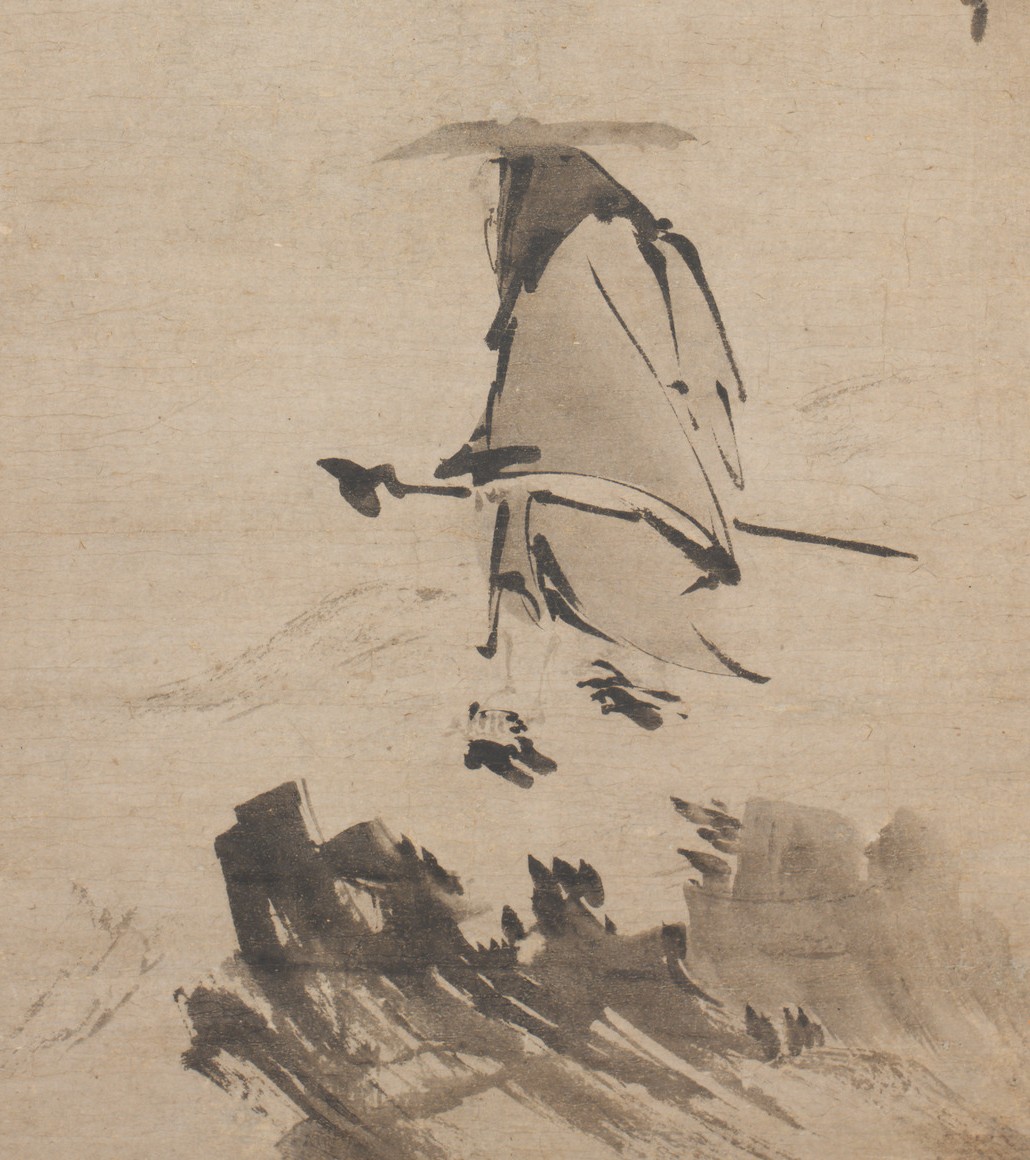

Unidentified Japanese painter, inscribed by Zuigan Ryusei and others, Su Shi (Dongpo) in a Bamboo Hat and Clogs, before 1460, The Metropolitan Museum of Art, Harry G. C. Packard Collection of Asian Art, 1975 (1975.268.39), public domain · The Metropolitan Museum of Art, 'Su Shi (Dongpo) in a Bamboo Hat and Clogs', hanging scroll, ink on paper, Japan, Muromachi period, made before 1460 (accession 1975.268.39), with inscriptions by several Zen monks including Zuigan Ryusei (1384-1460); the painter is not identified. A Japanese ink painting of the poet in the hat and clogs of a well-known episode, made about 350 years after his death, so it is a later depiction and not a likeness. The Met's collection record marks the work as public domain (open access). The file is a plain crop of the figure and rock from the original 1709 x 4000 pixel museum image, taken from the full image with the inscriptions and gold mounting cut away, at its original resolution and not enlarged. · Public domain (Metropolitan Museum of Art Open Access, CC0)
핵심 특성
주요 업적
송나라를 대표하는 시인이자 산문가로, 당송팔대가의 한 사람으로 꼽힌다. 유배지에서 쓴 「전적벽부」는 그의 글솜씨의 정점으로 평가된다.
송나라를 대표하는 서예가의 한 사람으로 꼽히며, 한 미술관은 그를 이후 중국 미술을 지배하게 되는 문인화 전통의 원류라고 부른다.
항저우 지사로서 가뭄과 기근, 전염병에 곡식 구휼과 병원으로 대응했고, 메워진 서호를 준설해 그 진흙으로 오늘날까지 그의 이름이 붙은 제방을 쌓았다.
삶의 장면들
항저우에 가뭄과 기근, 전염병이 닥치자 그는 지역 쌀 세금을 줄여 달라고 상소하고, 승려 도첩을 팔아 곡식을 마련했으며 의사가 일하는 병원을 세웠다.
이는 직무의 한계 안에서 실용적인 수단을 찾아내는 습관과 일치한다. 자원 활용 성향
하이난으로 유배된 그는 비를 만나 농부의 삿갓과 나막신을 빌려 신었고, 한 학예사는 그가 침착했다고 말하며 이 장면은 그를 대표하는 이미지가 되었다.
이는 상황이 바뀌고 어려워져도 평정을 유지하며 일을 이어 가는 능력과 일치한다. 적응력
전환점
1079년 감찰관들이 그의 시구를 문제 삼아 고발해 그는 투옥되었고, 사형은 면했지만 황저우로 유배되어 둥포라 이름 붙인 땅을 일구며 적벽부를 썼다.
이는 어쩔 수 없이 달라진 환경에 맞춰 삶과 작업을 새로 꾸리는 방식과 일치한다. 적응력
비슷한 인물
전체적인 프로필이 이 사람과 닮은 사람들이에요.


라빈드라나트 타고르

벤저민 프랭클린

레오나르도 다빈치

프란츠 카프카

마야 안젤루
출처
- Su Shi (Q36020), verified live via the Wikidata API (2026-10-31): label 'Su Shi', description 'Chinese writer and politician (1037-1101)', born 1037-01-08, died 1101-08-24, Korean label present. Orientation only; not used as support for any row.
- Wikipedia, 'Su Shi', fetched for orientation (dates, offices, the Four Masters of Song calligraphy, the poem-trial context). Orientation only; never counted as support for any row.
- Song Shi (the official history of the Song dynasty, compiled 1345), chapter 338, biography of Su Shi, read via the Chinese Wikisource text: the standard dynastic account of his offices (judge at Fengxiang, Hanlin academician, prefect of Hangzhou, Mizhou, Xuzhou and Huzhou), his 1079 arrest on charges drawn from his poems, exile to Huangzhou where he farmed the plot he called Dongpo, later exile to Hainan, and Hangzhou famine relief, the dredging of West Lake and the causeway. It also records his own remarks on writing and the compilers' closing judgment. CANONICAL SIGNIFICANCE SOURCE (with the Palace Museum curators' article). Compiled about 240 years after his death from earlier records, so the praise is retrospective, but it is the standard official biography. Read in an English summary produced by the fetch tool; the Chinese quotations were checked against the returned text.
- Wang Kaihao, 'A mind of the times', China Daily (22 September 2020), read in full: report on the Palace Museum, Beijing, exhibition on Su Shi's paintings and calligraphy that quotes curator Yu Wentao and deputy director Ren Wanping. It calls him one of the eight great prose masters of the Tang and Song, a leading Song calligrapher and a pioneer of poetry genres, with the Former Ode on the Red Cliffs as the peak of his writing, and says he broke with rigid copying of models. CANONICAL SIGNIFICANCE SOURCE (museum curators' view). Newspaper report of an exhibition: admiring and partly promotional.
- Santa Barbara Museum of Art, 'Bamboo, Rocks, and Old Trees: Chinese Calligraphy and Literati Painting' (exhibition page, 2019), read in full: describes Su Shi as a statesman, scholar, poet, writer, calligrapher and painter and as the fountainhead of the literati painting tradition, and calls 'Old Tree, Rock, and Bamboo' widely regarded as his only surviving painting. Museum framing with no independent sourcing on the page.
- Chiu-Ti Jansen, 'Su Dongpo's Friendship on the West Lake', Sotheby's (3 September 2013), read in full: sale-preview essay on a Su letter to Guo Xiangzheng written in Hangzhou around 1071-1072; says he asked for a Hangzhou post in 1071 to avoid the reformers' pressure, oversaw dredging of West Lake with the 1089 mud used for the causeway, was known for speaking his mind and suffered exile and sometimes imprisonment even when his own side held power. Auction-house marketing text: favourable and commercial, but independent of the museums.
- China Online Museum, 'Su Shi' (calligraphy masters section; unsigned), read in full: biography with the jinshi degree of 1057, posts from 1060, the Hangzhou causeway, the 1078 memorial from Xuzhou, the two exiles, and the calligraphy 'Cold Food Observance' and the Red Cliff odes written at Huangzhou; says his poems targeted Wang Anshi's reforms rather than the emperor and that after his death his work was collected and shrines built. Unsigned popular site that largely repeats standard accounts; used only for the outline and dates.
- Chen Xi, 'Beijing's Palace Museum explores life of the great Northern Song poet Su Shi', Global Times (2 September 2020), read in full: exhibition report with the reporter's summary of his calligraphy rank, his poems in Chinese school textbooks and the bamboo-hat-and-clogs episode in Hainan that an exhibited painting depicts. State-affiliated newspaper report; popular and admiring, used only to corroborate the Hainan episode and his reception.