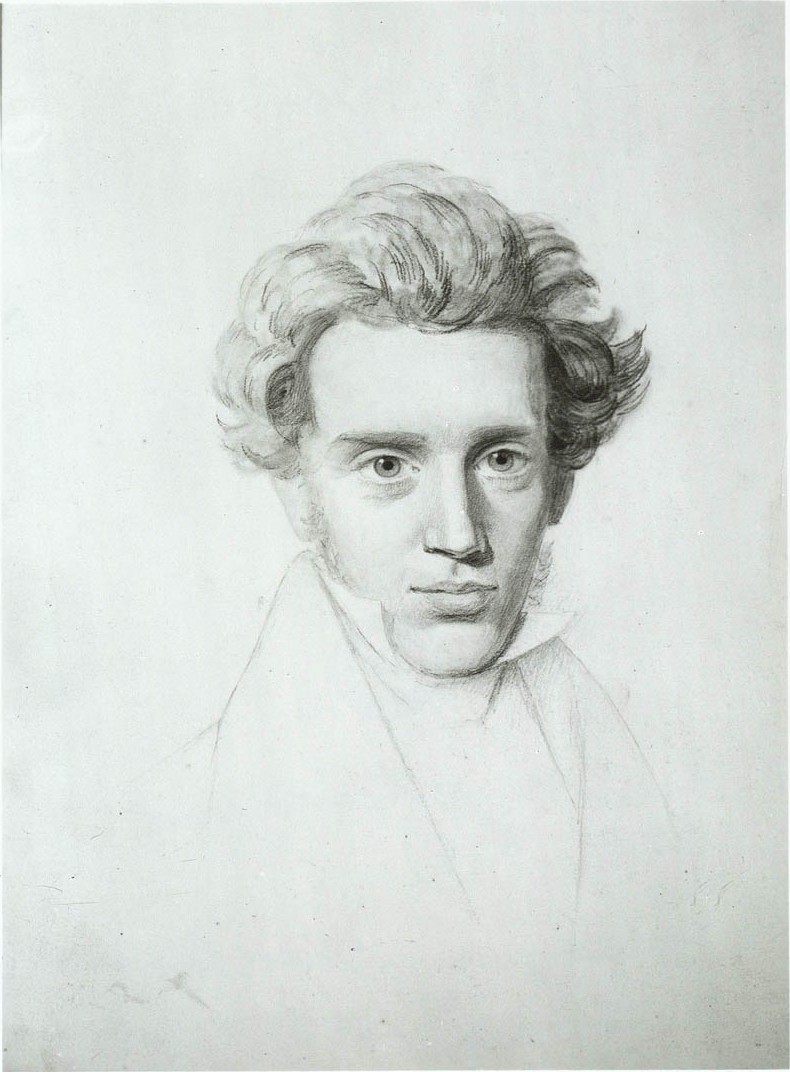

N. C. Kierkegaard, portrait of Søren Kierkegaard, pencil drawing c. 1840, photograph held by the Royal Danish Library (ke007311), public domain · Pencil portrait drawing made about 1840 by the draughtsman and lithographer N. C. Kierkegaard (1806-1882), reproduced in a photograph held by the Royal Danish Library (library id ke007311) and shared on Flickr Commons. The scan (940 x 1,294 pixels) was cropped to the drawing and not resampled; nothing was upscaled. No lettering appears on the sheet, so the sitter is identified by the library's title and catalogue description. Caveat: the date of the library's reproduction photograph is not recorded; the basis is the age of the underlying drawing (draughtsman died 1882). · Public domain (drawing c. 1840 by an artist who died in 1882; Royal Danish Library, no known copyright restrictions)
철학자 · 19세기
쇠렌 키르케고르
1813–1855
주요 업적 분야
아직 성격 매칭에 포함되지 않았습니다 — 기록된 근거가 성격 모델 전체를 다루기에는 충분하지 않습니다. 이 페이지의 다른 모든 내용은 자유롭게 확인하실 수 있습니다.
핵심 특성
주요 업적
그는 1843년부터 1846년까지 『이것이냐 저것이냐』, 『공포와 전율』, 『철학적 단편』, 『불안의 개념』, 『결론으로서의 비학문적 후서』 등을 가명으로 펴내 개인으로서 존재한다는 것이 무엇인지를 탐구했으며, 브리태니커는 그를 20세기 실존주의와 개신교 신학에 큰 영향을 준 인물로 평가한다.
그는 저마다 다른 세계관을 대변하는 여러 가명으로 글을 썼고, 아이러니와 풍자, 이른바 간접 전달의 방법으로 독자가 삶의 문제에 스스로 맞서도록 이끌었다.
1847년부터 이어진 두 번째 집필기에 그는 『사랑의 역사』와 『죽음에 이르는 병』 등에서 기독교 신앙의 요구를 제시했고, 1854~55년에는 직접 창간한 소책자 『순간』으로 덴마크 국교회를 공격했다.
삶의 장면들
1843년 가명으로 『이것이냐 저것이냐』를 낸 뒤에도 그는 자신의 저작이 계속 가명 저자의 것으로 불려야 한다고 고집했는데, 브리태니커는 이 가명들을 서로 다른 세계관을 구현하는 소설 속 인물에 비유해 이해해야 한다고 설명한다.
이는 저술 방식에서 독창적이고 관습에 얽매이지 않는 접근과 일치한다. 창의적 독창성
풍자 잡지 『코르사르』의 조롱 대상에서 제외되어 있던 그는 이 잡지를 공개적으로 도발했고, 이후 잡지는 연이어 그를 공격했다. 인터넷 철학 백과는 언론에 대한 그의 비판과 함께 허영심도 부분적 이유로 든다.
이는 공개적인 대립을 피하지 않고 스스로 시작하는 태도와 일치한다. 갈등 감내
전환점
1846년 『결론으로서의 비학문적 후서』로 저술을 마무리하려 했던 그는 목사가 되는 대신 저술가로 남았고, 스탠퍼드 철학 백과는 이후를 『사랑의 역사』와 『죽음에 이르는 병』 등을 낳은 매우 왕성한 두 번째 집필기로 설명한다.
이는 저술가로서 여러 해에 걸쳐 많은 분량의 작업을 이어 가는 모습과 일치한다. 자기 규율
비슷한 인물
전체적인 프로필이 이 사람과 닮은 사람들이에요.
출처
- Søren Kierkegaard (Q6512), verified live via the Wikidata API (2026-11-06): label 'Søren Kierkegaard', description 'Danish theologian, philosopher, poet and social critic (1813-1855)', born 5 May 1813, died 11 November 1855, Korean label 쇠렌 키르케고르. Orientation only; not used as support for any row.
- Stanford Encyclopedia of Philosophy, 'Søren Kierkegaard' (Life and Works section and the section on trajectories in Kierkegaard scholarship read in full, about 3,500 words). CANONICAL SIGNIFICANCE SOURCE: gives the two periods of his authorship (Either/Or, Fear and Trembling, Philosophical Fragments, The Concept of Anxiety, Concluding Unscientific Postscript, 1843-46; Works of Love, The Sickness Unto Death, Practice in Christianity, 1847-50), the pseudonymous and signed texts, the Corsair controversy, the 1854-55 attack on the Danish state church in The Moment, and the contrast between Lowrie's devotional and Garff's critical biographies; also reports that Jon Stewart's work shows his Hegel targets were largely Danish Hegelians.
- Internet Encyclopedia of Philosophy, 'Søren Kierkegaard' (introduction, life sections on the early pseudonymous articles, the first authorship and the Corsair read, about 3,500 words). Independent scholarly account listing the range of his authorship (aesthetic novels, psychology, dogmatics, satirical prefaces, literary reviews, edifying discourses, polemics) and a deliberately sceptical reading of motive: says he provoked the Corsair partly out of vanity. Passages on his family and inner life were read but are not used.
- Encyclopaedia Britannica, 'Søren Kierkegaard' (public-web portion read in full, about 2,000 words; the remainder is behind a paywall and was not opened). General-encyclopedia account: major influence on existentialism and Protestant theology, the 1843-46 and 1847-55 periods of writing, the pseudonyms as authors who embody distinctive worldviews, and the Corsair and church collisions.
- Times Higher Education, 'A genius who spat globs of venom', review of Joakim Garff's Søren Kierkegaard: A Biography by John Lippitt (21 October 2005; read in full, about 1,500 words). COUNTER-VOICE: independent critical review that describes his stubbornness as the dark side of his integrity, faults the biography where it speculates, and says the venom of his 1855 attack on the church makes it hard not to sympathise with the pastors; reports a secretary's account of taking dictation from a prolific employer. The reviewer's discussion of speculation on illness is not used.
- The Christian Science Monitor, 'Kierkegaard's tortured faith', review of Garff's biography by Heller McAlpin (1 March 2005; read in full, about 1,700 words). Independent press review: describes him as choosing an iconoclastic, individual path often at odds with the institutions of his day, and as channelling his energies into a voluminous outpouring of polemical prose; sets out his view that truth must be internalised. Remarks on his private life are not used.
- Danish Agency for Culture press release, 'The Original Papers of Søren Kierkegaard in a Unique Exhibition' (Royal Library, Copenhagen, 'The Original Kierkegaard', 23 April to 28 September 2013; read in full, about 250 words). Institutional account of the archive of his papers (UNESCO Memory of the World list, 1997) and a summary of his output: pseudonymous works in layered fictional voices, works under his own name, and the manuscripts showing how his ideas took shape, 'highly productive' in a short life.
- Royal Danish Library (Flickr Commons), 'Søren Kierkegaard (1813-1855)', photograph of a pencil drawing made about 1840 by N. C. Kierkegaard (1806-1882), library id ke007311; holder record read (title, description, 'No known copyright restrictions'). Holder record for the portrait.