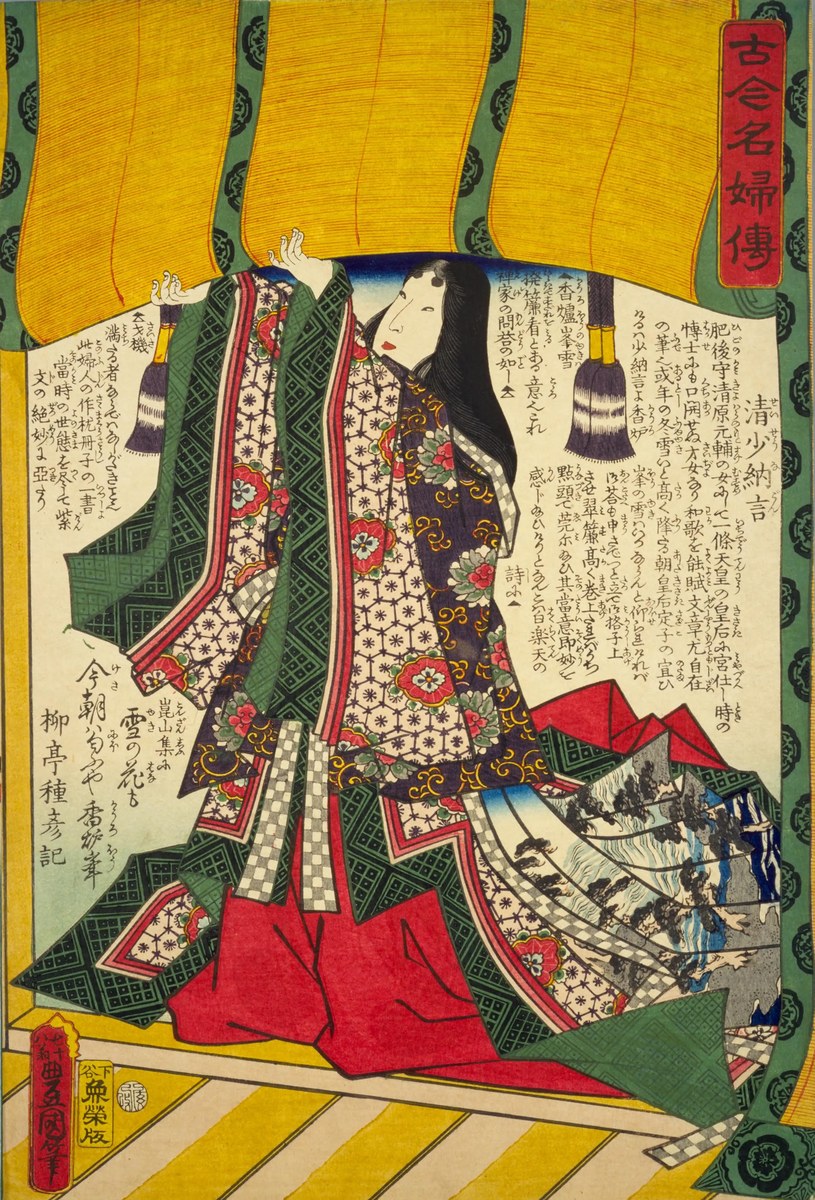

Utagawa Kunisada (Toyokuni III), Kokin meifu den: Sei Shonagon, 1863. National Diet Library, Japan, digital collections, public domain · Kokin meifu den: Sei Shonagon ('Biographies of Famous Women, Ancient and Modern'), colour woodblock print by Utagawa Kunisada (Toyokuni III), published 1863 by Uoei with text by Ryutei Tanehiko, in the National Diet Library, Tokyo (call number Yose-betsu 2-7-1-4, persistent ID 1304224). The print's cartouche and text name her and show her lifting the blind in the snow episode of the Pillow Book; it is an idealised image made about 850 years after her life, not a likeness. The file is a crop of the library's 4096 x 6144 scan (colour chart and ruler removed), downscaled to 815 x 1200 with no upscaling. · Public domain (the library's item record carries the Public Domain Mark; the artist died in 1865)
작가 · 중세
세이 쇼나곤
966–1025
헤이안 시대 일본
주요 업적 분야
아직 성격 매칭에 포함되지 않았습니다 — 기록된 근거가 성격 모델 전체를 다루기에는 충분하지 않습니다. 이 페이지의 다른 모든 내용은 자유롭게 확인하실 수 있습니다.
주요 업적
993년경부터 1000년까지 헤이안 궁정에서 황후 데이시를 모시며 『마쿠라노소시』를 썼고, 이 책은 독창적인 산문 문체로 일본 고전문학의 걸작으로 평가받는다.
『마쿠라노소시』는 생생한 회고와 '짜증나는 것' 같은 목록 항목을 섞어 놓은 책으로, 헤이안 시대 궁정 생활에 관한 가장 좋은 자료로 꼽힌다.
시인 집안에서 태어난 시인으로, 헤이안 중기 36가선의 한 사람으로 꼽히며 그녀의 와카 한 수가 오구라 백인일수 62번에 실려 있다.
삶의 장면들
두견새 소리를 들으러 간 나들이 뒤 황후가 시를 지으라고 재촉하자, 그녀는 내킬 때만 시를 짓겠으며 계속 즉석에서 지으라고 하면 모시기를 그만두겠다고 말했고, 황후는 웃으며 좋을 대로 하라고 했다.
이는 자신의 작업을 언제 어떻게 할지 스스로 정하려는 태도와 일치한다. 자율성 욕구
황후가 누군가의 재채기를 두고 그녀의 말이 진심이 아니라고 놀리자, 그녀는 이튿날 아침 다른 사람의 코 때문에 마음이 얕다는 소리를 듣게 되었다는 말장난 가득한 시로 답했다.
이는 궁정 사람들 앞에서 곧바로 응수하는 태도와 일치한다. 사회적 적극성
전환점
996년 그녀는 몇 달 동안 황후의 시중에서 물러나 집에 머물렀고, 헤이본샤 백과사전은 이때 『마쿠라노소시』의 초기 형태를 쓰기 시작했을 것으로 본다. 그 뒤 그녀는 황후 곁으로 돌아갔다.
이는 떨어져 지내야 했던 시기를 독자적인 글쓰기의 출발점으로 삼은 모습과 일치한다. 창의적 독창성
비슷한 인물
전체적인 프로필이 이 사람과 닮은 사람들이에요.

코코 샤넬

세쿼야

볼프강 아마데우스 모차르트

듀크 엘링턴

마크 트웨인
출처
- Sei Shonagon (Q231603), verified live via the Wikidata API (2026-11-04): English label 'Sei Shonagon' (with macron), description 'Japanese author and court lady', Korean label 세이 쇼나곤, birth 966 and death 1025 (year precision), image a Tosa Mitsuoki portrait. Orientation only; not used as support for any row.
- Encyclopaedia Britannica, 'Sei Shonagon' (article body of about 300 words read in full from the public page). CANONICAL SIGNIFICANCE SOURCE: a diarist, poet and courtier born about 966 and died about 1025 whose Pillow Book (Makura no soshi) 'exhibits a brilliant and original Japanese prose style and is a masterpiece of classical Japanese literature' and 'is also the best source of information on Japanese court life in the Heian period'; daughter of the poet Kiyohara Motosuke; in the service of the empress Teishi (Sadako) at Heian-kyo from about 993 to 1000; little is known of her life outside court; the book mixes memoirs with categories such as 'Annoying Things'; its 'sensitive descriptions of nature and everyday life' and 'detached, sometimes caustic, value judgments'; her wit won her place and also enemies, according to Murasaki Shikibu's diary, which called her conceited; the legend of a miserable old age 'is likely an invention'. Scholarly reference; its praise is retrospective.
- Arthur Waley, introduction ('Japan in the Tenth Century') and closing essay in 'The Pillow-Book of Sei Shonagon' (Boston: Houghton Mifflin, 1929; Internet Archive scan of the text, the lines on her family, service at court, the months away in 996, the Empress's death, Murasaki's remark, the later legends, and the closing character assessment all read). The translator-scholar's independent assessment: the book is 'a plain record of fact' and 'the most important document of the period that we possess'; she entered the Empress's service about 991 and the book deals with 991 to 1000; he calls her 'incomparably the best poet of her time' in her prose, with 'delicate precision of her perceptions' and 'extraordinary power of conveying character'; says her learning is known only from her own book and has been exaggerated, that it was 'her extreme readiness of wit rather than her erudition' that is remarkable; describes a character of contradictions, 'extreme fastidiousness and irritability', behaviour 'calculated to inspire fear rather than affection', and a 'detachment about herself'. Note: Waley's 1929 judgements and some dates differ from later scholarship (the Heibonsha entry dates her service from 993).
- The Pillow-Book of Sei Shonagon (Makura no soshi, written in the years around 1000), in Arthur Waley's 1929 selection of about a quarter of the work (episodes read: her first night in the Empress's service and the sneeze episode, the cuckoo excursion and her refusal to be pressed to compose poems, the evening Korechika and the Empress asked her to take a theme, the months away from the Empress in 996 and the azalea-petal letter). SELF-REPORT: she is the author of every episode; the sources below are used to check or balance it. The Waley volume is a selection, not the whole book.
- The Diary of Lady Murasaki (Murasaki Shikibu nikki, about 1008-1010), translated by Annie Shepley Omori and Kochi Doi in 'Diaries of Court Ladies of Old Japan' (1920; Project Gutenberg text read, the character-sketches passage on court women including Sei Shonagon and the translator's notes). A contemporary and rival-court voice: Murasaki calls her 'a very proud person' who 'values herself highly, and scatters her Chinese writings all about', says 'should we study her closely, we should find that she is still imperfect', that she 'tries to be exceptional' and gives offence, and predicts a bad end. Hostile and personal; used only as the counter-voice, not for private-life inference. The translator's editorial notes in the volume are not used.
- Kotobank (Japanese reference aggregator) entry for Sei Shonagon, reproducing four Japanese reference works: Shogakukan's Digital Daijisen, the Nihon Kokugo Daijiten, Heibonsha's World Encyclopedia (entry by Hagiya Haku) and Shogakukan's Nipponica (entry by Ueno Osamu), read in the original Japanese. They record service with Empress Teishi from about 993, membership among the thirty-six poetic immortals of the middle Heian period, the reputation she won for the snow-of-Koro-ho exchange in the winter of 994, a long stay at home in 996 during which the first form of the Pillow Book was probably begun (Hagiya), the later completion of the surviving text, that she asked the Empress to excuse her from composing poems, left only about 55 poems of her own, and withdrew after the Empress's death; the Nipponica entry notes the Murasaki diary's criticism of her learning and her taste for being different, and that later stories of destitution are probably untrue. Japanese scholarly reference, independent of Waley's selection.