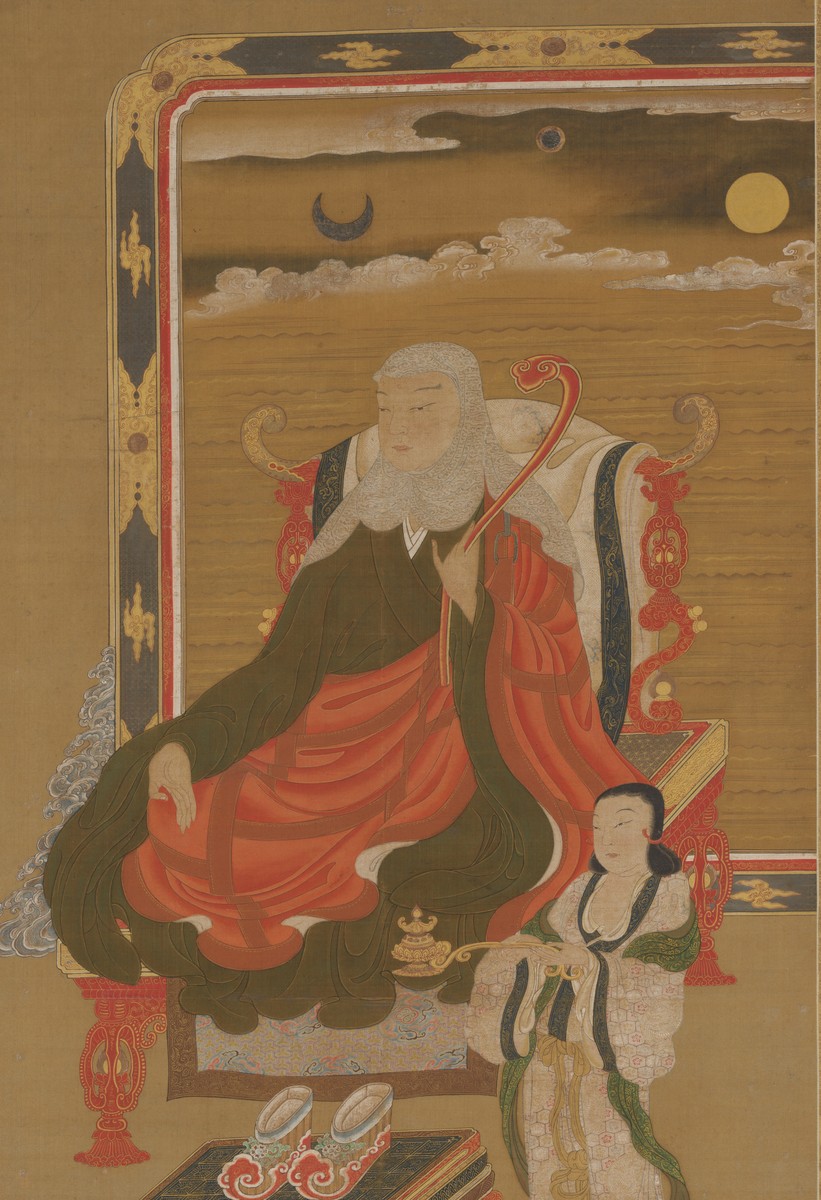

Portrait of Dengyo Daishi (Saicho), Japan, Edo period, early 18th century, hanging scroll; The Metropolitan Museum of Art, Mary and Cheney Cowles Collection, Gift of Mary and Cheney Cowles, 2020, accession 2020.396.6 (Open Access) · Hanging scroll 'Portrait of Dengyo Daishi (Saicho)', Japan, Edo period (1615-1868), early 18th century, ink, color and gold on silk, artist unidentified, The Metropolitan Museum of Art, New York, Mary and Cheney Cowles Collection, Gift of Mary and Cheney Cowles, 2020 (accession 2020.396.6). The Met's Open Access API record (object 845127) marks it as public domain; the file is the figure and attendant cropped from the museum's 2368 x 4000 pixel image (mounting removed) and downscaled to 821 x 1200 pixels, with no upscaling. · Public domain (The Metropolitan Museum of Art Open Access, API field isPublicDomain true; a painting of the early 18th century)
종교 지도자 · 중세
사이초
767–822
주요 업적 분야
아직 성격 매칭에 포함되지 않았습니다 — 기록된 근거가 성격 모델 전체를 다루기에는 충분하지 않습니다. 이 페이지의 다른 모든 내용은 자유롭게 확인하실 수 있습니다.
핵심 특성
주요 업적
일본 천태종을 세운 승려이다. 804~805년 중국 천태산에서 공부한 뒤 히에이산에 천태종을 열었고, 간무 천황은 그의 암자를 엔랴쿠지로 만들어 주었다. 천태 연구와 밀교 수행을 함께 닦는 교과 과정을 두었고 806년부터 해마다 득도자 2명을 허가받았다.
일본인은 보살계만 받으면 충분하다고 주장하며 히에이산에 독립된 대승 계단을 세우려 했지만, 청원은 거듭 거부되었고 허가는 822년 그가 세상을 떠난 지 일주일 뒤에 내려졌다. 또 법상종의 도쿠이쓰와 모든 중생이 성불할 수 있는가를 두고 논쟁했다.
그가 세운 엔랴쿠지는 이후 4세기 동안 일본의 대표적인 승려들을 길러냈다. 제자로는 중국에 함께 간 기신과 훗날 이곳의 주지가 된 엔닌이 있으며, 그는 중국에서 가져온 문헌을 『에슈로쿠』로 정리했다.
삶의 장면들
그는 여러 해 동안 구카이에게 문헌을 빌려 달라고 청해 구카이가 들여온 목록의 거의 절반을 베껴 썼다. 구카이에게 보낸 현존 편지 24통 가운데 11통이 문헌의 대여와 필사에 관한 것이고, 811년에는 관정을 받게 해 달라고 청했다.
이는 자신과 종단을 위해 더 많은 가르침을 구하려 한 지도자의 모습과 일치한다. 숙련 지향
도쿠이쓰가 천태의 불성론을 비판하는 논서를 쓰자 사이초는 세 편의 저작으로 응답했고, 계단 설립 청원이 거절되는 와중에도 청원을 이어 갔다.
이는 반대에 부딪혀 물러서지 않고 글과 청원으로 대응한 사람의 모습과 일치한다. 끈기
전환점
804년 중국으로 건너갔는데 배가 항로를 벗어나 천태산에서 공부하게 되었다. 이듬해 문헌과 밀교 관정을 받아 돌아왔고, 806년 조정은 해마다 천태종 득도자 2명을 허가했다.
이는 히에이산의 은둔 수행자에서 독자적인 교과 과정을 지닌 종단의 창시자로 바뀐 궤적과 일치한다. 주도 성향
비슷한 인물
전체적인 프로필이 이 사람과 닮은 사람들이에요.
출처
- Saichō (Q449943), verified live via the Wikidata API (2026-11-05): English label 'Saichō', description 'Japanese Buddhist monk, founder of the Japanese Tendai school', Korean label 사이초, born 15 September 767, died 26 June 822, citizenship Japan. Orientation only; not used as support for any row.
- Tendai Buddhist Institute (Tendai Buddhist Institute / Tendai tradition website), page 'Tendai in Japan', read through a summarising fetch (English): CANONICAL SIGNIFICANCE SOURCE: Saichō (767-822) ordained at Todaiji in Nara, withdrew to a hermitage on Mount Hiei, was sent to China in 804, studied on Mount Tiantai and received esoteric initiation, returned to teach the One Vehicle reading of the Lotus Sutra and to perform esoteric rituals for the court; Emperor Kanmu turned his hermitage into Enryakuji; the Tendai curriculum had a Tendai track and an esoteric track; Nara scholars such as Tokuitsu objected to his claim that all beings can attain Buddhahood; he sought autonomy from Nara and argued for the Mahayana precepts in his Kenkairon but died before the goal was reached; disciples Gishin and Ennin carried the school on. A sectarian institutional page, hedged with 'it is said' on some details.
- 'Saichō', entry in The Princeton Dictionary of Buddhism (Princeton University Press, 2014, page 737) as reproduced on the Tsadra Foundation's Buddha-Nature site, read in full (English): a scholarly dictionary entry on his birth, ordination in 785, the hermitage and the permanent temple on Mount Hiei (788), his 804 journey to Mount Tiantai with Gishin and nine and a half months in China, the Esshuroku catalogue of texts, the 806 permission for two annual Tendai ordinands, the souring of relations with Kukai after a close disciple left him, the prolonged debate with the Hosso monk Tokuitsu (with Saichō's replies Shogonjikkyo, Hokke kowaku and Shugo kokkaisho), the campaign for an independent Mahayana ordination platform (petitions repeatedly denied, permission granted a week after his death) and the naming of Gishin as successor. It notes that the exact birth place and dates are debated.
- David L. Gardiner, 'Saichō', Encyclopedia of Buddhism entry as reproduced by Encyclopedia.com, read through a summarising fetch (English): a short scholarly entry recording that he began study and meditation on Mount Hiei in 785, built Enryakuji, which trained leading Japanese Buddhist monks for the next four centuries, wanted to purify and strengthen Buddhist practice, proposed that Tendai monks be exempt from ordination at Nara and proposed a Mahayana ordination centre on Mount Hiei, and that his criticism of the Nara schools, especially Hosso, drew strong opposition; the centre was built shortly after his death. It does not cover the China trip, the Tokuitsu debate or Kukai.
- Ryuichi Abe, 'Saicho and Kukai: A Conflict of Interpretations', Japanese Journal of Religious Studies 22/1-2 (1995), pages 103-137 (English), downloaded as a PDF and read for the first half and the passages on the break with Kukai (not read to the end): a scholarly reappraisal based on Saichō's surviving letters, the Kenkairon engi and Kukai's letters. It reports that Saichō's encounter with esoteric Buddhism in China was largely accidental and his exposure limited, that in 805 Kanmu praised the esoteric texts he brought back, that the 806 edict gave Tendai two annual ordinands for a Tendai track and an esoteric track, that he borrowed and copied texts from Kukai (eleven of the twenty-four surviving letters to Kukai concern loans and copying, and he copied nearly half of the texts in Kukai's catalogue), asked in 811 to receive an initiation, appointed Encho and Taihan as successors in 812 when seriously ill, returned to Mount Hiei despite Kukai's repeated requests to resume study, and that Kukai finally rebuked him in a letter for violating the esoteric pledge and for attachment to writing, to which Saichō retorted by denouncing Kukai's way of instruction. Abe is a critical scholar who argues against the idealised founder accounts.
- The Metropolitan Museum of Art, Open Access API record for object 845127, 'Portrait of Dengyo Daishi (Saicho)', Japan, Edo period, early 18th century, hanging scroll, ink, color and gold on silk (accession 2020.396.6; isPublicDomain true). Opened for the portrait only.