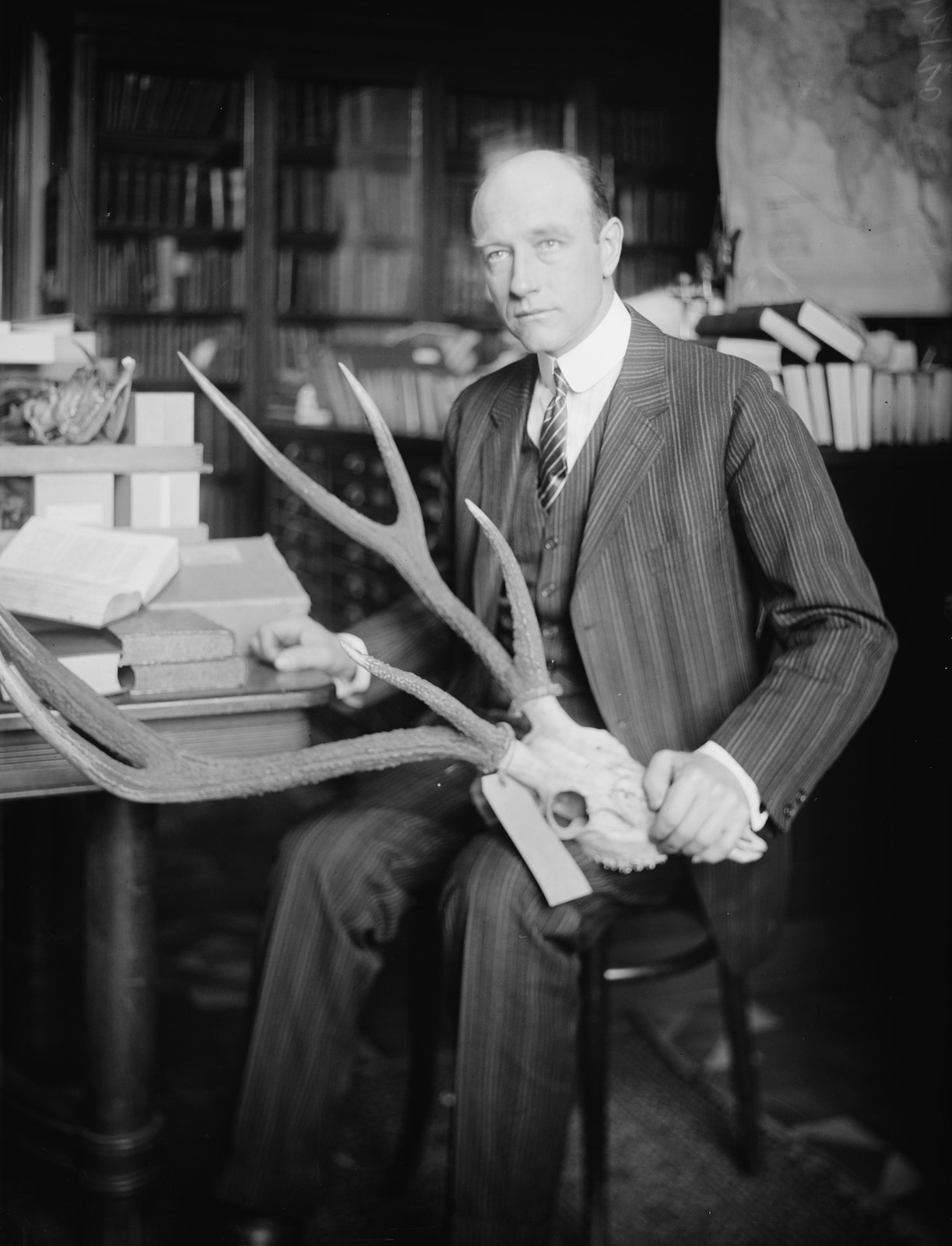

Bain News Service, publisher; George Grantham Bain Collection, Library of Congress; LCCN 2014719636 · Library of Congress, Prints and Photographs Division, George Grantham Bain Collection, LC-DIG-ggbain-50488 (Bain News Service glass negative), via Wikimedia Commons · Public domain (Bain News Service negative; Library of Congress: no known restrictions on publication)
핵심 특성
주요 업적
앤드루스는 1922년부터 1930년까지 미국자연사박물관의 중앙아시아 탐사대를 다섯 차례 이끌고 몽골과 중국 북부로 들어갔으며, 낙타 대상(隊商)이 연료와 물자를 대는 자동차로 고비 사막을 누볐다. 1925년 탐사대에는 과학자와 기술자 14명, 조수 26명, 자동차 5대, 트럭 2대, 낙타 125마리가 포함되었고 비용은 70만 달러에 가까웠다. 탐사의 목적은 인류가 아시아에서 기원했다는 헨리 페어필드 오즈번(Henry Fairfield Osborn)의 생각을 검증하는 것이었으나 인류 화석은 나오지 않았다. 대신 포유류와 공룡 화석을 대량으로 수집했고, 서구 학계에 거의 알려지지 않았던 지역의 지도와 지질 조사를 남겼다.
1923년 7월 고비 사막의 플레이밍 클리프스(Flaming Cliffs)에서 조지 올슨(George Olsen) 등 탐사대원들이 공룡 알을 발견했다. 이는 과학적으로 공룡 알로 인정된 최초의 사례로 널리 소개된다. 1859년 프랑스에서 발견된 알 껍데기는 거대한 새의 알로 여겨졌다. 같은 곳에서 앤드루스의 이름을 딴 프로토케라톱스(Protoceratops)가 1923년에 명명되었고, 소형 수각류인 벨로키랍토르(Velociraptor)와 오비랍토르(Oviraptor)는 1924년 오즈번이 명명했다. 이 알들은 처음에 프로토케라톱스의 것으로 여겨졌으나, 1993년 우하 톨고드(Ukhaa Tolgod)의 비슷한 둥지에서 배아가 발견된 뒤 오비랍토르류의 것으로 바뀌었다.
아시아 탐사에 앞서 앤드루스는 박물관에서 고래를 연구했다. 그는 한국, 일본, 알래스카 등에서 여러 고래 종을 조사하고 골격을 수집했으며, 1913년 컬럼비아 대학에서 고래를 주제로 석사 학위를 받았다. 캘리포니아 회색고래에 관한 그의 연구서는 1914년 박물관 회보(Memoirs)에 실렸고, 1916년에는 『총과 카메라로 하는 고래 사냥』이 나왔다.
앤드루스는 『고대인의 자취를 따라』(1926), 『중앙아시아의 새로운 정복』(1932), 어린이용 『공룡 이야기』(All About Dinosaurs, 1953) 등 20권이 넘는 책을 펴냈으며, 마지막 책은 훗날 고생물학자 필 커리(Phil Currie)와 마이크 노바첵(Mike Novacek)에게 영감을 주었다. 그는 1930년대 중반 미국자연사박물관의 관장이 되었고 1941년 말 무렵 자리에서 물러났다.
삶의 장면들
1923년 공룡 알이 신문 머리기사를 장식하자, 모금을 위해 뉴욕에 돌아와 있던 앤드루스는 오즈번에게 알 하나를 경매에 부치자고 제안하고, 기자들에게 소액 기부도 환영한다고 독자에게 알려 달라고 부탁했다. 그의 설명에 따르면 오스틴 콜게이트(Austin Colgate)가 콜게이트 대학에 기증할 목적으로 5천 달러에 알을 샀고, 기부금이 약 5만 달러 더 들어왔다. 훨씬 높은 값에 팔렸다는 소문을 들은 몽골과 중국 당국은 상업적 동기를 의심하기 시작했고, 다음 탐사는 1년 넘게 미뤄졌다. 앤드루스는 훗날 이 경매를 부메랑이었다고 평했다.
발견의 화제성을 곧바로 모금과 연결한 일은 기회 포착과 부합한다. 여러 출처는 같은 조치가 탐사에 허가가 필요했던 정부들의 호의를 잃게 했다는 점도 함께 전한다. 기회 감지
앤드루스의 설명에 따르면 그는 1920년 오즈번과의 점심 자리에서 오즈번의 아시아 기원설을 검증할 고비 사막 탐사를 제안했다. 앞서 러시아 탐사대가 거의 성과를 내지 못했다는 지적에는 낙타로 10년 걸릴 일을 자동차로는 한 시즌에 해낼 수 있다고 답했다. 자동차가 고비 사막을 건널 수 있는지 어떻게 아느냐는 물음에는 알지는 못하지만 철저히 준비하면 가능하다고 믿는다고 했다. 그는 함대의 보급선처럼 낙타 대상이 먼저 물자를 싣고 가 있게 하고, 각자 자급할 수 있는 여러 작업 조를 꾸리는 계획을 설명했다.
핵심 방법이 검증되지 않았음을 인정하면서도 보급 체계를 미리 설계한 점은 계획 지향성과 부합한다. 다만 이 서술은 앤드루스 본인의 것이어서 다듬어진 회고의 성격이 있다. 계획 지향
전환점
1928년 시즌이 끝날 무렵 내몽골에서 수집한 화석 상자 87개가 장자커우(Kalgan)에서 중국의 민족주의 단체인 고물보존위원회에 압수되었다. 이 단체는 미국인들이 중국의 보물을 가져간다고 비난했다. 박물관, 미국 국무부, 중국 정부가 협상한 끝에 표본은 돌려받았다. 앤드루스는 1929년을 협상으로 보냈고, 1930년에는 중국인 과학자 두 명을 데리고 고생물학 조사로만 제한된 마지막 시즌을 치렀으며, 가치 있는 수집품의 절반을 중국 측 단체에 넘겼다. 1930년이 마지막 시즌이 되었다. 중국 학자들은 화석을 국가 유산으로 보았고, 앤드루스는 화석이 인류 전체의 것이라고 주장했다.
프로그램을 곧바로 끝내지 않고 한 시즌을 더 하기 위해 1년 동안 조건을 협상한 점은 끈기와 부합한다. 그 자신은 제한된 조건이 조사를 크게 위축시켰다고 평가했다. 끈기
비슷한 인물
전체적인 프로필이 이 사람과 닮은 사람들이에요.


넬슨 만델라

마틴 루터 킹 주니어

마하트마 간디

무스타파 케말 아타튀르크

모리타 아키오
출처
- Roy Chapman Andrews (Q266266) -- verified live via the Wikidata API (2026-10-05): en label 'Roy Chapman Andrews', description 'American explorer, naturalist, and writer (1884-1960)', born 26 Jan 1884, died 11 Mar 1960, citizenship United States, instance of human, ko label '로이 채프먼 앤드루스', image 'Roy Chapman Andrews 50488r.jpg'. Orientation only; not used as support for any row.
- Wikipedia, 'Roy Chapman Andrews', and 'Timeline of egg fossil research' -- orientation only (dates, the 1859 Pouech eggshell versus the 1923 first scientifically recognised dinosaur eggs, the directorship start year). Not used as support for any scored row.
- Roy Chapman Andrews, Under a Lucky Star: A Lifetime of Adventure (Viking Press, 1943), Internet Archive full text -- SELF-WRITTEN autobiography, entertaining and openly self-presenting; the author's own account of the 1906 museum job, the 1920 Osborn lunch, the Gobi expeditions, the 1923 egg auction, the 1928 seizure and the directorship. Read the chapters on those episodes in full; the rest (whaling, China travel, later life) was skimmed. Never used as the sole basis for a scored row.
- Palaeontologia Electronica, review of Charles Gallenkamp, Dragon Hunter: Roy Chapman Andrews and the Central Asiatic Expeditions (Viking, 2001), 31 January 2002 -- paleontology-journal book review (non-self, broadly admiring of the book); describes the car-plus-camel-caravan method, Andrews's talent for fundraising and for organising expeditions, his own admission that he was not a great scientist and disliked laboratory work, and the later revision of the egg identification. Read in full. The biography itself (a lending-only book) was NOT read.
- Kirkus Reviews, review of Charles Gallenkamp, Dragon Hunter (2001) -- CRITICAL review (non-self): finds the expeditions failed in their original aim of showing Asia to be the cradle of mankind, objects to the biography's uncritical hero-worship and to Andrews's condescension toward the Chinese. Read in full; used for the critical perspective, not for a scored row.
- 'The Original Indiana Jones', review of Charles Gallenkamp, Dragon Hunter, Jack's Stack column, March 2003, Dry Dredgers (Cincinnati amateur paleontology society) -- non-self hobbyist review that summarises the biography's account of the 1905 job, the Philippine island episode, the New York fundraising, the egg auction and its fallout, and that Andrews repeated and embellished stories from book to book. Read in full.
- Michon Scott, 'Roy Chapman Andrews', Strange Science (Rocky Road page), drawing on Douglas Preston, Dinosaurs in the Attic, and on Lukas Rieppel and Yu-chi Chang -- non-self popular history that is critical in places: expedition cost and size, the fundraising arrangements, the egg auction and Mongolian suspicion of it, Granger as the 'real star' in some historians' view, Andrews's reputation for damaging fossils, a 1945 book that repeated period racial views, and his unease as director. Read in full. Several of its anecdotes (the 'RCA'd' fossils, the quip about water) are unattributed retellings and are used only at inference level.
- Madison Paige, 'Roy Chapman Andrews (1884-1960)', Embryo Project Encyclopedia, Arizona State University (2015) -- neutral academic encyclopedia entry (non-self): whale work, the 1923 Flaming Cliffs eggs, the Protoceratops assignment, the egg auction and the Chinese reaction, directorship and resignation, books. Read in full.
- Madison Paige, 'Oviraptor philoceratops Dinosaurs', Embryo Project Encyclopedia, Arizona State University (2015) -- neutral entry (non-self) on the Oviraptor skeleton found over the nest in 1923, Osborn's 1924 'egg thief' reading, and the 1993 Ukhaa Tolgod embryo (Norell and colleagues, 1994) that reassigned the Flaming Cliffs eggs. Read in full.
- Linda Hall Library, 'Scientist of the Day: Walter Granger' (6 September 2022) -- institutional history note (non-self) on the chief palaeontologist and second-in-command of the expeditions, listing Velociraptor, Protoceratops, Oviraptor and Baluchitherium finds and the first dinosaur eggs found in place, and citing Edwin Colbert on Granger's standing with the team in contrast to 'Andrews the showman'. Read in full; Colbert's book itself was not read.
- J. W. Gregory (geologist), review of Andrews, On the Trail of Ancient Man, Nature 119, 521-522 (9 April 1927) -- contemporary independent scientific review (abstract page only; the full review is paywalled and was not read): records the expeditions' funding, the Osborn hypothesis they set out to test, and the eggs as the most dramatic find.
- Charles Gallenkamp (Andrews's biographer), editorial introduction to Andrews's 'The Fate of the Rash Platybelodon', Natural History magazine, March-April 1931 (online 'Picks from the Past') -- biographer's summary of the five expeditions (1922-1930): budget of nearly $700,000, the 1925 party of fourteen scientists and technicians, twenty-six assistants, five cars, two trucks and 125 camels, the 1928 confiscation of eighty-seven crates by the Committee for the Preservation of Ancient Objects, and the end of the programme after 1930. Read the introduction; the Andrews article was only skimmed.
- University of California, Santa Cruz Center for Cultural Studies, announcement and abstract of Lukas Rieppel (Brown University historian of science), 'Locating the Central Asiatic Expedition' (talk, 5 February 2020), the basis of Rieppel and Yu-chi Chang, 'Locating the Central Asiatic Expedition: Epistemic Imperialism in Vertebrate Paleontology', Isis 114 (2023) -- scholarly CRITICAL perspective (abstract only: Chinese intellectuals accused the Americans of plundering national heritage, while Andrews argued that fossils older than China belong to all mankind). The Isis article itself is behind a bot-check wall and was NOT read or bypassed.