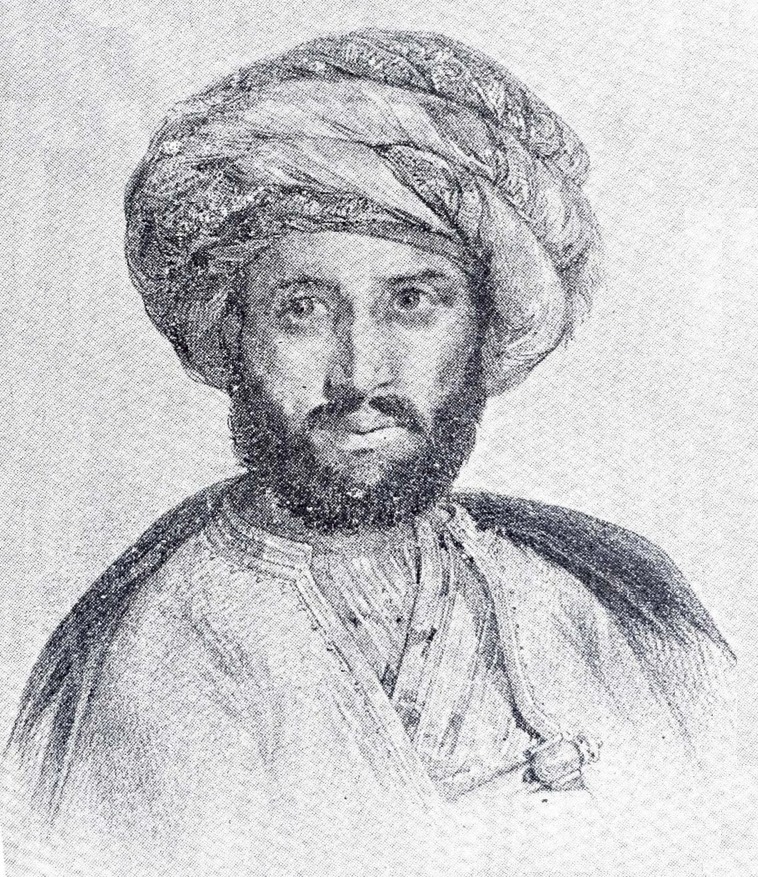
Anonymous, portrait drawing of Rifa'a al-Tahtawi, printed in Jurji Zaydan, Tarajim Mashahir al-Sharq vol. 2 (Cairo, 1922); public domain · Anonymous drawing of Rifa'a al-Tahtawi in Arab dress, artist and date unknown. The same drawing is printed as plate 3 (captioned 'Rifa'a Bey Rafi' al-Tahtawi') in Jurji Zaydan's Tarajim Mashahir al-Sharq, volume 2, third edition (Cairo: Matba'at al-Hilal, 1922), Internet Archive scan from the Bibliotheca Alexandrina (item AAlexandrina-084569), where the text calls it his portrait; that 1922 print is the verified publication basis. The file is the clearer Wikimedia Commons scan of the same drawing ('Rifa'a el-Tahtawi.png', which its uploader attributes to a 1912 edition of his Manahij al-Albab), converted to JPEG on a white background at its original 758 x 877 pixels, not upscaled. · Public domain (anonymous drawing published in 1922, before 1931)
학자 · 19세기
리파아 알타흐타위
1801–1873
주요 업적 분야
아직 성격 매칭에 포함되지 않았습니다 — 기록된 근거가 성격 모델 전체를 다루기에는 충분하지 않습니다. 이 페이지의 다른 모든 내용은 자유롭게 확인하실 수 있습니다.
핵심 특성
주요 업적
그는 1835년부터 이집트의 언어학교(알순 학교)를 이끌며 교과를 역사, 지리, 수학, 법으로 넓혔고, 이후 번역국을 이끌어 학생과 직원이 프랑스어 저작을 아랍어로 옮기도록 했다.
그는 1826년 무함마드 알리의 유학생단의 이맘으로 파리에 가서 프랑스 체류기 《타클리스 알이브리즈》를 썼고, 이 책은 이집트에서 출간되어 19세기 프랑스에 관한 초기 아랍어 여행기의 하나가 되었다.
그는 관보 《알와카이 알미스리야》를 편집했고 1870년부터는 학교 잡지 《라우다트 알마다리스》를 편집했으며, 1872년에는 소녀와 소년의 교육에 관한 논고를 썼고, 1850년에는 하르툼에 학교를 세웠다.
삶의 장면들
그는 1265년(이슬람력)에 말트브룅의 지리서 한 권을 60일 만에 번역했으나, 전기 작가 자이단은 이 번역이 서둘러 이루어진 것으로 보인다고 덧붙인다.
작업 속도가 빨랐고 전기 작가가 그 때문에 완성도가 떨어졌다고 본 것과 부합하지만, 하나의 초기 전기에 의존한다. 실행 속도
1850년 언어학교가 폐쇄되고 하르툼으로 보내진 뒤에도 그는 그곳에 학교를 세우고 4년 동안 페늘롱의 《텔레마크》를 비롯한 번역을 마무리했다.
강제된 이동 속에서도 교육과 번역 일을 이어 간 것과 부합하지만, 폐쇄와 재배치는 통치자의 결정이었다. 끈기
전환점
1826년부터 파리에서 유학생단의 이맘으로 지내던 그는 스스로 프랑스어 공부를 시작하고 역사, 지리 등 근대 학문을 공부했으며, 이는 1831년 귀국 후 번역가이자 교사로서의 경력으로 이어졌다.
서양 학문에 대한 자발적인 호기심과 부합하지만, 그란은 아즈하르와 타흐타에서의 교육이 이미 그를 준비시켰다고 주장한다. 호기심
비슷한 인물
전체적인 프로필이 이 사람과 닮은 사람들이에요.
출처
- Rifa'a at-Tahtawi (Q981929), verified live via the Wikidata API (2026-11-01): label "Rifa'a at-Tahtawi", description 'Egyptian scholar (1801-1873)', born 15 October 1801, died 27 May 1873, no Korean label, image 'Tahtawi.jpg' (150 x 216). Orientation only; not used as support for any row.
- 'Rifaa et-Tahtavi', TDV Islam Ansiklopedisi (Turkish Religious Foundation Encyclopedia of Islam), read in full in Turkish. CANONICAL SIGNIFICANCE SOURCE: presents him as an Egyptian scholar of language, literature, history and geography and a translator, who studied at al-Azhar (1817-21) under Hasan al-Attar, went to Paris in 1826 as imam of Muhammad Ali's student mission and wrote the Takhlis al-Ibriz about it, directed the School of Languages from 1835 (adding history, geography, mathematics and law to the curriculum; a preparatory school 1841, an accounting school 1845), edited the official gazette al-Waqa'i al-Misriyya from 1841, was sent by Abbas to Khartoum in 1850 to found a school there and returned in 1854, directed the military school 1856-60, and from 1863 headed the revived Translation Bureau and edited the journal Rawdat al-Madaris; lists his translations (geography, logic, geometry, the French Civil Code with a student, Fenelon's Telemaque) and his 1872 education treatise, and says efforts he supported led to a girls' school opened in January 1873. The entry is descriptive, gives no sustained critique, and ties his career closely to the rulers' changing patronage.
- Jurji Zaydan, 'Rifa'a Bey Rafi' al-Tahtawi', in Tarajim Mashahir al-Sharq fi al-Qarn al-Tasi' 'Ashar, vol. 2, third edition (Cairo: Matba'at al-Hilal, 1922), Internet Archive scan from the Bibliotheca Alexandrina (item AAlexandrina-084569), pages 22-25 read as page images in Arabic: an early twentieth-century biography based, as Zaydan says, on Salih Majdi's manuscript biography of Tahtawi; gives his early life, Azhar teaching, appointment as imam of the 1241 AH mission to France, learning French at his own initiative, return in 1247, translation work at the medical, artillery and later other schools, the establishment of the gazette in 1248 AH with his help, the School of Languages opened in 1251 AH and entrusted to him (50 pupils at first, then 250), the Translation Bureau formed in 1258 AH, exile to Khartoum under Abbas I, the military school under Said, the abolition of the schools in 1277 AH and his return to the Translation Bureau and to editing Rawdat al-Madaris until his death in 1290 AH aged 75, and lists his works, noting that he translated one volume of Malte-Brun in sixty days and that the translation was hasty. Earlier-generation admiring biography relying on one manuscript source; the plate of his portrait in the same pages is the portrait review source.
- Peter Gran, 'Tahtawi in Paris', a scholarly essay (open PDF hosted by Ca' Foscari University of Venice, Hitrade project), read in full: argues for a less Eurocentric reading, that his formation owed much to Tahta's culture and the Azhar curriculum rather than only to the French sojourn, that the 'dominant paradigm' leans on his exceptionalism, that his teacher Hasan al-Attar and he 'broke rank' with the Azhar by working for the government and were criticised for it, that his earnings in Paris (250 piasters) were a tenth of a less productive fellow student's (2500), that his mother objected to his going, and that the French loan words and ideas he introduced (citizens' rights, the Copernican view) were less of a rupture than usually claimed. Revisionist counter-voice; the essay is an essay rather than a full archival study and says some of its points are speculation.
- Ines Ait Mokhtar, 'Tahtawi, le pionnier de la Nahda', Les cles du Moyen-Orient (French online magazine; published 2013, updated 2018), read in full in French: summary portrait: Azhar from 1817, Paris 1826-31, Takhlis al-Ibriz ('L'Or de Paris'), direction of the School of Languages and translations of French works (including Montesquieu on the Romans), publication of Arabic classics, exile to Khartoum under Abbas until 1854 where he translated Telemaque; notes he preferred an enlightened ruler to popular government (Hourani's 'conventional Islamic point of view'), criticised Azhar conservatism and was liberal toward Jews and Christians; warns that the 'nationalist' reading is an interpretation and that his political stance limits calling him a liberal. Popular-press synthesis with a short bibliography.
- Abdallah Tagourramt El Kbaich, 'Al-Tahtawi en castellano', blog of the University of Barcelona project Cartografies literaries de la Mediterrania (27 November 2020), read in Spanish: review of the 2018 Spanish translation of the Takhlis al-Ibriz, describing its six essays (the journey to Marseille; Paris geography, customs, politics, education and the French Constitution; rhetoric and his relations with French orientalists; the 1830 revolution; the classification of French sciences and languages) and arguing that the book mirrors France to criticise Egypt and fits the adib ideal rather than the Azhar sheikh. Appreciative academic blog; no independent critical evaluation and no coverage of his school work.
- Farah Rafik, 'How Rifa'a Al-Tahtawi pioneered the Egyptian intellectual awakening', Egyptian Streets (22 June 2022), read in full: laudatory popular article giving the career outline (Azhar at 17, Paris 1826, School of Languages, translation bureau) and quoting others calling him a pioneer of the Nahda, with the unsourced claim that he oversaw more than 2,000 translated books (not used). Used only for the dates it shares with the other sources.