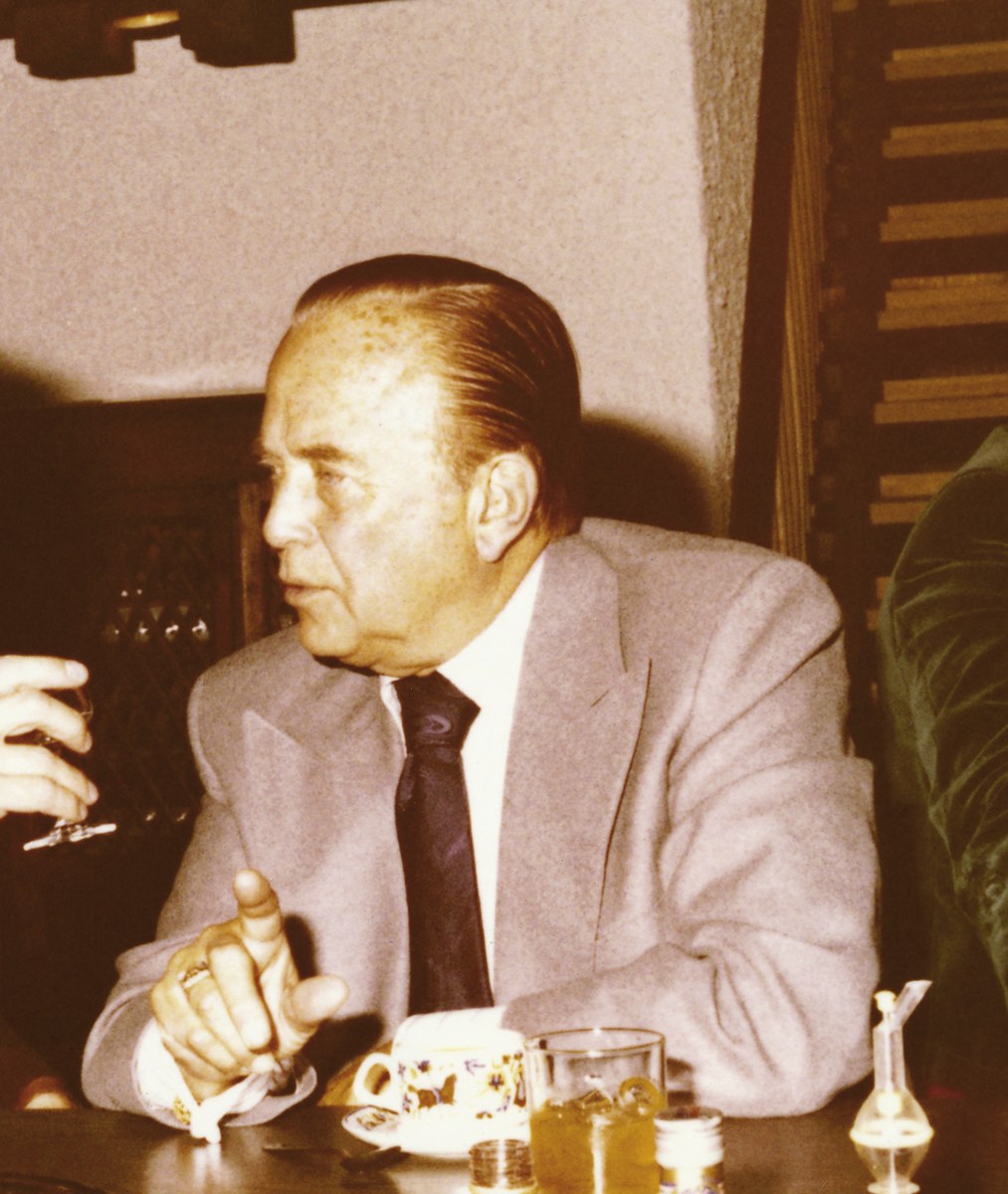
Photo: Sigfried Rödig (Knauss Verlag), undated (c. 1970s), CC BY-SA 4.0; cropped · Wikimedia Commons 'Ray Kroc und Jürgen Knauss.jpg': photograph credited to Sigfried Rödig (source: Knauss Verlag), licensed CC BY-SA 4.0 on the file page with a VRT permission ticket (2020031010005709) recorded there; used on the English and German Wikipedia pages for Ray Kroc and Jürgen Knauss. Shows Kroc (right, older man) in conversation with Jürgen Knauss (left); identity rests on the Commons/Wikipedia caption and was checked against the 1976 Padres press photo (same man). CAVEAT: the file page gives no exact photograph date (only a 2011 metadata timestamp); Knauss's German Wikipedia biography says he met Kroc in 1971 and Kroc died in 1984, so the photograph dates from roughly 1971-1984 (apparently 1970s). Cropped to the Kroc half of the 3043 x 2080 original (1300 x 1540 crop) and downscaled to 1013 x 1200; no upscaling. Derivative of a CC BY-SA 4.0 work, so the cropped file stays CC BY-SA 4.0 (ShareAlike). Supersedes the rejected eBay-sourced 'Ray Kroc 1976.jpg'. · CC BY-SA 4.0
사업가 · 20세기
레이 크로크
1902
주요 업적 분야
아직 성격 매칭에 포함되지 않았습니다 — 기록된 근거가 성격 모델 전체를 다루기에는 충분하지 않습니다. 이 페이지의 다른 모든 내용은 자유롭게 확인하실 수 있습니다.
핵심 특성
주요 업적
1954년 맥도날드 형제의 샌버너디노 식당을 찾은 뒤 프랜차이즈 권리를 얻어 1955년 일리노이주 데스플레인스에 매장을 열었고, 1984년 그가 세상을 떠날 때 이 체인은 32개국 7,500개 매장, 그중 4분의 3이 프랜차이즈였다.
문서화된 운영 지침, 정확한 식재료 규격, 이후 햄버거 대학에서의 교육으로 가맹점을 균일하게 만들었으며, 품질·서비스·청결·가치를 신조로 삼았다.
1961년 270만 달러에 맥도날드 형제의 시스템 권리를 사들였으며, 그가 키운 셀프서비스 식당 개념은 형제의 것이었고 형제는 그가 훗날 창업자를 자처한 것에 이의를 제기했다.
삶의 장면들
부고는 그가 매장의 청결을 끊임없이 살폈고 햄버거에 증량재를 쓰지 못하게 했다고 전한다.
이는 브랜드 일관성의 바탕으로서 운영 세부에 기울이는 세심한 주의와 부합한다. 디테일 지향
1961년 인수 뒤 형제가 원래 식당을 유지했는데, 크로크는 타임에 그들을 몰아냈다고 말했고 딕 맥도날드는 그것이 농담이었다고 답했다.
이는 거친 추진력의 동업 방식과 부합하지만, 설명이 엇갈려 이 자료만으로는 결론 내릴 수 없다. 협업 성향
전환점
1954년, 52세의 그는 맥도날드 형제의 식당이 믹서기를 그토록 많이 주문하는 것을 보고 멀티믹서 판매원에서 맥도날드 프랜차이즈 사업가로 방향을 바꿨다.
이는 주변 사람들이 확장하지 못한 기회를 알아보는 안목과 부합한다. 기회 감지
비슷한 인물
전체적인 프로필이 이 사람과 닮은 사람들이에요.
출처
- Ray Kroc (Q319648) -- verified live via the Wikidata API (2026-10-23): English label 'Ray Kroc', description 'American businessman', born 1902-10-05, died 1984-01-14, Korean label present, P18 'Ray Kroc 1976.jpg'. Orientation only; not used as support for any row.
- Horatio Alger Association of Distinguished Americans, 'Ray A. Kroc' member profile (Class of 1972), read in full via fetch: founder and chairman of McDonald's Corporation; born 1902 in Oak Park, Illinois; Red Cross ambulance driver training in World War I; paper-cup salesman and piano player; national salesman for the Prince Castle Multi-Mixer; met the McDonald brothers in San Bernardino and bought the rights to franchise McDonald's nationwide; first restaurant opened 1955 in Des Plaines, Illinois; bought out the brothers in 1961 for $2.7 million; McDonald's became the world's largest fast-food chain; also owned the San Diego Padres; named among Time's 'Builders and Titans' of the 20th century. CANONICAL SIGNIFICANCE SOURCE (an award body's short profile; it gives no year for the 1954 meeting and says nothing of standardisation or the brothers' dispute). Celebratory by design.
- EBSCO Research Starters, 'Ray Kroc' (history), read in full: Kroc dropped out of high school, sold paper cups for Lily-Tulip for 17 years (rising to Midwest sales manager) and studied carry-out trends, left to sell the Multimixer in 1939, and by the early 1950s faced falling sales from imitators; he travelled to San Bernardino to see why a small drive-in bought so many Multimixers, 'Kroc did not invent fast food, nor did he found McDonald's restaurants', and chose to buy franchising rights instead of opening his own drive-in; he wrote manuals for uniform quality, incorporated at 52 and opened the Des Plaines store on 15 April 1955; early franchises failed to prosper because menus and operations differed, so he made each franchise uniform (patties ten to a pound, 1.6 ounces, 3.9 inches, a quarter ounce of onions at fifteen cents), trained owners and managers (Hamburger University, first operated in a store basement in 1961), kept franchise fees low, withdrew support from non-compliant franchisees, and let franchisees create the Big Mac, Egg McMuffin and Filet-O-Fish; the 1960s share sale made him a millionaire at 62; 'honored and vilified'; criticism of the menu and 'McDonaldization'. CANONICAL SIGNIFICANCE SOURCE (second). Salem/EBSCO reference biography; the political-donation and philanthropy passages were not used.
- Eric Pace, 'Ray A. Kroc Dies at 81; Built McDonald's Chain', The New York Times obituary, 15 January 1984, read via a reproduction on a funeral-home obituary page (the original nytimes.com page was not opened): 'a pioneer in automating and standardizing operations'; opened his first McDonald's in 1955, 7,500 outlets in the United States and 31 other countries by his death, three-quarters franchised; credited with carefully choosing franchisees skilled at personal relations, relentlessly stressing quality (banning fillers), using part-time teenage help, keeping operating costs down, and team food-preparation techniques; his eyes 'constantly checking his restaurants for cleanliness'; executives displayed his favourite dictum on persistence; notes controversies (a 1976 book alleging polygraph tests and tip appropriation, nutrition criticism) and his outspoken public rebuke of his baseball team; wrote that his huge success came late (in his 50s). Independent newspaper obituary of its time, laudatory in tone with a controversy section; its Nixon-campaign contributions and teen-wage-politics paragraphs were not used.
- 'Ray Kroc', Encyclopedia.com (Business Leaders, Gale/U-X-L reference biography), read in full: Kroc saw that the McDonald brothers' San Bernardino restaurant ran five Multimixers almost nonstop, quizzed diners and the brothers, proposed franchising nationwide when the brothers resisted the extra work; at 52 opened Des Plaines; kept the McDonalds' one-job-per-employee system; wanted control over franchisees but sold each only one store, did not sell supplies to them at high prices, trained them at Hamburger University; quotes Love ('the genius of Ray Kroc was that he treated franchisees as equal partners'); poured money into television advertising (Ronald McDonald from 1965); gave the brothers $2.7 million in 1961; reference-book retelling that leans on Kroc's own autobiography Grinding It Out for several episodes, so those parts are self-sourced; the passages on his health, marriages, daughter and charity were not used.
- Kirkus Reviews, review of John F. Love's 'McDonald's: Behind the Arches' (1 November 1986), read in full: calls it a meticulously researched, 'definitive corporate history' that 'accentuates the positive without ignoring the implications of the rough spots'; vivid portraits of Kroc, who 'had the foresight to let franchisees and suppliers achieve wealth before him', the McDonald brothers (local pioneers of the techniques Kroc applied to mass markets) and Harry Sonneborn (credited with the real-estate base); cordial vendor relationships; more contentious franchisee relations (about 2,200 franchisees, an ombudsman appointed). Independent trade-book review of an authoritative secondary account; used because Love's book itself was not opened (lending-only); the review's characterisation is second-hand and sympathetic.
- McDonald's Corporation announcement, 'Restaurant Innovator Richard McDonald Dies at 89: Pioneered McDonald's, World's Largest Restaurant System', Hotel Online Special Report, 14 July 1998, read in full: Dick and Mac McDonald opened the San Bernardino drive-in in 1940 and in 1948 rebuilt it as a limited-menu self-service restaurant (15-cent hamburgers); they franchised eight restaurants in the West before Kroc arrived; Kroc, who held the national marketing rights to the Multimixers the brothers used, was granted exclusive rights in 1955 to develop and franchise McDonald's in the United States, formed McDonald's System, Inc. in 1955 and opened the ninth McDonald's in Des Plaines in April 1955; in 1961 he bought the proprietary rights to the system, including the rest of the world; Dick McDonald was credited with the Golden Arches and 'Billions Served' signs; Fred Turner is quoted in 1987: 'Mac and Dick came up with the original design, Ray provided the foundation'. Corporate press release carried by a trade site, written by the company that Kroc built, so it is institutional and conciliatory, but it credits the brothers' prior work and corroborates the franchising chronology.
- Money magazine article on the film The Founder and how the accounts of Kroc and McDonald's original founders differ (16 December 2016), read in full: recounts the 1973 TIME cover story in which Kroc says he asked for the job of franchise agent on seeing the line of customers in San Bernardino; the brothers had already franchised about six restaurants; Kroc agreed to pay them 0.5 per cent of sales and built a chain of 228 restaurants in five years; the price for the whole chain was $2.7 million with the brothers keeping their original restaurant, Kroc says it 'ended up costing me $14 million'; he told TIME 'I ran em out of business' after opening a restaurant across from the original, while Dick McDonald's letter says they renamed it themselves and that Kroc was kidding; Dick McDonald told the Wall Street Journal in 1991 that no one called Kroc the founder before the sale; the company did not honour the brothers on Founder's Day until 1991. Independent business-magazine article built on contemporaneous TIME and WSJ reporting; the contested points are presented as contested; some secondary details about dates of the autobiography are loose. CRITICAL COUNTER-VOICE on the founder claim and the buyout.