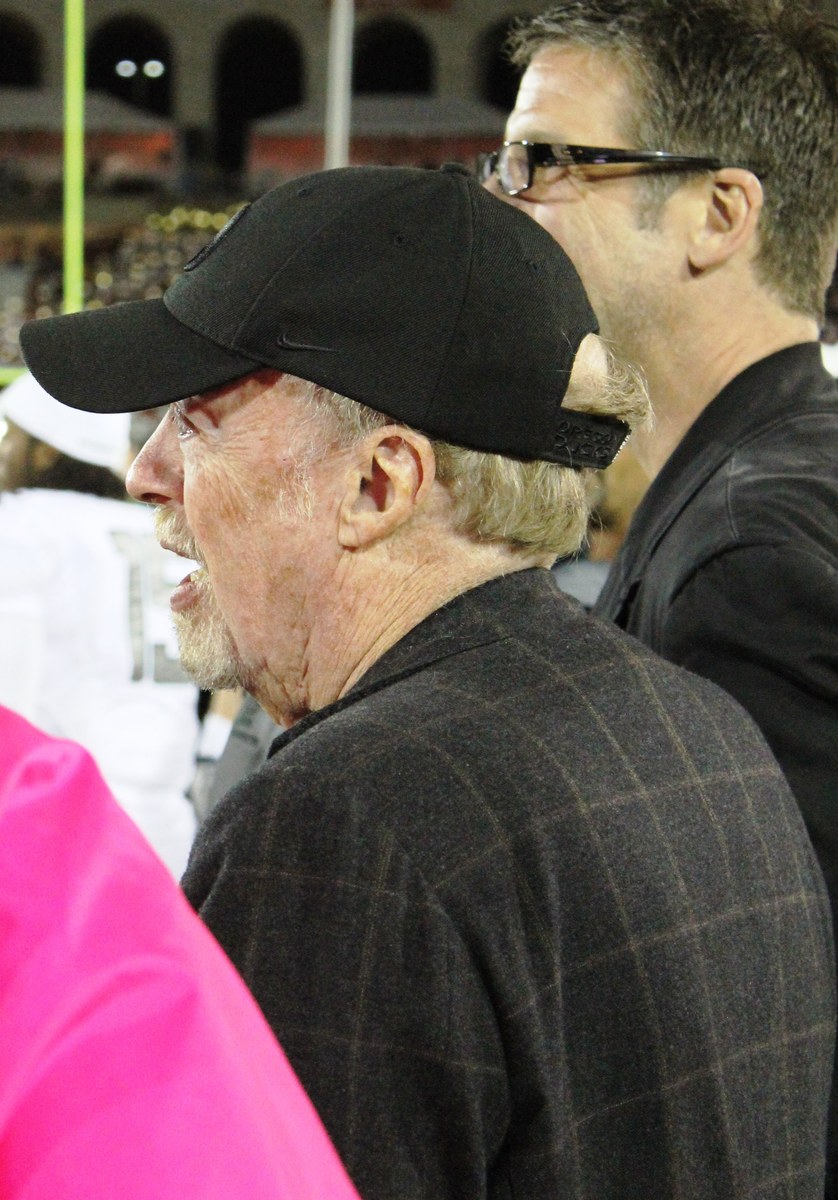

Photo: Neon Tommy, 2010, CC BY-SA 2.0 · Wikimedia Commons, 'Philknightfootball.jpg' -- photograph by Neon Tommy, taken 30 October 2010 at the Oregon-USC football game, imported from Flickr and passed an automated Flickr licence review (21 March 2012) as CC BY-SA 2.0. Original 2435 x 3486 pixels; saved downscaled only (Lanczos) to 838 x 1200 pixels, never upscaled. · CC BY-SA 2.0
사업가 · 현대
필 나이트
b. 1938
주요 업적 분야
아직 성격 매칭에 포함되지 않았습니다 — 기록된 근거가 성격 모델 전체를 다루기에는 충분하지 않습니다. 이 페이지의 다른 모든 내용은 자유롭게 확인하실 수 있습니다.
핵심 특성
주요 업적
1964년 오리건대 육상 코치 빌 바우어만과 함께 블루리본스포츠를 공동 창업해, 오니쓰카 타이거 러닝화를 수입하며 사업을 시작했다.
1971년 회사 이름을 나이키로 바꾸고 1980년 상장했으며, 2004년까지 CEO, 2016년까지 회장으로 회사를 이끌었다.
1984년 마이클 조던과 계약했으며, 이 계약은 스포츠 마케팅을 바꾸고 에어 조던 라인을 탄생시켰다고 평가된다.
삶의 장면들
한 비공인 저서의 서평에 따르면, 1970년대 초기 회사는 잔고가 부족한 수표를 발행하며 '플로트'에 의존했고, 은행이 거래를 끊자 닛쇼이와이가 구제했다.
이는 회사 성장 초기에 재무적 위험을 크게 감수한 태도와 일치한다. 위험 감수
스탠퍼드 수업 과제 이후 1962년 일본으로 건너가, 『스우시』 서평에 따르면 미국 수입업자를 자처해 오니쓰카와 면담을 얻어냈다.
이는 스스로 발견한 시장의 빈틈에 신속히 움직인 태도와 일치한다. 기회 감지
전환점
1969년 회계사와 강사 일을 그만두고 회사에 전념했으며, 1971년 오니쓰카와 결별하고 나이키로 거듭났다.
이는 자신의 경력을 사업에 거는 것을 마다하지 않은 태도와 일치한다. 위험 감수
비슷한 인물
전체적인 프로필이 이 사람과 닮은 사람들이에요.
출처
- Phil Knight (Q557305) -- verified live via the Wikidata API (2026-10-23): English label 'Phil Knight', description 'American billionaire and co-founder of Nike', born 24 February 1938, no date of death, citizenship United States, Korean label '필 나이트', P18 image 'Philknightfootball.jpg'. Orientation only; not used as support for any row.
- Encyclopaedia Britannica, 'Phil Knight' (britannica.com), read in full via a local copy: cofounded Blue Ribbon Sports in 1964 with his former University of Oregon coach Bill Bowerman to sell Onitsuka Tiger shoes; the Stanford small-business class paper arguing that Japanese shoe production could outpace German makers; a 1962 trip to Japan to tour the Onitsuka factory; selling shoes from his car at regional track meets while working as an accountant and teaching, leaving those jobs in 1969; the split with Onitsuka in 1971 and the renaming to Nike, the swoosh logo bought for $35, the waffle-sole shoe, the 1980 public offering, the 1984 Michael Jordan contract he was 'initially reluctant' to sign, the 1988 'Just Do It' slogan, his tenure as CEO until 2004 and chair until 2016, and the late-1990s accusations of sweatshop and child-labour conditions that Britannica says were ultimately confirmed 'despite the company's initial denial', followed by announced changes, factory audits and higher minimum wages. CANONICAL SIGNIFICANCE SOURCE. Its passages on family, political giving, philanthropy, the Laika studio and net worth were not used.
- Karen Milburn, review of 'Swoosh: The Unauthorized Story of Nike and the Men Who Played There' (Julie Strasser and Laurie Becklund), The Seattle Times, 6 February 1992, read in full: reports the book's account of Knight as a recent business-school graduate going to Japan in 1962 and presenting himself as an American importer ('a serious exaggeration') to meet Onitsuka; of Blue Ribbon Sports in the 1970s writing checks against insufficient funds and relying on 'the float' until its bank relationship ended and Japanese trading company Nissho Iwai rescued it; of Knight pushing financial risk onto suppliers, sales representatives and endorsing athletes; of management dismissing the aerobics boom, after which Reebok became the No 1 athletic-shoe company in 1982, a lesson called 'expensive, and nearly fatal'; and that Knight kept control and over 40 percent of a $3 billion public company. The reviewer notes that Strasser was Nike's first advertising manager and her husband a founding manager, that Knight opposed and threatened to sue over the book (Strasser's account), and that Strasser says two or three sources corroborated most scenes. Unauthorised insider-authored account as relayed by an independent reviewer; mixed favourable/critical; the review's passages on liquor, drugs and 'outrageous behaviour' were not used.
- The Oregon Encyclopedia, 'John Jaqua (1920-2009)' (oregonencyclopedia.org), the passage on Nike's founding read: in January 1964 Knight, a former University of Oregon runner, and coach Bill Bowerman met in Jaqua's living room and formed the partnership Blue Ribbon Sports, which became Nike; Jaqua helped them raise $50,000 to start; the business first imported running shoes from Japan and later manufactured shoes based on Bowerman's designs; Jaqua gave early legal help and sat on Nike's board from the start until 2004. State-history encyclopaedia, independent of Knight; the entry is about another person and is used only for the founding episode.
- Brendan Dunne, feature on who brought Michael Jordan to Nike in 1984 (Complex, sneakers section; headline not recorded), 30 September 2015, read in full: competing accounts from Michael Jordan (credits George Raveling), Raveling (credits Nike's bringing Jordan to Beaverton), Sonny Vaccaro (calls himself 'the savior of Nike' and accuses Knight and Jordan of lying), Peter Moore (names Rob Strasser and Vaccaro) and Phil Knight, who downplays Vaccaro and names Moore and Strasser as the 'MVPs' and credits Tinker Hatfield for design. The article does not describe how Knight himself reached the decision. Sneaker-press feature recording disputed credit among participants; Knight's statements in it are self-reported.
- William McCall (Associated Press), 'Nike chief falls short on pledge to labor, conditions worldwide unchanged, group says', The Seattle Times, 17 May 2001, read in full: the 105-page Global Exchange report assessing six promises Knight made in a May 1998 speech at the National Press Club (US indoor air-quality standards in shoe factories, minimum hiring ages of 18 and 16, NGOs in factory monitoring with published inspection results, expanded worker education, microenterprise loans for 4,000 families in four Asian countries, university research forums); the report's conclusion that the projects had 'been of little benefit to Nike workers' while crediting improved health and safety conditions; and Knight's reply that Nike had done more than any other shoe or apparel company for fair treatment of workers, that its expansion had helped raise wages, and 'I think we've made significant strides, and I'm proud of what the company's done over the last three years', with Knight and two managers noting contracts covering factories employing at least 500,000 workers in more than 50 countries. Wire report; critical report by an advocacy group with Knight's reply.
- Josh Richman, 'Is Nike Still Doing It?', Mother Jones, 16 May 2001, read in full: the 115-page Global Exchange report on the six pledges from Knight's 12 May 1998 National Press Club speech, alleging that wages remained unlivable, forced overtime and intimidation persisted, monitors' visits were announced in advance and only one independent inspection (by Verite in Mexico) appeared to have occurred, and that Nike refused a living-wage standard for its roughly 530,000 workers; Nike's response from vice president Dusty Kidd that it had met most commitments (88 percent cut in petroleum-based chemicals since 1995, Verite's Mexico report made public, Fair Labor Association monitoring delayed, loans extended to 5,000 families in four countries); and Global Exchange's Jason Mark saying the company's culture had not changed. Advocacy-leaning magazine report with a company reply; counted with the Seattle Times 2001 wire as ONE perspective on the same report, and the allegations are the report's, not findings of fact by this profile.
- Bill Snyder, 'Phil Knight on the Controversial Kaepernick Ad and Nike's Never-Give-Up Attitude', Stanford Graduate School of Business Insights, 14 February 2019, read in full: report on a 'View From The Top' session in which Knight traces his competitive never-give-up attitude to coach Bill Bowerman. Self-account relayed by his alma mater's school; used only to confirm the Bowerman relationship, never as support for a row, and its Kaepernick-advertising discussion was not used (cultural-political topic).
- Wikimedia Commons file page 'Philknightfootball.jpg' (wikitext and API record) -- checked for the portrait's licence: photograph by Neon Tommy (USC student news site), taken 30 October 2010 at the Oregon-USC football game, imported from Flickr and passed an automated Flickr licence review on 21 March 2012 as CC BY-SA 2.0; original 2435 x 3486 pixels. Not used for any scoring.