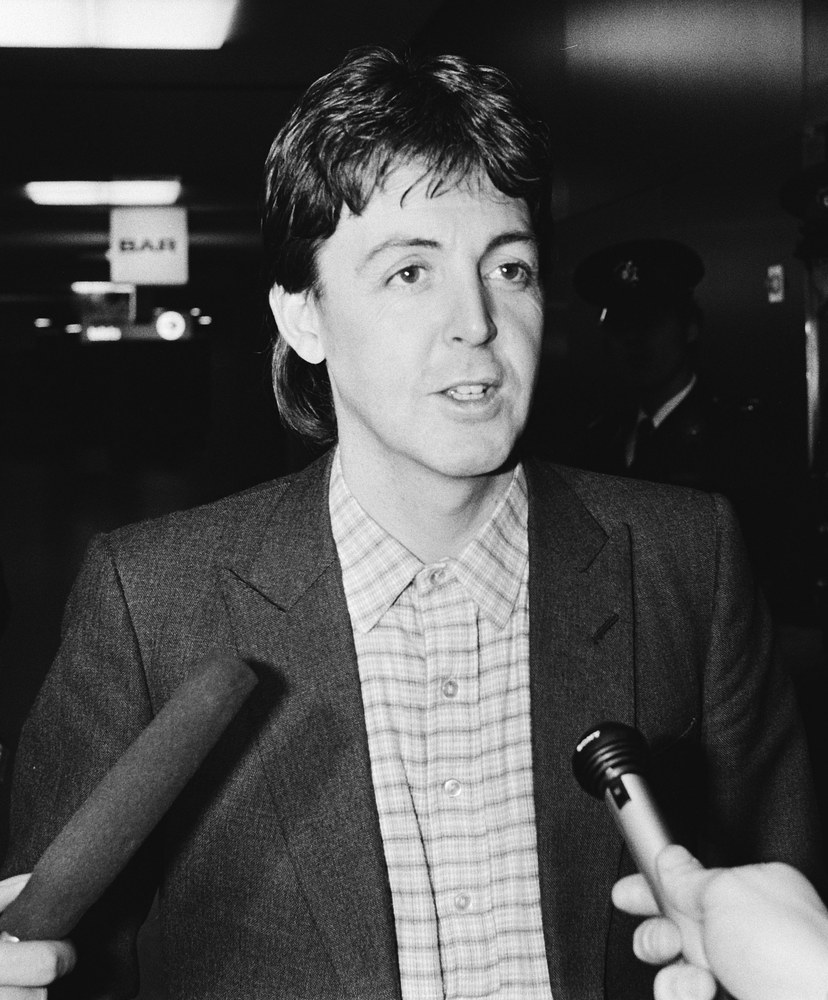

Photograph by Koen Suyk / Anefo, Nationaal Archief (CC0; credit not required, given as a courtesy); cropped and downscaled · Nationaal Archief, Fotocollectie Anefo, bestanddeelnummer 930-6404, photograph by Koen Suyk at Schiphol, 26 January 1980; Wikimedia Commons original 3682 x 2445 pixels (file 'Aankomst Paul McCartney op Schiphol ... Bestanddeelnr 930-6404.jpg'), cropped to the sitter (a 1636 x 1975 region, other people and microphones partly removed) and downscaled once to 828 x 1000, converted to greyscale (never upscaled) · CC0 1.0 Public Domain Dedication (Commons licence tag CC-zero; rights holder stated as Nationaal Archief)
음악가 · 현대
폴 매카트니
b. 1942
주요 업적 분야
아직 성격 매칭에 포함되지 않았습니다 — 기록된 근거가 성격 모델 전체를 다루기에는 충분하지 않습니다. 이 페이지의 다른 모든 내용은 자유롭게 확인하실 수 있습니다.
핵심 특성
주요 업적
존 레넌과 함께 비틀즈의 작곡의 중심을 이루었으며, 송라이터 명예의 전당은 두 사람이 비틀즈의 작곡을 대표하는 인물로 널리 알려져 있고 함께일 때나 따로일 때나 당대 가장 중요한 음악적 기여자로 꼽힌다고 소개한다.
1965년 현악 사중주와 녹음한 <Yesterday>와 현악 팔중주를 쓴 <Eleanor Rigby>로 비틀즈를 기타 밴드의 틀 너머로 이끌었고, 조지 마틴은 《서전트 페퍼스 론리 하츠 클럽 밴드》의 발상이 그에게서 나왔다고 설명한다.
비틀즈 이후 윙스와 솔로 활동을 이어 갔으며, 1987년 송라이터 명예의 전당에, 솔로 아티스트로서 1999년 로큰롤 명예의 전당에 헌액되었다.
삶의 장면들
<Paperback Writer>에서 그는 평소의 회프너 대신 릭켄배커 베이스를 연주했고, 엔지니어 제프 에머릭과 함께 베이스 앰프 앞에 스피커를 마이크처럼 놓아 EMI의 규정을 벗어난 방식으로 녹음했다.
더 큰 베이스 사운드를 얻기 위해 악기와 녹음 방식을 바꾸는 태도와 일치한다. 실험 성향
에머릭에 따르면 <Something>에서 매카트니는 처음에 화려한 베이스 라인을 연주했으나 조지 해리슨이 단순하게 해 달라고 하자 그대로 따랐다.
동료의 곡에 맞춰 자신의 연주를 조정하는 태도와 일치한다. 협업 성향
전환점
1965년 6월 그는 조지 마틴이 제안한 현악 사중주와 함께 자신의 기타와 목소리만으로 <Yesterday>를 녹음했는데, 이는 비틀즈로서는 처음이었다. 처음에는 회의적이었으나 비브라토를 쓰지 말 것을 요구하며 마틴과 함께 악보 작업을 했다.
처음에는 회의적이었던 음악가가 프로듀서의 제안을 받아들인 뒤 세밀하게 다듬는 태도와 일치한다. 입장 수정 성향
비슷한 인물
전체적인 프로필이 이 사람과 닮은 사람들이에요.
출처
- Paul McCartney (Q2599) -- verified live via the Wikidata API (2026-10-11): English label 'Paul McCartney', description 'English musician and member of the Beatles (born 1942)', born 18 June 1942, no date of death, citizenship United Kingdom, Korean label present. Orientation only; not used as support for any row.
- Songwriters Hall of Fame, 'Sir Paul McCartney' inductee profile (inducted 1987) -- CANONICAL SIGNIFICANCE SOURCE: the Hall's biography describes him as widely identified as the songwriting arm of the Beatles with John Lennon, names Yesterday, Eleanor Rigby, Let It Be, Live and Let Die and other songs, and notes his work with Wings and as a solo artist and his 1997 knighthood for services to music. Institutional, celebratory in tone; used for the achievement cards only, not for trait rows. Read in full.
- Rock and Roll Hall of Fame, 'Paul McCartney' inductee page (solo induction 1999) -- institutional page with an excerpt of Allan Kozinn's induction essay stating that an 'unquenchable musical curiosity' and the urge to create drive him as composer and performer; used only for the achievement cards (the page shows only the opening of the essay, so the full essay was not read). Not used for any trait row.
- MusicRadar, Geoff Emerick interview on recording the Beatles' Abbey Road (1969) -- the Beatles' recording engineer's track-by-track recollections: McCartney's wish to make a record 'the way the band used to' with George Martin and Emerick behind the console, his suggestion of a slower, 'swampy' tempo for Come Together, his habit of arriving early and rehearsing the Oh! Darling vocal over and over, his Moog solos on Maxwell's Silver Hammer, the concept he brought to tie the medley together, and his acceptance of George Harrison's wish for a simple bass line on Something. Colleague first-hand account (non-self), one engineer's memory. Read in full.
- Guitar World, 'Paul McCartney's Something bassline: did the Beatle overplay?' -- short feature quoting Geoff Emerick on the Something session and McCartney's own comment that he is 'a melodist' who tries to get a melody out of the bass part but must be selective, and that he had to 'sell' the Something bass line to Harrison. Mixes an engineer's account (the same Emerick quote as in the MusicRadar interview, so counted once) with McCartney's own recollection (self). Read in full.
- Guitar World, Abbey Road session feature built on Geoff Emerick's recollections -- the new console and bass sound on Abbey Road, McCartney being eager to cut a new album after the Let It Be sessions while the others were not, the Moog used for his solo on Maxwell's Silver Hammer, and his plan for the 16-minute side-two medley, which Lennon disliked. Press feature drawing on one engineer's account; relevant passages (console and bass sound, session background, the Moog, the medley plan) were read, the gear listings were skimmed.
- Tape Op, Geoff Emerick interview on his memoir 'Here, There and Everywhere' -- used only for Emerick's account of the Ob-La-Di, Ob-La-Da session in which McCartney, after repeated takes, had a specific idea of how he wanted to sing it and clashed with George Martin over direction, and for Emerick's note that McCartney asked him to rebuild the Apple studio. Colleague first-hand account (non-self), an informal and sometimes critical memory of the sessions. Read the Sgt. Pepper-to-Abbey Road sections in full.
- The Beatles Bible, 'Yesterday' song page -- compiler page assembling quotations from McCartney and George Martin and the session details documented in Mark Lewisohn's 'The Complete Beatles Recording Sessions' (14 and 17 June 1965): McCartney recorded guitar and vocal in two takes, considered a BBC Radiophonic Workshop backing, Martin proposed a string quartet (a first for the Beatles), McCartney insisted on no vibrato and worked on the score with Martin, who wrote most of it. Compiler page (comments section not used); the mixture of McCartney's own recollection and Lewisohn's session record is flagged in each row. Read in full.
- The Beatles Bible, 'Eleanor Rigby' song page -- compiler page quoting McCartney (Anthology, Barry Miles's 'Many Years From Now') and session information: McCartney began the song as a piano vamp, took the unfinished song to Lennon's house where the other Beatles and Pete Shotton suggested ideas (Ringo Starr's 'darning his socks', George Harrison's refrain, Shotton's final verse written up by McCartney), and the session used a string octet. Compiler page; the reader comments were not used. Read in full.
- The Beatles Bible, 'Paperback Writer' song page -- compiler page quoting Geoff Emerick and Mark Lewisohn's 'The Complete Beatles Recording Sessions' on the bass line: McCartney played a Rickenbacker bass instead of his Hofner, a loudspeaker was placed in front of the bass amplifier and used as a microphone against EMI's rules, and the bass and vocals were overdubbed. Compiler page; the comments section was not used. Read in full.
- NPR Fresh Air, 'Remembering Record Producer George Martin, The Fifth Beatle' (9 March 2016) transcript, including Terry Gross's 1980 interview with Martin -- Martin says that by the time of Sgt. Pepper Lennon and McCartney very rarely wrote together and each wrote their own songs, and that the Pepper idea came after McCartney had the idea of a song called Sgt. Pepper's Lonely Hearts Club Band, which he thinks was McCartney's own idea of presenting the album as a fictitious band's performance. Producer's first-hand account (non-self), hedged ('I think'). Read in full.
- Record Mirror, 'Beatles recording manager George Martin talks about their most ambitious LP' (27 May 1967), as republished by The Paul McCartney Project -- Martin on Sgt. Pepper: 700 hours in the studio, the group being perfectionists who wanted the LP exactly as they had it in their minds, always wanting to be one step ahead, and the string session of up to 41 musicians. Producer's first-hand account about the group as a whole (non-self); promotional context at the time of release. Read in full.
- Nationaal Archief (The Hague), Fotocollectie Anefo, photograph by Koen Suyk, 26 January 1980, bestanddeelnummer 930-6404 -- archive record and its Wikimedia Commons file page checked for the portrait's rights (CC0, rights holder Nationaal Archief). Not used for any scoring.