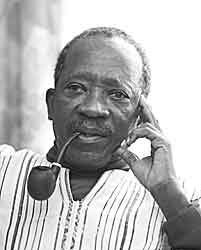

Photo: Guenter Prust, 1987, CC BY 3.0 · Wikimedia Commons file 'Ousmane Sembene (1987) by Guenter Prust.jpg': photograph by Guenter Prust of Ousmane Sembene on a visit to Berlin on 18 November 1987, uploaded by the photographer's account in November 2012 with his own statement that the work is his and that credit to him is required. Licensed CC BY 3.0. The original file is 201 x 250 pixels (6 KB); it is saved unchanged, never enlarged. The photographer's page foto-prust.de was not opened. Small but concrete: creator, date, place and licence are all stated on the file page by the photographer himself. A statue photograph in the Commons category (Laurent Mongis, 2017) was rejected because it does not show the person. · CC BY 3.0
영화감독 · 20세기
우스만 셈벤
1923–2007
주요 업적 분야
아직 성격 매칭에 포함되지 않았습니다 — 기록된 근거가 성격 모델 전체를 다루기에는 충분하지 않습니다. 이 페이지의 다른 모든 내용은 자유롭게 확인하실 수 있습니다.
핵심 특성
주요 업적
흔히 '아프리카 영화의 아버지'로 불리는 세네갈의 작가이자 감독으로, 아프리카 감독의 첫 주요 영화로 평가받는 「라 누아르 드...」(블랙 걸, 1966)를 만들었다.
문맹이 흔한 곳에서는 책이 소수에게만 닿는다고 판단해 영화로 눈을 돌렸고, 「만다비」(1968)에서는 월로프어로 촬영하는 결정을 내렸다.
그는 소설가이기도 해서 『검은 부두 노동자』(1956)부터 『신의 나무 조각들』(1960)까지 썼고, 이후 영화로는 「세도」, 「티아로예 수용소」, 칸 영화제 주목할 만한 시선상을 받은 「몰라데」가 있다.
삶의 장면들
모스크바에서 돌아온 뒤 그는 영사기를 들고 외딴 마을을 돌며 의자를 놓고 밤늦게까지 토론을 벌였다.
이는 관객에게 직접 다가가려는 자발적 노력과 부합한다. 선제적 행동력
「세도」(1977)는 일부 설명에 따르면 제목 철자를 이유로 세네갈에서 상영이 금지되었고, 그는 약 십 년간 영화를 만들지 못하다가 「티아로예 수용소」(1988)로 돌아왔다.
이는 작품 활동에 큰 대가를 치르면서도 논쟁적인 영화를 계속 만들려는 태도와 부합한다. 갈등 감내
전환점
1960년경 소설가로 자리 잡은 뒤, 프랑스어를 읽지 못하는 아프리카 관객에게 다가가기 위해 영화로 전환했고 모스크바에서 공부했다.
이는 더 넓은 관객에게 닿으려는 동기가 매체 선택을 이끌었다는 해석과 부합한다. 영향 창출 동기
비슷한 인물
전체적인 프로필이 이 사람과 닮은 사람들이에요.


마하트마 간디

체 게바라

아웅산 수치

치누아 아체베

무스타파 케말 아타튀르크
출처
- Ousmane Sembene (Q314966), verified live via the Wikidata API (2026-10-25): label 'Ousmane Sembène', description 'Senegalese film director, producer, screenwriter, actor, and author (1923-2007)', Korean label in Hangul, born 1923-01-01, died 2007-06-09, P18 image by Guenter Prust. Orientation only; not used as support for any row.
- Encyclopaedia Britannica, 'Ousmane Sembene', read in full. CANONICAL SIGNIFICANCE SOURCE: Senegalese writer and film director; early work as fisherman, mason and mechanic, service in the Free French forces, years as a docker and trade unionist in Marseille; self-taught in French; novels from Le Docker noir (1956) to God's Bits of Wood (1960); turned to film around 1960 to reach an African audience most of whom could not read French; Moscow film school; La Noire de... (1966) regarded as the first major film by an African filmmaker; Mandabi (1968) in Wolof; Ceddo (1977) banned in Senegal; Camp de Thiaroye, Guelwaar, Moolaade (Cannes Un Certain Regard). Reference entry: factual, admiring.
- African Film Festival (New York), 'Ousmane Sembene' filmmaker page, read in full: his move from father's fishing trade to mechanic, mason and army service, labour-movement militancy, work as a longshoreman in Marseille, the 1956 novel, the decision to become a filmmaker because much of his target audience could not read, study in Moscow, the short Borom Sarret (1963) as the first fiction film by an African distributed outside Africa, and his film list. Festival organisation's biography: factual and admiring; the 'first' claims are quoted as this source states them.
- Daily Maverick, 'Iconic African cinema: Ousmane Sembene' (15 June 2021), read in full: his family and schooling, the move into film to reach working-class Africans, the lack of equipment and funding under colonial rule, Borom Sarret made with limited equipment and family help, Prix Jean Vigo for La Noire de..., quotations from the film critic A. O. Scott (2007) on his influence, on his unsparing criticism of African governments that made him controversial, and on his larger audience at foreign festivals than at home, and a Cannes 2004 remark about Africa not being an eternal guest. Popular profile quoting critics; the Scott lines are read through this article only.
- Marjorie Baumgarten, 'Senegal's Pere du Cinema' (The Austin Chronicle, on the Austin Film Society's Sembene series), read in full: his background, the 1947 railway strike, union and party activity in Marseille, his stated reason for moving from books to film (a book reaches a limited number of people where illiteracy prevails), the first film Borom Sarret (1963), La Noire de... as the first film by a sub-Saharan director seen outside the continent, Mandabi in Wolof, satire running through the later films, and a note that his work is not as widely known as it deserves. Critic's series preview: admiring.
- Jacobin (German edition), 'Hundred years of Ousmane Sembene' (2023), read in full. COUNTER-VOICE / independent angle: a left-leaning retrospective that records his reservations about the 'father of African cinema' title, his Moscow training with Mark Donskoi, his projector tours of villages with late-night discussions, his tension between a French industry that financed him but wanted Wolof dubbed and a Senegalese government that tried to censor him, the ban of Ceddo (officially over the spelling of the title) and a near-decade without a film before Camp de Thiaroye, his reliance on European broadcasters in later years, and the later decline of Senegal's cinema infrastructure. Opinionated retrospective; its political framing is not scored.
- au-senegal.com, 'Hommage a Sembene Ousmane, militant jusqu'au bout de la cause africaine' (tributes after his death on 9 June 2007), read in full: his path from school expulsion to Marseille, the move to Moscow's Gorky studio where he learned to handle a camera, return to Senegal and screenings in working-class districts, Borom Sarret (1963), La Noire de... prizes, the list of later films, the ban of Ceddo (the stated spelling objection) and the refusal of Camp de Thiaroye at Cannes, and tributes from a fellow writer, a party leader who knew him in Marseille, and a young filmmaker. French-language obituary compilation: warmly admiring; the party leader's remarks are partisan.
- Wikimedia Commons file page 'Ousmane Sembene (1987) by Guenter Prust.jpg' (photograph by Guenter Prust, CC BY 3.0, taken on a visit to Berlin on 18 November 1987), checked for the portrait only.