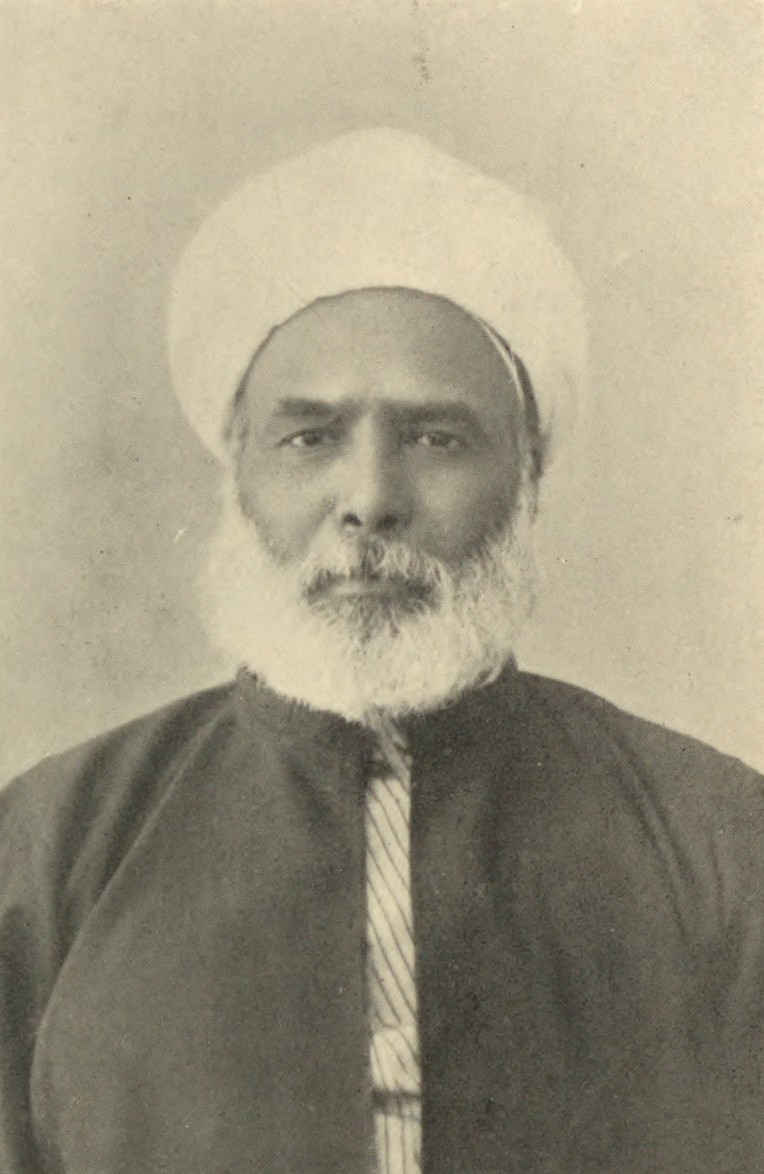
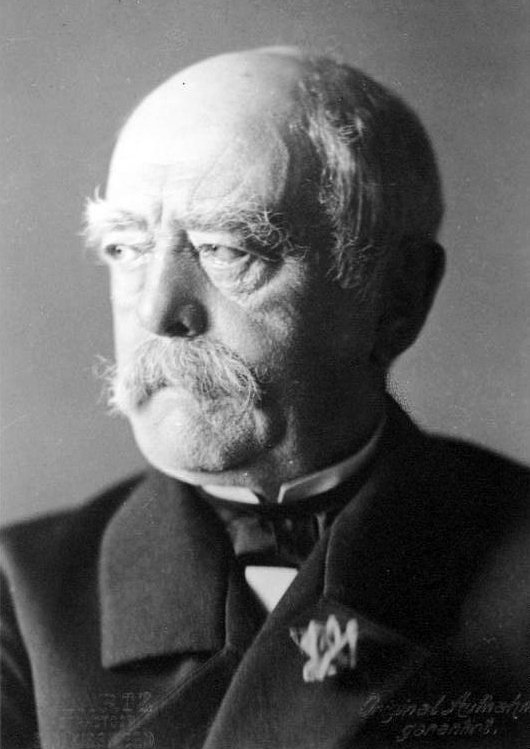
Photograph credited Fasani, in A. B. de Guerville, New Egypt, 1906, via Wikimedia Commons (public domain) · Photograph captioned 'The late Grand Moufti, Sheik Mohamed Abdou', reproduced in A. B. de Guerville, New Egypt (William Heinemann, London, 1906 edition; first published 1905 according to the Internet Archive record, with a Dutton edition in New York in 1906), facing page 159, with the credit 'Fasani' printed beside the plate in the Internet Archive text. Photographer not otherwise identified. The photograph was published in a book in 1905-1906, before 1931, so it is in the public domain in the United States on the basis of publication date; the Wikimedia Commons file 'The late Grand Moufti.png' carries the tag for works whose US copyright has expired and was uploaded from the Internet Archive scan. The Wikidata image 'Muhammad Abduh.jpg' was not used because its Commons page gives only an uploader's 'PD-old' with no publication source. Original file 764 x 1174 pixels, converted from PNG to JPEG with no resizing, cropping or upscaling. · Public domain (published before 1931)
신학자 · 19세기
무함마드 압두
1849–1905
주요 업적 분야
아직 성격 매칭에 포함되지 않았습니다 — 기록된 근거가 성격 모델 전체를 다루기에는 충분하지 않습니다. 이 페이지의 다른 모든 내용은 자유롭게 확인하실 수 있습니다.
핵심 특성
주요 업적
그는 19세기 후반 이집트 이슬람 근대주의 개혁 운동을 이끌며, 타클리드(전통 답습)에서 사유를 해방하고 이슬람이 이성과 근대 과학에 부합한다고 주장했다.
1899년 이집트 무프티가 되어 종교 법원과 와크프(기부 재산) 운영을 개혁하려 했고, 1895년부터는 알아즈하르 행정위원회의 중심 인물로서 일부 개혁을 이루었다.
베이루트 강의를 바탕으로 체계적인 신학서 《타우히드 논고》를 썼고, 그의 꾸란 강의는 그의 승인 아래 라시드 리다가 확장하여 《알마나르 주석》이 되었다.
삶의 장면들
소년 시절 탄타 모스크 학교에서 주석을 암기하는 방식에 당황해 달아났다가, 삼촌의 설득으로 돌아왔다.
이는 훗날 타클리드 비판으로 이어진, 암기식 학습에 대한 이른 조급함과 일치한다. 독립적 사고
1895년 케디브를 설득해 알아즈하르 행정위원회를 설치하게 했고, 10년 동안 가장 두드러진 위원으로서 조직 개혁을 일부 이루었다.
이는 저술만이 아니라 자신이 닿을 수 있는 제도를 통해 일한 개혁가의 모습과 일치한다. 선제적 행동력
전환점
알아프가니를 만난 뒤 극단적 금욕 생활에서 벗어나 철학 공부를 시작하고(이븐 시나의 《이샤라트》를 손수 필사) 사회 문제에 관한 글을 쓰기 시작했다.
이는 내면적 신비주의 공부에서 철학과 공적 문제로 관심이 넓어지는 전환과 일치한다. 분야 횡단성
비슷한 인물
전체적인 프로필이 이 사람과 닮은 사람들이에요.


에이다 러브레이스

카를 융

거트루드 벨

벤저민 프랭클린

라빈드라나트 타고르
출처
- Muhammad Abduh (Q311826), verified live via the Wikidata API (2026-10-31): label 'Muhammad Abduh', description 'Egyptian Islamic jurist, religious scholar and liberal reformer (1849-1905)', died 1905-07-11, citizenship Egypt, Korean label 무함마드 압두. Orientation only; not used as support for any row.
- Encyclopaedia Britannica, 'Muhammad Abduh' (biography page including its summary and question-and-answer sections; the full article body is subscriber-only and was not opened). CANONICAL SIGNIFICANCE SOURCE: an Egyptian religious scholar, jurist and liberal reformer who sought to revitalise Islamic teaching; studied at the Tanta mosque school and Al-Azhar (graduating 1877); joined al-Afghani in Paris in 1884 and later taught in Beirut; returned in 1888; as mufti of Egypt implemented reforms in Islamic law, administration and higher education against conservative resistance; works include Risalat al-tawhid and a Qur'an commentary.
- Albert Hourani, 'Arabic Thought in the Liberal Age 1798-1939' (Oxford University Press, 1962), chapter VI 'Muhammad Abduh', read as the Internet Archive full-text scan (about 25 pages of the chapter: early life, Azhar years, career, thought, critiques). Scholarly intellectual history by a historian who is neither a disciple nor a hostile critic; it draws on Rida's biography but also on Cromer, Blunt and Broadley, reports the doubts of Cromer, Blunt and Azhar critics, and describes Abduh's 'eclecticism' and avoidance of hard questions (for example a statement on the created Qur'an quietly removed from later editions of the Risalat al-tawhid). Quotes his own fragment of autobiography stating his purposes (self-report, as relayed).
- 'Muhammad Abduh: A Profile from the Archives', Jadaliyya (series with the newspaper As-Safir, translated by Mazen Hakeem; read in full, about 6,800 characters): chronology of his career from the Tanta mosque and Al-Azhar to the 1895 Azhar administrative council and the 1899 appointment as mufti with reform of religious courts and endowments; says he rejected the dominant rote method and 'transcribers', corresponded with Le Bon, Spencer, Tolstoy and Blunt, and warns that researchers urge caution against relying wholly on Rashid Rida's reading of Abduh. Short journalistic profile; not footnoted.
- Muzaffar Iqbal, 'Muhammad Abduh (1849-1905)', Center for Islam and Science biographical archive (read in full, about 19,000 characters). Partly follows the standard encyclopedia outline but adds a critical assessment: says his limited knowledge of science and modern philosophy led him to reconcile Qur'anic statements with scientific theories (jinn as microbes, evolution), describes his 1900-01 Qur'an lectures taken down and expanded by Rida with his approval, and quotes the Risalat al-tawhid. Evaluative and partly sceptical; used as the counter-voice.
- A. B. de Guerville, 'New Egypt' (William Heinemann, London, 1906 edition; Internet Archive full-text scan), the chapter 'The Political Testament of the Late Grand Moufti' and the surrounding passages (read: the author's own account of conversations with the Grand Moufti on religious and educational questions and a note Abduh sent him shortly before his death, with Abduh's statements on free education and the content of Egyptian schooling; a letter from his physician calling him 'the greatest man in modern Mussulman Egypt' is the correspondent's admiring testimony). A contemporary European journalist's witness, written within weeks of his death; admiring; the rows use only what the book reports Abduh as saying and doing about teaching. The book is also the publication source of the portrait.