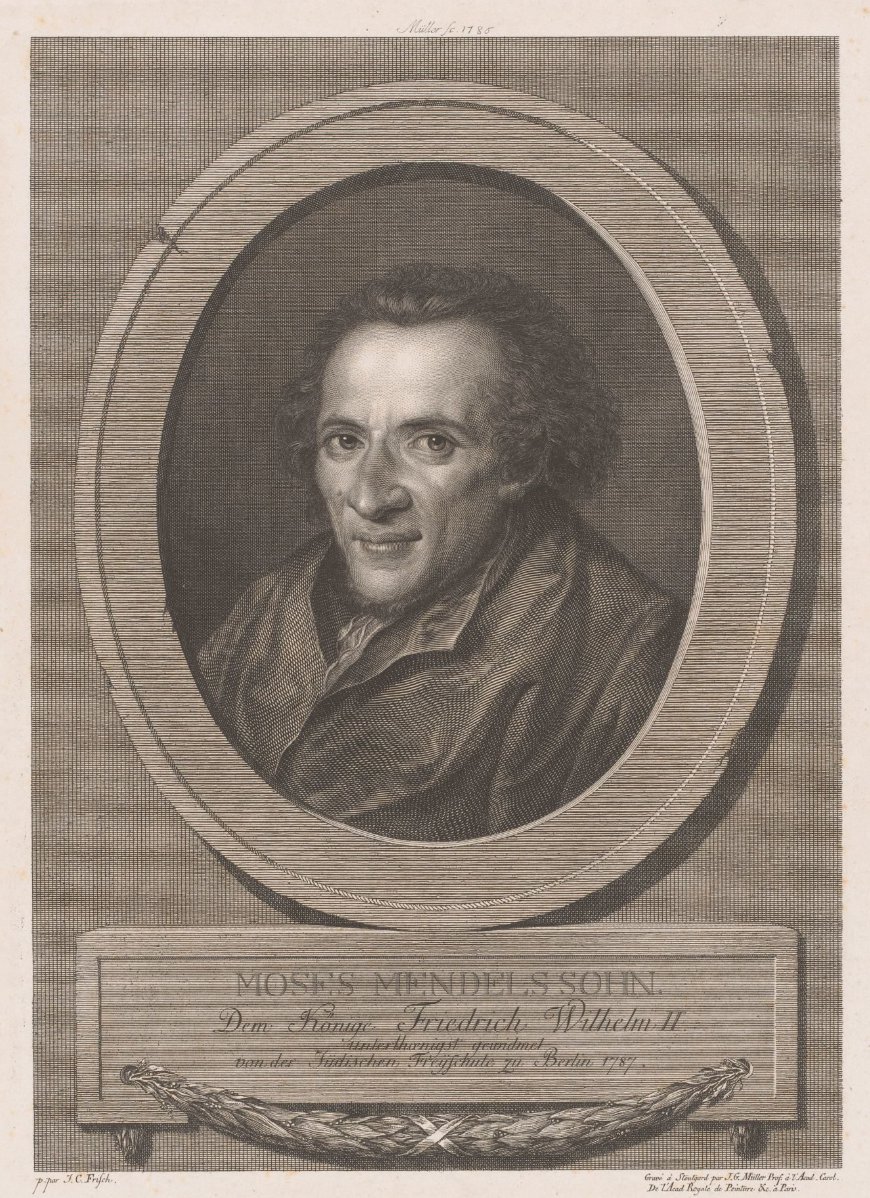
Johann Gotthard Muller after Johann Christoph Frisch, Portrait of Moses Mendelssohn, engraving, Rijksmuseum, Amsterdam (RP-P-1907-2896), public domain (cropped and downscaled) · Engraved portrait of Moses Mendelssohn by Johann Gotthard Muller after a painting by Johann Christoph Frisch, Rijksmuseum, Amsterdam (object number RP-P-1907-2896), engraving on paper, plate 290 x 219 mm. The plate itself names the sitter (MOSES MENDELSSOHN), the painter ('p. par J.C. Frisch') and the engraver ('Grave a Stoutgard par J.G. Muller'), and carries a dedication to King Frederick William II from the Jewish Free School in Berlin dated 1787; the museum catalogues it as 1770-1775, which does not agree with the dated dedication, so the date is given here as the 1780s. It is a copy engraved after a painting, so it is a historical depiction and not a documented sitting. The image is a crop of the plate area from the museum's own image service, downscaled from about 2650 x 3650 source pixels to 870 x 1198 with no upscaling. · Public domain (Rijksmuseum Public Domain Mark; the museum's open-data record states CC0)
철학자 · 근세
모제스 멘델스존
1729–1786
주요 업적 분야
아직 성격 매칭에 포함되지 않았습니다 — 기록된 근거가 성격 모델 전체를 다루기에는 충분하지 않습니다. 이 페이지의 다른 모든 내용은 자유롭게 확인하실 수 있습니다.
핵심 특성
주요 업적
그는 독일 계몽주의의 대표적 철학자로, 레싱·니콜라이와 함께 문예 비평지를 편집했으며, 유대 학문을 독일 철학·문학과 잇는 하스칼라(유대 계몽운동)의 상징적 인물이다.
그는 오경과 시편을 독일어로 옮기고 히브리어 주석(비우르)을 붙였으며, 랍비들의 금지령에도 협력자들과 함께 1783년에 완성했고, 그의 제안으로 1781년 베를린 유대인 자유학교가 문을 열었다.
1763년 형이상학의 명증성에 관한 그의 논문은 베를린 아카데미 상을 받았고, 영혼의 불멸을 다룬 대화 《파이돈》(1767)은 베스트셀러가 되었으며, 《예루살렘》(1783)에서는 종교가 신념을 강제해서는 안 되며 유대교는 계시된 율법에 기초한다고 논했다.
삶의 장면들
1769년 라바터가 기독교 변증서를 반박하거나 개종하라고 공개적으로 요구하자, 그는 종무국의 허락을 받아 자신의 종교에 대한 믿음이 흔들리지 않으며 보네의 책으로는 개종할 수 없다고 인쇄물로 답했다.
이는 공개적 압박 속에서도 자신의 입장을 지킨 사상가의 모습과 일치한다. 독립적 사고
1779년 알토나와 프라하 등지의 랍비들이 그의 독일어 오경을 금지하고 첫 주석자가 창세기 뒤에 떠나자, 그는 직접 주석을 맡고 다른 책들은 베셀리, 야로슬라프, 홈베르크에게 맡겨 1783년에 작업을 마쳤다.
이는 반대와 협력자의 이탈 속에서도 긴 작업을 이어 간 모습과 일치한다. 끈기
전환점
《유대 백과사전》에 따르면 1769~70년의 라바터 논쟁은 그의 경력의 두 번째 시기를 열어, 철학과 비평 중심에서 유대교와 유대 학문 중심으로 옮겨 가며 히브리어 주석, 독일어 오경과 시편, 《예루살렘》으로 이어졌다.
이는 일반 철학과 비평에서 성서와 유대 학문으로 작업 영역이 넓어진 것과 일치한다. 분야 횡단성
비슷한 인물
전체적인 프로필이 이 사람과 닮은 사람들이에요.
출처
- Moses Mendelssohn (Q76997), verified live via the Wikidata API (2026-11-02): label 'Moses Mendelssohn', description 'German-Jewish philosopher and theologian (1729-1786)', born 1729-09-06, died 1786-01-04, Korean label 모제스 멘델스존, citizenship Germany. Orientation only; not used as support for any row.
- Stanford Encyclopedia of Philosophy, 'Moses Mendelssohn' (substantive revision 2023), life and career, metaphysics, rational psychology, political theory and Jacobi-controversy sections read. CANONICAL SIGNIFICANCE SOURCE: a creative and eclectic thinker whose writings on metaphysics and aesthetics, political theory and theology, together with his Jewish heritage, placed him at the focal point of the German Enlightenment for over three decades; co-editor with Lessing and Nicolai of literary journals; dubbed 'the Jewish Luther' for translating the Pentateuch and Psalms into German; his 1763 prize essay on evidence in metaphysics won the Berlin Academy's prize (Kant's essay came second); his Phaedo (1767) was a best-seller; Lavater challenged him in 1769 to refute Bonnet or convert and he disabled the challenge with a plea for tolerance; in Jerusalem (1783) some Jewish thinkers took exception to his argument and the entry notes that his claim that excommunication was borrowed from Christianity is apparently erroneous; he was the model for Lessing's Nathan the Wise and in 1785-86 was drawn into the pantheism dispute with Jacobi. Independent scholarly reference; retrospective in tone about influence.
- Jewish Encyclopedia (1906), 'Mendelssohn' family article, sections on Moses Mendelssohn read in full (early influences, bookkeeper, friendship with Lessing and Nicolai, criticism, Phaedo, controversy with Lavater, Jewish activities, translation of the Bible, influence on German Judaism, Jerusalem, Morgenstunden): his poverty, self-education in Latin from a copy of Locke, Greek with Nicolai, work as tutor, bookkeeper and partner in a silk firm, co-editing the Literaturbriefe, the 1769 Lavater challenge and his public reply with the consistory's permission, the 1779 rabbinical ban on his German Pentateuch, his 'philosophic calm' toward opponents, collaborators on the commentary, and the Berlin Jewish Free School founded in 1781 at his suggestion. Based on the Kayserling biography; admiring in tone and partly legendary on anecdotes (the Frederick the Great and d'Argens stories are flagged as legend and not used).
- Jewish Encyclopedia (1906), 'Biurists', read in full: Mendelssohn compiled for his children a literal German translation of the Pentateuch with a Hebrew commentary (biur) begun by Solomon Dubno; rabbis of the old school including Raphael ha-Kohen of Hamburg and Ezekiel Landau of Prague criticised it and in June 1779 issued a ban on the 'German Pentateuch of Moses of Dessau'; Dubno gave up after Genesis and Mendelssohn took the commentary himself, assigning Leviticus, Numbers and Deuteronomy chapters to Wessely, Jaroslav and Homberg; the work was completed in March 1783 as Netivot ha-Shalom and founded the Biurist school. Independent counter-voice on the traditionalist opposition and on how the project was collaboratively finished.
- Encyclopaedia Britannica, 11th edition (1911), 'Mendelssohn, Moses' (Wikisource transcription), read in full: foremost Jewish figure of the eighteenth century, self-taught in Latin and Locke, tutor then partner to a silk merchant, Lessing published his Philosophical Conversations without telling him, the Phaedo hailed him as the 'German Plato', the Lavater challenge, the German Pentateuch, and Jerusalem, which Kant called 'an irrefutable book'; also reports that his descendants left the synagogue for the church. Old encyclopedia article; admiring in tone, used only for facts independently found in the other sources.
- Jewish Virtual Library, 'Moses Mendelssohn (1729 - 1786)', read: poor Torah scribe's son who followed Rabbi Fraenkel to Berlin at fourteen, studied languages, mathematics, logic and philosophy, worked as tutor, bookkeeper and silk-firm partner while writing, the 1769 Lavater challenge, Jerusalem (1783) on religious coercion and Judaism as revealed law, translation of the Bible into German with the Biur, and the label father of the Jewish Enlightenment. Popular reference; its claim that he was 'the first Jew to bring secular culture to Orthodox life' is a superlative and is not repeated.
- Jewish Museum Berlin, 'Moses Mendelssohn, Philosopher', read: the great philosopher of the European Enlightenment who played a crucial role as Jews in mid-eighteenth-century Berlin began to adopt the language and culture around them; came to Berlin in 1743 as a young Talmud scholar, learned modern languages and secular sciences, worked as tutor, bookkeeper and partner of the silk manufacturer Isaac Bernhard while complaining that the business kept him from his studies, became known as the 'German Socrates' after the Phaedo (1767), published Jerusalem (1783), lived strictly by the Jewish precepts, and later generations saw in him the first modern German Jew and the symbolic figure of the Haskalah. Museum overview; museum framing is retrospective.