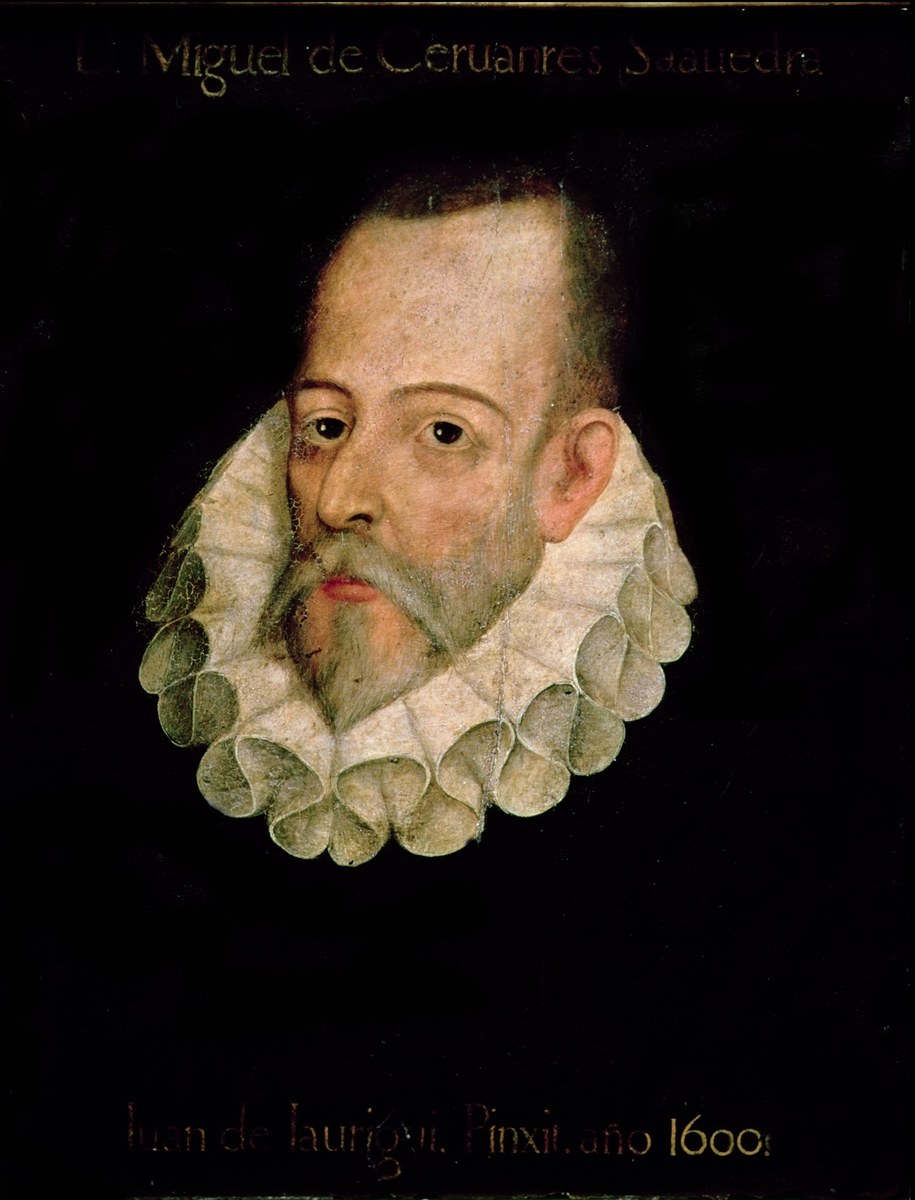

Attributed to Juan de Jauregui, c.1600, Real Academia de la Historia (traditional, unverified portrait of Cervantes), public domain · Wikimedia Commons, 'Cervantes Jauregui.jpg' -- oil on panel, about 1600, held by the Real Academia de la Historia (Madrid), attributed to Juan de Jauregui (died 1641); Commons credits the Biblioteca Virtual Miguel de Cervantes and Bridgeman Art Library object 119216, tagged PD-Art / PD-old-auto-expired. IMPORTANT: this is NOT a documented likeness. Commons and the Biblioteca Virtual (which captions it 'Cervantes (?)') state that no authentic portrait of Cervantes exists, that modern scholarship does not accept this image as authentic, that no document shows Jauregui painted it, and that the painted names are centuries later. It is shown only as the traditional, presumed portrait (a historical depiction). Original 1443 x 1893 pixels, 423,402 bytes (SHA-1 of the download fd1e1a67a565acf0a7e4110a14baa733d9c9ec95); stored copy downscaled only to 915 x 1200. Rights basis: a c.1600 painting by a painter who died in 1641, so out of copyright everywhere relevant; the file is a faithful photographic reproduction of a flat work. Residual caveat: the specific photograph's own rights are not stated on Commons beyond the PD-Art assertion; no conflicting notice was found on the Biblioteca Virtual image page (its legal page was not opened). · Public domain (painting c.1600; Commons PD-Art, PD-old-auto-expired)
작가 · 근세
미겔 데 세르반테스
1547–1616
주요 업적 분야
아직 성격 매칭에 포함되지 않았습니다 — 기록된 근거가 성격 모델 전체를 다루기에는 충분하지 않습니다. 이 페이지의 다른 모든 내용은 자유롭게 확인하실 수 있습니다.
핵심 특성
주요 업적
'돈키호테'(1부 1605년, 2부 1615년)를 썼다. 많은 학자들은 이를 최초의 근대 소설로 보며, 브리태니커는 그를 스페인 문학에서 가장 중요하고 유명한 인물로 꼽는다. 이 작품은 60개가 넘는 언어로 번역되었다.
거의 모든 주요 장르에서 작업했다. 목가 로맨스 '라 갈라테아'(1585), 희곡과 막간극, '모범 소설집'(1613), 시 '파르나소 여행'(1614), 사후에 출간된 '페르실레스'가 그 예다.
1614년 다른 사람이 쓴 가짜 속편이 나오자, 1615년 진짜 2부를 완성해 출간했다. 이야기 속에서 그 모방작에 답하며 돈키호테의 모험을 끝까지 이끌었다.
삶의 장면들
1614년 가짜 속편이 나오자, 그는 이를 자신의 2부 안에 끌어들였다. 돈키호테가 가짜 책을 넘겨 보고 그 책의 등장인물을 만나 진짜 주인공임을 확인받는다.
이는 경쟁자를 무시하기보다 자신의 작품을 고쳐 짜서 대응한 작가의 면모와 부합한다. 적응력
여러 서문에서 거듭 예고했던 로맨스 '페르실레스와 시히스문다'를 1616년 사망 나흘 전에 완성했고, 작품은 그의 사후에 출간되었다.
이는 오래 약속했던 책을 생의 마지막까지 이어 쓴 작가의 면모와 부합한다. 끈기
전환점
로페 데 베가가 마드리드 무대를 장악하자 그는 희곡을 접어 두었다가, 1615년 상연된 적 없는 희곡 여덟 편과 막간극 여덟 편을 인쇄본으로 먼저 내놓았다. 관객에게 닿는 통상의 길과 달랐다.
이는 통상의 길이 막히자 경로를 바꾼 작가의 면모와 부합한다. 실험 성향
비슷한 인물
전체적인 프로필이 이 사람과 닮은 사람들이에요.
출처
- Miguel de Cervantes (Q5682) -- verified live via the Wikidata API (2026-10-24): English label 'Miguel de Cervantes', description 'Spanish novelist, poet, and playwright (1547-1616)', Korean label '미겔 데 세르반테스', born 1547 (29 September 1547 recorded, plus a year-only value), died 1616 (22 April, 23 April and year-only values), citizenship Spain. Orientation only; not used as support for any row.
- Jean Canavaggio, 'Biografia de Miguel de Cervantes Saavedra' (three pages), Biblioteca Virtual Miguel de Cervantes, Universidad de Alicante, read in full in Spanish: documented-record limits (many gaps, 1597-1604 especially, and little known of motives); Lepanto 1571 and the wounds; four escape attempts from Algiers in which he always sought to take sole responsibility, the 1580 ransom of 500 ducados by the Trinitarians; the failed bid for an Indies post in 1590 ('Busque por aca en que se le haga merced'); his years as supply commissary and the 1592 and 1594-1597 jailings; the 1585 Galatea; his claim, in the 1615 prologue to Ocho comedias, to have cut plays from five acts to three, then the rise of Lope de Vega and his decision to print rather than stage plays; Don Quixote Part I (end of 1604, quickly pirated and reprinted); the 1614 Avellaneda continuation, its insulting prologue, and his reply in the 1615 Part II (writing 23 chapters in about two months in summer 1614, a rebuttal in the prologue, the book Don Quijote leafs through, the character don Alvaro Tarfe); the unfulfilled Lemos hopes; finishing Persiles four days before he died. CANONICAL SIGNIFICANCE SOURCE (with Britannica). Specialist scholar's narrative; balanced, notes that many 'known' anecdotes are unproven; his remarks on religion, family and illness were not used.
- 'Miguel de Cervantes', Encyclopaedia Britannica (articles by Anne J. Cruz, University of Miami, and Edward C. Riley, University of Edinburgh), read through an Internet Archive copy that is cut off after the Algiers captivity section: calls him the creator of Don Quixote and the most important figure in Spanish literature; Don Quixote translated into more than 60 languages; 'a great experimenter' who tried every major genre except the epic; the Exemplary Stories as close to the novel's level in miniature; no university education; independent accounts of his courage at Lepanto; four escape bids from Algiers; made little money from his writing; worked as royal messenger, Armada commissary and tax collector. CANONICAL SIGNIFICANCE SOURCE. Later sections (publication of Don Quixote, critical traditions, influence) were not in the copy that could be opened.
- 'Miguel de Cervantes', Academy of American Poets (poets.org) biography: Don Quixote (Part I about 1605, Part II 1615) as one of the most significant works of world literature and, in the view of many scholars, the first modern novel; Galatea 1585; Exemplary Stories 1613, which he called the first novellas in Castilian (the page says scholars think the claim likely true); Journey to Parnassus 1614 as his best-known verse; recurring financial trouble and little gain from Don Quixote; he reportedly rated a play above his novel. Read through a page-extraction tool that returns a summary. Reference-level and admiring; its mention of a Valladolid stabbing and a duel was not used (Canavaggio shows he was a bystander in the 1605 Ezpeleta case).
- Alfonso Martin-Jimenez (University of Valladolid), 'Cervantes and Avellaneda, the mysterious author of the sequel to Don Quixote' (English article on the author's academic blog): argues that Part II is a corrective, satirical reworking of Avellaneda's 1614 continuation and that Cervantes knew the author was the Aragonese soldier Jeronimo de Pasamonte; points to Part II chapters 59, 61 and 70 and the final chapter's request that the false author not continue. Read through a page-extraction tool. One scholar's confident, contested thesis; the Pasamonte identification is NOT accepted here, and only the uncontroversial point that Cervantes answered the false sequel inside Part II is used (Canavaggio independently reports the same and notes the identification lacks decisive proof).
- Wikimedia Commons file page 'Cervantes Jauregui.jpg' (wikitext and rendered page) and the Biblioteca Virtual Miguel de Cervantes image page 'Retrato de Miguel de Cervantes (?) de Juan de Jauregui' -- checked for the portrait: Commons titles it a 'supposed portrait', oil on panel about 1600, attributed to Juan de Jauregui (died 1641), held by the Real Academia de la Historia, tagged PD-Art with PD-old-auto-expired; the Commons text states that modern scholarship does not accept this or any other image as an authentic likeness of Cervantes and that no document shows Jauregui painted it; the painted names are centuries later than the panel. The Biblioteca Virtual itself captions the image with a question mark.