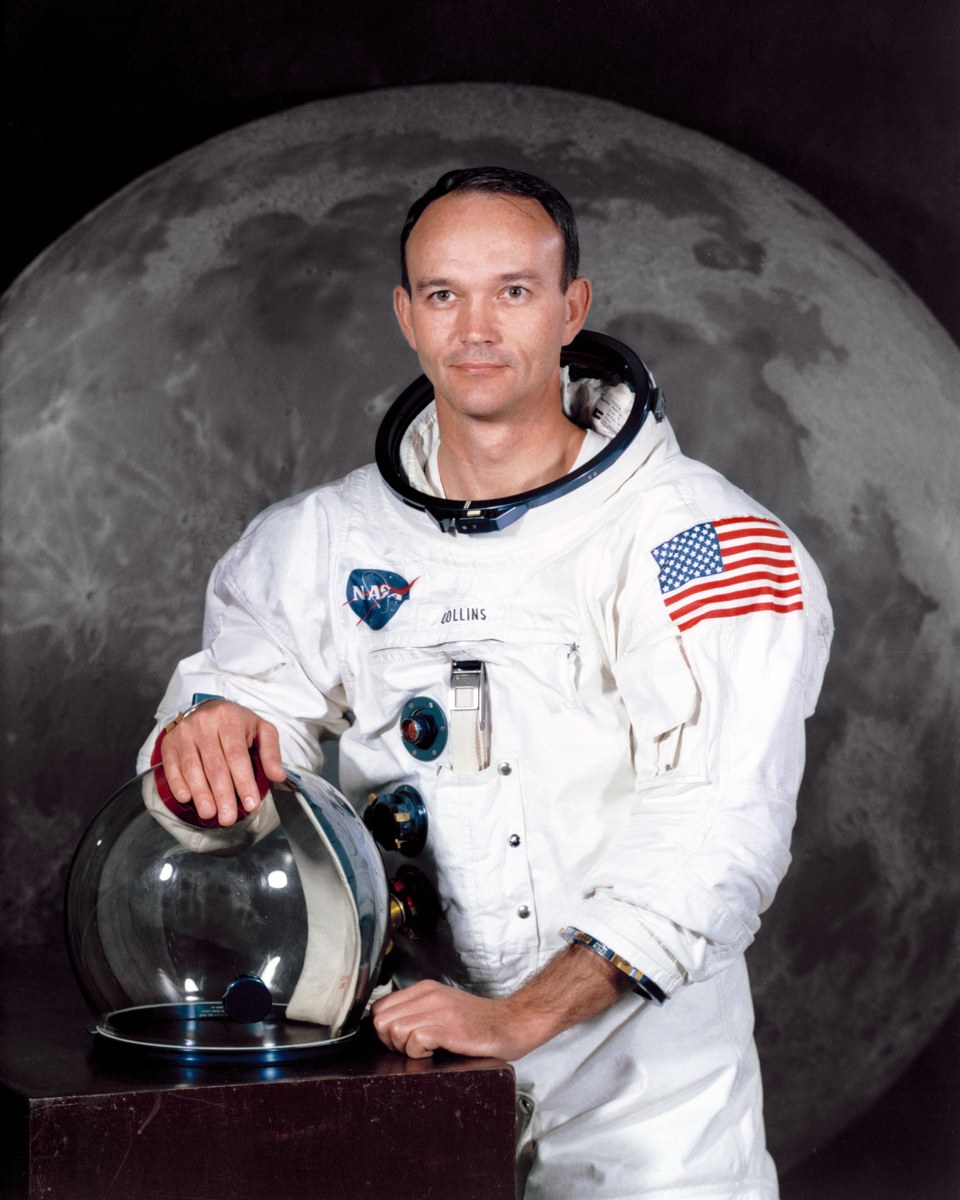

NASA / Johnson Space Center, photo S69-31742, Apollo 11 prime crew portrait, 16 April 1969, downscaled from the original · NASA Johnson Space Center photograph S69-31742, 'APOLLO XI - PRIME CREW PORTRAIT' (Astronaut Michael Collins; NASA record date 16 April 1969, although the record's caption text begins '(July 1969)'), downloaded from the NASA Image and Video Library original (6461 x 8076 pixels, 5,464,797 bytes), the same size as the Wikimedia Commons file 'Michael Collins (S69-31742).jpg' (author NASA, tagged public domain as a NASA work, with only the standard personality-rights warning). This is the NASA original, NOT the Commons restoration 'Michael Collins (S69-31742, restoration).jpg' (a third-party digital restoration of the same photograph). NASA's Media Usage Guidelines say NASA content is generally not subject to copyright in the United States and that third-party copyrighted material is marked with the holder's name; this record carries no third-party credit and no logo. Downscaled once to 960 x 1200 (never upscaled). · Public Domain (NASA work)
우주비행사 · 20세기
마이클 콜린스
1930–2021
주요 업적 분야
아직 성격 매칭에 포함되지 않았습니다 — 기록된 근거가 성격 모델 전체를 다루기에는 충분하지 않습니다. 이 페이지의 다른 모든 내용은 자유롭게 확인하실 수 있습니다.
핵심 특성
주요 업적
콜린스는 최초의 달 착륙 임무였던 아폴로 11호(1969년 7월 16~24일)의 사령선 조종사였다. 닐 암스트롱과 버즈 올드린이 착륙선 이글을 타고 달 표면으로 내려가는 동안 그는 사령선 컬럼비아호에 남아 21시간 넘게 혼자 달 궤도를 돌았고, 두 사람이 달 표면에서 이륙해 돌아오자 마지막 도킹 기동을 맡아 승무원들이 다시 합류해 지구로 돌아올 수 있게 했다.
1966년 7월 그는 존 영과 함께 제미니 10호를 조종했다. 사흘간의 이 비행에서는 먼저 아제나 표적 우주선 하나와 랑데부·도킹한 뒤 그 아제나의 엔진을 이용해 궤도에 남아 있던 두 번째 아제나와 다시 랑데부했다. 콜린스는 열린 해치에서 서서 작업한 선외활동과 줄을 달고 나가 두 번째 아제나에서 미소 운석 실험 장치를 회수한 우주 유영까지 두 차례 선외활동을 했으며, 국립항공우주박물관은 그를 한 임무에서 우주 유영을 두 번 한 최초의 사람으로 소개한다.
NASA를 떠난 뒤 그는 1971년부터 1978년까지 스미소니언 국립항공우주박물관장을 맡았다. 그가 부임했을 때 건물은 승인만 났을 뿐 예산이 확정되지 않은 상태였고, 그는 배리 골드워터 상원의원의 지원으로 예산을 확보해 1972년에 착공했으며, 1976년 7월 1일 워싱턴 내셔널 몰에서 박물관이 문을 열기까지 팀을 이끌었다. 박물관은 그의 1974년 회고록 『Carrying the Fire』를 지금도 많은 사람들이 역대 최고의 우주비행사 회고록으로 꼽는다고 설명한다.
삶의 장면들
제미니 10호의 두 번째 우주 유영에서 콜린스는 두 번째 아제나를 향해 몸을 밀어 날아갔지만 도킹 콘의 매끈한 가장자리를 붙잡지 못하고 실험 장치에서 멀어졌다. 우주선에서 약 5미터 떨어진 지점에서 그는 감겨 있는 생명줄을 당길지 손에 쥔 추진 건을 쓸지 재빨리 결정해야 했고 추진 건을 택했다. 짧게 여러 번 분사해 우주선으로 갔다가 다시 아제나에 다가가 미소 운석 실험 장치를 회수했다. 손에 쥔 장치를 잃을까 봐 교체용 장치를 설치하는 일은 포기했고, 이후에는 생명줄에 몸이 엉켜 영의 도움으로 풀려나야 했다.
계획한 접근이 실패했을 때 즉석에서 쓸 만한 해법을 찾아낸 모습과 일치하지만, 작업은 예상보다 오래 걸렸고 이후 생명줄이 몸에 엉키기도 했다. 자원 활용 성향
이글이 달 표면에서 이륙해 랑데부한 뒤 콜린스는 자동 조종 상태로 컬럼비아호를 이글에 도킹했다. 암스트롱이 대략적인 자세 정렬을 해 두면 콜린스가 마지막 조정을 맡았다. 도킹 프로브를 끌어당기는 가스 장치를 작동시키자 두 우주선 사이에 요 방향 진동이 커졌고, 그는 수동 조종으로 자세를 바로잡으며 착륙선을 놓아 주고 다시 시도해야 할지도 모른다고 생각했지만, 장치를 작동시킨 지 6~8초 뒤 걸쇠가 잠겼다. 1969년 기술 보고에서 그는 진동이 어떻게 될지 충분히 지켜보지 않았고 작동 전에 더 기다리는 편이 나았을 수 있다고 말하면서도, 진동의 원인에 따라 다르기 때문에 다시 해도 달리 할지는 확신하지 못한다고 덧붙였다. 암스트롱의 보고는 같은 순간을 착륙선 안에서 설명한다.
도킹을 마친 뒤 자신의 절차를 솔직하게 되짚으면서도 원인이 분명하지 않다고 밝힌 조종사의 모습과 일치하지만, 이 설명은 본인의 기술 보고에 근거한다. 입장 수정 성향
전환점
콜린스의 첫 번째 NASA 우주비행사 지원은 1962년에 거절되었다. 훗날 그가 회고한 바에 따르면 통지서는 그가 우주비행사 프로그램의 특별한 요건을 충족하지 못한다고 했다. 그는 이듬해 다시 지원했고 1963년 10월 NASA의 세 번째 우주비행사 그룹으로 선발되어 제미니 10호와 아폴로 11호로 가는 길에 올랐다.
거절을 다시 지원할 이유로 삼은 지원자의 모습과 일치하지만, 두 보도의 설명은 모두 그의 회고록에 바탕을 둔다. 끈기
비슷한 인물
전체적인 프로필이 이 사람과 닮은 사람들이에요.
출처
- Michael Collins (Q104859) -- verified live via the Wikidata API (2026-10-16): English label 'Michael Collins', description 'American astronaut (1930-2021)', born 31 October 1930, died 28 April 2021, citizenship United States, Korean label present. Orientation only; not used as support for any row.
- NASA Johnson Space Center, 'Biographical Data: Michael Collins (MGEN, USAF, Ret.), NASA Astronaut (Former)', September 2015 -- the agency's official biography: third astronaut group (October 1963); backup pilot for Gemini 7; pilot of the three-day Gemini 10 flight (launched 18 July 1966) with command pilot John Young, a rendezvous and docking with an Agena target vehicle, a second rendezvous with a passive Agena using the first Agena's engine, and two periods of extravehicular activity that included recovering a micrometeorite experiment from the passive Agena; command module pilot of Apollo 11 (16-24 July 1969), the first lunar landing mission, who stayed aboard Columbia in lunar orbit while Armstrong and Aldrin descended in Eagle and who performed the final re-docking manoeuvres; two flights, 266 hours in space, 1 hour 27 minutes of EVA; left NASA in January 1970. CANONICAL SIGNIFICANCE SOURCE (honouring in tone, so used for the achievement cards and for dates and roles only; its personal data, honours and out-of-date directorship line were not used). Read in full.
- Barton C. Hacker and James M. Grimwood, 'On the Shoulders of Titans: A History of Project Gemini' (NASA SP-4203, NASA History Office, 1977), the Gemini X section of 'Charting New Space Lanes' (about pp. 341-351) and the later passages on Gemini XI and XII that mention Collins -- NASA's commissioned official history of the dual-rendezvous flight, built on the mission report, technical debriefs and interviews with Young and Collins: Collins unstowing the sextant and mistaking the airglow for the horizon until he saw stars below the line, the sextant image not matching what he had been taught so that he laid it aside and tried another instrument and the ground's figures were used, a stand-up spacewalk photographing the southern Milky Way (22 frames over a night pass), computing two midcourse corrections for the second rendezvous, the second spacewalk in which he lost his grip on the passive Agena, chose the hand-held gun over the umbilical, retrieved the S-10 micrometeorite package, abandoned installing its replacement for fear of losing it and then had to be untangled from the umbilical by Young, and the later changes for Gemini XI and XII (handholds on the docking cone, better foot restraints, and an umbilical cut from 15 to 9 metres at Collins's and Young's suggestion), with Collins passing his experience to Gemini XI pilot Richard Gordon. Official history by NASA-commissioned historians, factual and not hostile; some of its Gemini X detail rests on the crew's own debriefs and interviews. Read the Gemini X section and the Collins passages in the Gemini XI and XII chapters; the rest of the book was not read.
- W. David Woods, Kenneth D. MacTaggart and Frank O'Brien (eds.), Apollo Flight Journal, 'Apollo 11 Day 6, part 2: Rendezvous and Docking' (corrected transcript and commentary, updated 2025) -- historian-edited transcript of the ascent-stage rendezvous with Columbia: Collins's VHF-ranging and sextant tracking and his reports when the ranging dropped out, his independent calculation of the terminal phase initiation burn time (127:02:34.50, about 32 seconds later than Aldrin's) and his follow-up calls to confirm the final time, the commentary that he was prepared to fly a mirror-image manoeuvre and start a command-module-active rendezvous if Eagle could not, the commentary that his figure proved nearer the actual burn time, and the 1969 technical debrief passages in which Collins and Armstrong each describe the docking, including the yaw oscillation after the retract bottle was fired, Armstrong's account of the gimbal lock and Collins's own appraisal of how he fired the bottle. Independent scholarly editorial account built on mission transcripts and debriefs, with crewmates describing the same event from both vehicles. Read the commentary in full and the transcript passages on ranging, the TPI calculation and docking; the remaining transcript was skimmed.
- Eric M. Jones (ed.), Apollo Lunar Surface Journal, Apollo 11 'Post-landing Activities' and 'EVA Preparations' pages (annotated transcript and commentary) -- Collins in Columbia during the lunar stay: asking Houston whether another P22 tracking program was wanted, being asked to devote his attention to picking out the LM visually, reporting 'no joy' after keeping his eyes glued to the sextant on one pass, realising that the automatic optics had not been pointing at the coordinates he was given, proposing to run the tracking program while driving the sextant himself because the sextant was his best tool for looking, and later reporting the tracking program still pointing in the wrong place and asking for corrected latitude, longitude and altitude; the editors' notes that Houston's several estimates were up to several kilometres off and that the sextant's field of view was about 3.2 km. Independent editorial commentary on mission records. Read the P22 and sextant-search exchanges across GET 106:11-108:48 and the editors' notes on them; the rest of both pages (the surface EVA and other transcript) was not read.
- Margaret A. Weitekamp, 'Remembering Michael Collins', National Air and Space Museum, 28 April 2021 -- the museum's own memorial: he campaigned for a museum on the National Mall by the 1976 bicentennial and worked tirelessly on both building and exhibits, marshalling curators and designers; in 1971 inquired about becoming the museum's third director when the building was approved but unfunded, secured the funding with Senator Barry Goldwater's support and broke ground in 1972; the building opened on 1 July 1976 and drew a million visitors in its first month; in 1978 he became a Smithsonian undersecretary; Gemini 10 as the first person to perform two spacewalks on the same mission (the museum's statement); Apollo 11 and his rejection of the 'loneliest person' label; Carrying the Fire still regarded by many as the best astronaut memoir ever written; colleagues remembered his wit, intelligence and thoughtfulness. Institutional and honouring in tone, written by the museum he led; its family and honours passages were not used. Read in full.
- Sarah LeClaire, 'Carrying the Fire: An Astronaut's Journeys Manuscript' (NASM.XXXX.0399), finding aid with biographical note and 'A Chronology of Major General Michael Collins' Life', National Air and Space Museum Archives, 2023 -- the archive's chronology of his NASA application and Deke Slayton's call, the Gemini 10 and Apollo 11 entries, the pre-flight press-conference remark that going 99.9 percent of the way suited him fine, and the museum years (the 1971 appointment, lobbying for funding, the $40 million allocated, the 1976 opening described as under budget and three days ahead of schedule thanks to his leadership, and the undersecretary post held until 1980). Institutional archivist's chronology, honouring in places; its count of solo lunar orbits conflicts with the Flight Journal's revolution numbering and was not used, and its personal-life, family, health and surgery, and State Department entries were not used. Read the biographical note and chronology in full.
- William Harwood, 'Apollo 11 astronaut Mike Collins dies at 90', written for CBS News and reproduced by Spaceflight Now, 28 April 2021 -- news obituary: orbited the Moon alone while Armstrong and Aldrin landed; Gemini 10 dual rendezvous with two Agena targets and two spacewalks; his first application to NASA rejected and a second one accepted in 1963; his 2019 CBS interview on the 'daisy chain' of events and the single ascent engine; biographer Andrew Chaikin's characterisation of him as perceptive, balanced, a fine writer who did not enjoy fame and kept out of the limelight; the later career at the Smithsonian's museum. Independent news summary quoting an outside biographer and Collins's own words; its cause-of-death and family passages were not used. Read in full.
- Jay Bennett, 'The enduring legacy of Michael Collins, astronaut and chronicler of Apollo 11', National Geographic, 28 April 2021 -- news profile: alone for more than 21 hours in Columbia; the 1962 rejection of his first astronaut application, quoting Carrying the Fire on the rejection letter and on deciding to reapply, and his selection with the third group; his own 2019 recollection of drifting away from the Agena on a long umbilical during Gemini 10; his Apollo 8 capsule-communicator role; his service as the museum's director from 1971 to 1978 overseeing the opening of the main building; his later advocacy of Mars exploration; the book as perhaps his most important legacy. Independent journalism, partly built on Collins's own words from his memoir and a 2019 interview; its cause-of-death, family and sidebar passages were not used. Read in full.
- NASA Image and Video Library record S69-31742 (Johnson Space Center), 'APOLLO XI - PRIME CREW PORTRAIT' (record date 16 April 1969; description 'Astronaut Michael Collins'), with NASA's Media Usage Guidelines and the Wikimedia Commons original-file page 'Michael Collins (S69-31742).jpg' -- checked for the portrait's basis. Not used for any scoring.