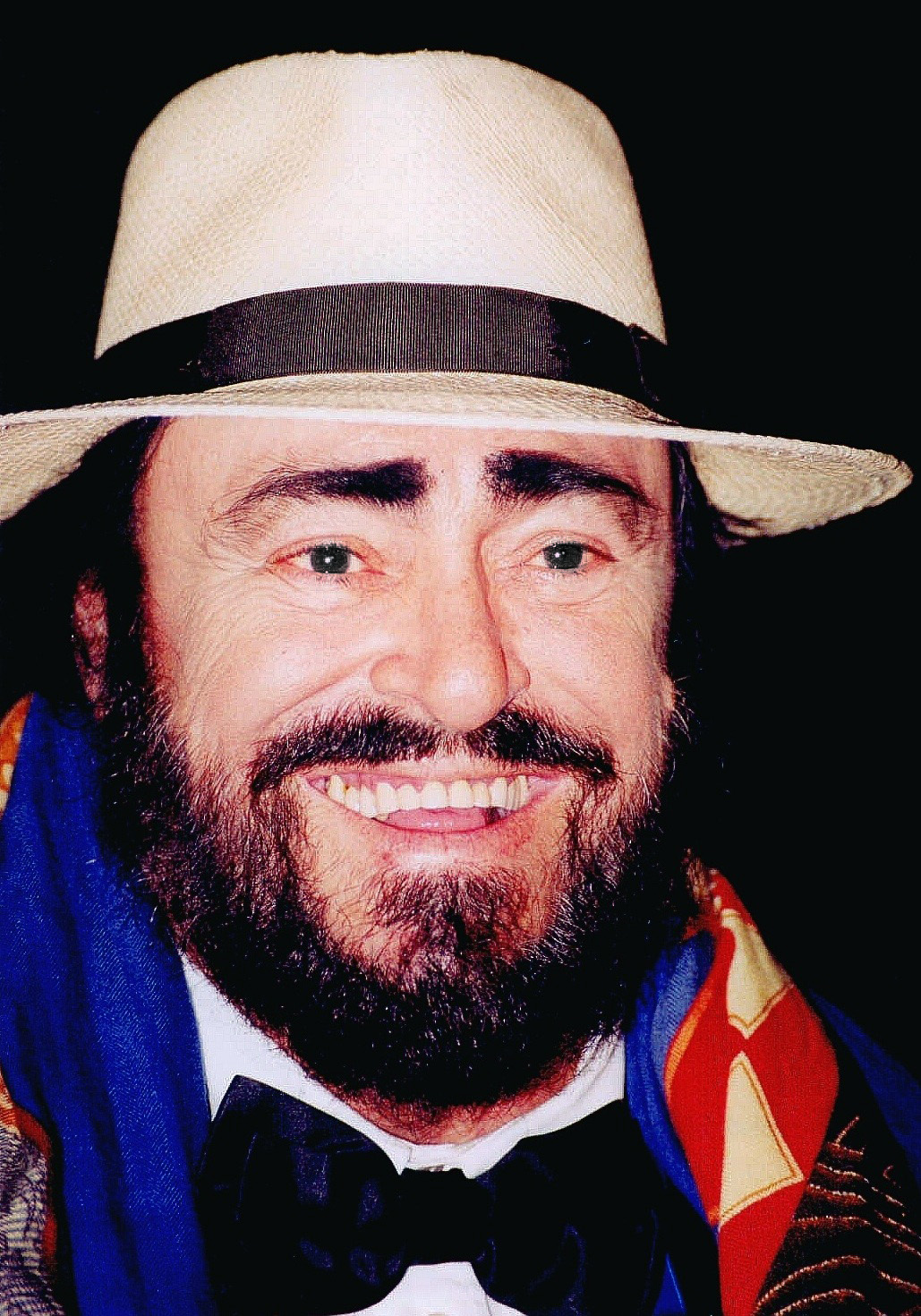

John Mathew Smith / www.celebrity-photos.com, CC BY-SA 2.0, via Wikimedia Commons · Photograph of Luciano Pavarotti by John Mathew Smith (www.celebrity-photos.com), Flickr 'Luciano Pavorotti' (photo 5139163179, scanned and uploaded 2010-11-02), licensed by the rights-holder on the photo itself as CC BY-SA 2.0 (live Flickr page JSON-LD and licence badge checked 2026-10-24); Commons file 'Luciano Pavarotti 2004.jpg' carries cc-by-sa-2.0 with a FlickreviewR 'passed' result (reviewed 2018-11-30 against a web.archive.org capture of 2020-05-25, i.e. the licence was stable, not newly changed). Original 1029 x 1470 pixels, SHA-1 caafc6a8480e81185f7dbf9ff40a2e5931818a6c (matches the downloaded file); saved unchanged, never resized or upscaled. CAVEATS: the Flickr description says only 'From Wash D.C.'; the Commons text adds 'Kennedy center honors 2001' while the Commons file name says 2004, so the exact date is uncertain (Pavarotti was a 2001 Kennedy Center honoree; the filename year is treated as an error and 2001 is used with that uncertainty); the photographer's account-level licence policy was not checked beyond this photo's own licence. Rejected alternatives: Library of Congress 'Luciano Pavarotti, opera star' (Bernard Gotfryd, 1979-1983, 3161 x 4647) because the Commons PD-Gotfryd tag rests on 'no known restrictions' and its own note says Gotfryd's photographs were restricted during his lifetime and may carry privacy/publicity limits, which is not a rights basis I could resolve; other Commons images are amateur or YouTube screenshots. · CC BY-SA 2.0 (photo-level licence by John Mathew Smith on Flickr; Commons FlickreviewR passed)
가수 · 20세기
루치아노 파바로티
1935–2007
주요 업적 분야
아직 성격 매칭에 포함되지 않았습니다 — 기록된 근거가 성격 모델 전체를 다루기에는 충분하지 않습니다. 이 페이지의 다른 모든 내용은 자유롭게 확인하실 수 있습니다.
핵심 특성
주요 업적
1970년대 중반 최고의 서정 테너로 꼽혔다. 부드러움과 힘을 겸비한 목소리로 벨칸토와 이탈리아 레퍼토리에서 명성을 얻었고, 1972년 메트로폴리탄 오페라 「연대의 딸」의 토니오 역에서 아홉 개의 하이 C를 소화해 '하이 C의 제왕'이라는 별명을 얻었다.
36년에 걸쳐 메트로폴리탄 오페라에서 약 379회 무대에 올라 어느 극장보다 많이 출연했고, 1977년 「라 보엠」으로 방송된 '라이브 프롬 더 메트' 중계에 출연해 오페라를 폭넓은 텔레비전 시청자에게 알렸다.
텔레비전, 스타디움 공연, 팝 가수와의 듀엣, 도밍고·카레라스와 함께한 1990년 '3대 테너' 공연으로 오페라를 대중에게 가져갔다. 이는 수많은 관객을 모았지만 오페라의 격을 떨어뜨렸다고 보는 순수주의자들의 비판도 받았다.
삶의 장면들
1972년 메트로폴리탄 오페라에서 「연대의 딸」 토니오의 아리아에 나오는 하이 C를 모두 소화했다. 이 이름난 고음 구간은 그를 세계적인 이름으로 만들었고 '투나잇 쇼' 출연으로 이어졌다.
이는 유명한 고난도 구간을 공개 무대에서 감당하려는 태도와 부합한다. 위험 감수
1977년 「라 보엠」 방송 뒤 그는 텔레비전의 힘을 깨달았고 이를 위해 힘쓰기로 했다고 말했으며, 이후 메트 텔레비전 방송에 19차례 출연했다.
이는 청중을 넓힐 새로운 매체를 알아보는 안목과 부합한다. 기회 감지
전환점
1970년대 중반부터 오페라 활동에 리사이틀, 텔레비전, 스타디움 공연을, 1990년부터는 3대 테너 공연을 더해 청중을 넓혔지만 오페라의 격을 떨어뜨린다는 비판도 받았다.
이는 더 많은 대중에 닿기 위해 형식을 바꾸는 유연함과, 그에 따른 순수주의자 사이의 평판 하락 가능성과 부합한다. 적응력
비슷한 인물
전체적인 프로필이 이 사람과 닮은 사람들이에요.
출처
- Luciano Pavarotti (Q37615) -- verified live via the Wikidata API (2026-10-24): Korean label '루치아노 파바로티', English description 'Italian operatic tenor (1935–2006)', but the structured dates are born 12 October 1935 and died 6 September 2007 (the English description's end year is a Wikidata error; the press sources read agree on 2007). Orientation only; not used as support for any row.
- Encyclopedia.com, 'Luciano Pavarotti' (encyclopedia.com), page read in full as raw text; it reproduces two reference entries (a Contemporary Musicians-style profile and a longer biographical dictionary entry). They say he was considered by many the greatest male singer since Caruso and in the mid-1970s probably the century's best lyric tenor; trained for years with two teachers (Arrigo Pola and Ettore Campogalliani) while working as a teacher and insurance salesman; made his professional debut as Rodolfo in 1961, stepped in for Giuseppe Di Stefano at Covent Garden in 1963, sang with Joan Sutherland under Richard Bonynge in a partnership of nearly thirty years, sang the nine high Cs of Tonio in La Fille du Regiment at the Met in 1972 and became 'King of the High Cs', moved into recitals, arenas, television and film, joined Carreras and Domingo as the Three Tenors in 1990 and organised the Pavarotti & Friends concerts; quotes Pavarotti ('I want to be famous everywhere') and records criticism: that his appeal outside opera drew chastisement, that in the 1990s his voice waned and he depended on amplification, that cancellations became frequent, and a reviewer's likening of a Met recital to 'a well-made mummy'. The two entries disagree on his U.S. debut year (1965 versus 1967) and on the leading soprano of the first Live from the Met telecast, so those details were not used. CANONICAL SIGNIFICANCE SOURCE. Reference compilation, partly drawn from magazine interviews; his family, tax and illness passages were not used.
- Associated Press, 'Pavarotti bids adieu to opera with Tosca', Deseret News (14 March 2004), read in full: his decision that the March 2004 Tosca at the Metropolitan Opera was his last night of staged opera anywhere; his 379 scheduled Met performances compared with 140 at La Scala, 100 at Covent Garden and fewer elsewhere; reviewers who found him nearly immobile and the voice lacking the bloom of youth though with moments of the distinctive sound; his own candid remarks ('in the last 10 years there are a lot of performances that are not super') and that he needed to be lighter on stage; his account of the 1977 Live from the Met telecast and his decision to 'devote myself to television'; 19 Met television broadcasts and 31 Three Tenors concerts; the two famous May 2002 Tosca cancellations. Wire-service journalism built partly on an interview; the self-quotations are his own retrospective.
- Associated Press obituary, 'Luciano Pavarotti, world renowned tenor, dies aged 71', Taipei Times (7 September 2007), read in full: his career milestones (1961 debut, Covent Garden 1963, La Scala 1965, San Francisco 1967, the Met 1968), the mid-1970s turn to television commercials and stadium mega-concerts and pop collaborations, the 1990 Three Tenors concert, Placido Domingo's tribute to his voice, the verdict that for serious fans the beauty and urgency of his voice made him the ideal interpreter of the Italian lyric repertory, and that his last public performance was 'Nessun dorma' at the 2006 Turin Olympics. Standard wire obituary, admiring; its coverage of his marriages and illness was not used.
- Biography.com, 'Pavarotti Once Quit Singing, Then Came Back and Became an Opera Legend' (biography.com), read in full: his years of study with Arrigo Pola and Ettore Campogalliani and a decision (told in his autobiography) to quit singing before his voice settled; the 17 curtain calls after the 17 February 1972 Fille du Regiment at the Met; the 1977 Live from the Met broadcast and almost 400 Met performances; the Three Tenors and Pavarotti & Friends; soprano Shirley Verrett's tribute; and the unattributed summary that he was criticised for poor music-reading, was unpopular with conductors for insisting on tempos, had his professionalism questioned late in his career over cancellations, and in 1989 was banned from the Lyric Opera of Chicago after cancelling 26 performances over a decade. Popular-history article; the criticisms are not sourced in the piece, so they were used only at reduced confidence and the music-reading claim was not scored.
- Las Vegas Sun, 'The one tenor' (9 April 1999), read in full: his concert promoter Tibor Rudas on seventeen years and some 200 arena shows with Pavarotti, the packaging of the Three Tenors, Pavarotti's refusal to sing in 1,200-seat casino showrooms as too small for his voice, the 1982 first booking, and critics' reactions: Norman Lebrecht's description (as quoted) of the arena shows as 'a travesty of the art', the Fort Worth critic Wayne Lee Gay's comparison with opera, the German author Jurgen Kesting's view that Pavarotti had become a trademark, and the Los Angeles Times critic Mark Swed's view that the concerts address a different audience. Local-newspaper feature; the promoter is a partial and admiring voice, the critics supply the counter-view.
- NPR (Sylvia Poggioli), 'Pavarotti's Death Gets Little Attention in Italy', All Things Considered (7 September 2007; transcript), read in full: Italian opera lyricist Gianluigi Melega's view that the 1990 Three Tenors concerts 'cheapened' opera mystique, a young scholar's view that Italian critics never forgave the crossover, the absence of musicologists and opera critics from Italian airwaves after his death, and Pavarotti's own dismissal of such criticism and wish to be remembered as an opera singer. COUNTER-VOICE. Radio report; its remarks on his marriage and the tax matter were not used.
- Time (Associated Press-credited obituary), 'Luciano Pavarotti dies' (6 September 2007; content.time.com), read in full: tributes from Domingo and Italy's culture minister; Italian critic Mario Luzzato Fegiz's description of him as a tenor 'without pretensions' close to the people; the description of him as both a perfectionist and a born showman; the Pavarotti & Friends duets that some opera purists never forgave, which he acknowledged in a 2006 interview; his 1965 Miami stand-in beside Joan Sutherland followed by La Scala. Magazine obituary, admiring with a purist counter-quote; its remarks on tax and marriage were not used.