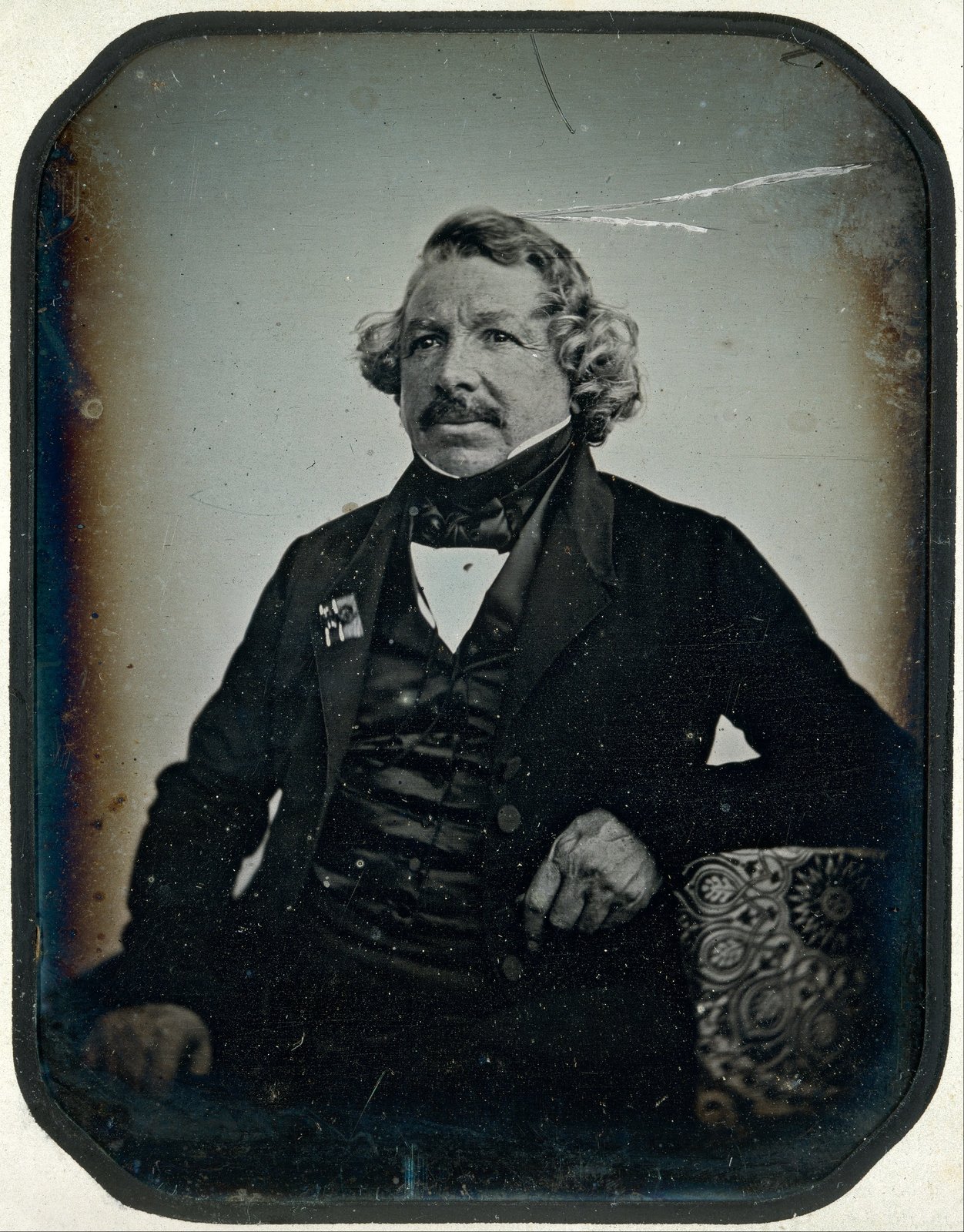

Jean-Baptiste Sabatier-Blot (1801-1881), 'Louis Jacques Mande Daguerre', daguerreotype, 1844; George Eastman Museum. Basis: an 1844 original by a creator who died in 1881 (public domain by term, Commons PD-Art/PD-old-100), and the museum's own partner listing on Google Arts & Culture shows 'Rights: Public Domain'. The museum's own collection site (collections.eastman.org) is behind a Cloudflare wall and could not be consulted, so no museum-site rights notice was read, and none conflicting was observed. The original verso inscription confirms the sitter, the maker (his friend Sabatier-Blot) and the year 1844. · George Eastman Museum (Rochester, NY), daguerreotype of Louis-Jacques-Mandé Daguerre by Jean-Baptiste Sabatier-Blot, 1844 (gift of Eastman Kodak Company; ex-collection Gabriel Cromer), via Google Arts & Culture partner page asset kAGH5aEML9GTQQ and the Wikimedia Commons Google Art Project copy (original 2349x3001, downsized to 1252x1600 at q85) · Public domain
핵심 특성
주요 업적
1839년 다게르가 공개한 방법에서는 은을 입힌 구리판에 요오드 증기를 쐬어 감광층을 만들고, 카메라에서 노출한 다음 가열한 수은 증기로 상을 나타내고, 마지막으로 빛에 반응하지 않도록 처리했다. 정부의 취지서는 이 방법에 4~5분이 걸린다고 밝혔는데, 니세포르 니엡스의 역청 방식은 몇 시간이 걸렸다. 다게르는 1839년 자신의 글에서 다게레오타입이 니엡스에게 빚진 것이 없다고 주장했지만, 니엡스를 기리는 입장의 다바네도 수은 증기로 현상하는 잠상 현상을 알린 공은 다게르에게 있다고 인정한다.
1822년 다게르는 화가 샤를마리 부통(Charles-Marie Bouton)과 함께 파리에 디오라마를 열었다. 앞뒤 양면에 그린 커다란 반투명 캔버스를 앞이나 뒤에서 비춰, 한 장면이 낮에서 밤으로, 또는 다른 효과로 바뀌게 한 것이다. 한 회 공연은 그림 두 점으로 이루어졌고, 다게르의 〈생테티엔뒤몽의 자정 미사〉가 초기 작품에 속했다. 1839년 정부와의 계약에는 디오라마의 회화·조명 기법도 공개한다는 조항이 들어 있었다.
프랑스에서는 이 방법에 특허를 줄 수 없었기 때문에, 내무장관은 1839년 6월 14일 다게르와 이지도르 니엡스와 합의하여 국가가 이를 사들이고 다게르에게 연 6,000프랑, 니엡스에게 연 4,000프랑의 종신 연금을 주기로 했다. 법은 7월 3일 하원, 7월 30일 상원을 통과했다. 프랑수아 아라고는 8월 19일 과학 아카데미에서 이 방법을 설명했고 회의장은 넘치는 청중으로 가득 찼다. 다게르의 설명서는 제작자 알퐁스 지루(Alphonse Giroux)에서 나왔고, 지루는 다게르의 서명이 든 장비를 팔았다. 에더는 다게르가 1839년 8월 14일 영국 특허도 받았다고 덧붙인다.
삶의 장면들
1827년 9월 3일 다게르는 1826년부터 접촉해 온 니세포르 니엡스와 파리에서 세 시간가량 만났다. 에르누프가 인용한 니엡스의 이튿날 편지에 따르면, 다게르는 그에게 디오라마를 구경시키고 자신의 빠른 방법과 여러 색을 담으려는 시도의 어려움을 설명했으며, 니엡스가 더 앞서 있다고 믿었고, 상을 고정하는 시간을 줄여야 한다고 강하게 말했다. 두 사람은 1829년 12월 동업 계약을 맺었다.
여러 번 미적지근한 답을 받고도 더 앞선 연구자를 찾아가고, 그 만남에서 다음 과제를 밀어붙인 일은 주도적 행동과 부합한다. 이 서술은 에르누프가 실은 니엡스 쪽 서신에 근거한다. 선제적 행동력
1839년 3월 8일 다게르가 새뮤얼 모스의 전신기를 보러 가 있는 사이 불이 나 디오라마와 그의 집이 타 버렸고, 모스는 이튿날 형제들에게 편지를 썼다. 5월 20일 모스는 미국에서 다게르의 작품 전시를 주선하겠다고 제안했고, 다게르는 7월 26일 프랑스 정부와의 거래가 거의 끝나 가고 있어 그 제안을 받을 수 없다고 답했다.
손실을 겪은 뒤에도 외국의 제안 대신 정부 매각이라는 기존 방향을 유지한 점은 끈기와 부합한다. 모스는 다게르에게 우호적인 증인이며 편지는 그의 아들이 엮었다. 끈기
전환점
1837~1838년 다게르와 이지도르 니엡스는 투자자를 찾았고, 1838년 5월 15일에는 구독 방식으로 이 방법을 팔려 했다. 에르누프에 따르면 사람들은 은판 사진에 감탄하면서도 상이 오래갈지 의심하고 복제를 걱정했으며, 에더는 이 시도가 실패했다고 전한다. 다게르는 이후 비밀을 프랑수아 아라고에게 알렸고, 아라고는 1839년 1월 7일 과학 아카데미에 이 발명을 알리고 내무장관과의 협의를 도왔다.
특허로 보호할 수 없는 발명에 시장이 값을 치르지 않자 국가로 방향을 바꾼 일은 임기응변·자원 활용 능력과 부합한다. 구매자들의 이유는 에르누프의 서술에만 의존한다. 자원 활용 성향
비슷한 인물
전체적인 프로필이 이 사람과 닮은 사람들이에요.
출처
- Louis Daguerre (Q131405) -- verified live via wbgetentities (2026-10-08): en label 'Louis Daguerre', description 'French scientist, artist and photographer (1787-1851)', ko label '루이 다게르', citizenship France (Q142), P569 18 Nov 1787, P570 10 Jul 1851 (Wikidata also carries alternate date values). Orientation only; not used as support for any row.
- Louis Daguerre and Boulevard du Temple (photograph), Wikipedia articles -- read as orientation only (the Boulevard du Temple article dates the plate '1838 or possibly 1837', so that plate is deliberately left out of the editorial cards); not used as support for any scored row.
- Daguerre, Historique et description des procédés du daguerréotype et du diorama (Paris: Alphonse Giroux, 1839), Internet Archive full text (historiqueetdesc00dagu) -- SELF SOURCE and also the vehicle for Daguerre's own priority case against Niépce: his 'Note historique' argues that Niépce had no part in the daguerreotype and prints extracts of Niépce's 1831-32 letters 'pour copie conforme, Arago, Daguerre'. Read locally: the Giroux apparatus notice, the 1839 contract, the practical description of the process, the Note historique with the Niépce and Isidore Niépce letter extracts, and the closing paragraphs on coloured light in the Diorama. Not used for any evaluative claim about himself; used only for dated facts and his documented actions.
- Official parliamentary documents of 1839 as reprinted in the same Giroux volume (Internet Archive historiqueetdesc00dagu): the Minister of the Interior's exposé des motifs (Duchâtel), François Arago's report to the Chamber of Deputies, and Gay-Lussac's report to the Chamber of Peers -- ADVOCATE-OFFICIAL texts written to secure the pensions (Arago was Daguerre's confidant and verified his sealed deposit), so their praise is discounted; read in part (exposé, the Arago report through the process description and the Delaroche note, and Gay-Lussac's closing arguments). Used for dated facts, the stated length of the research, the 6,000/4,000 franc pensions and for what the committee said it had verified.
- Edward Lind Morse (ed.), Samuel F. B. Morse: His Letters and Journals, vol. 2 (Boston: Houghton Mifflin, 1914), Project Gutenberg #11018 -- EYEWITNESS FRIEND'S letters (Morse, in Paris in March 1839), edited and framed by Morse's admiring son; read the passages on Daguerre: Morse's 2 and 9 March 1839 letters (the Diorama fire), his 20 May 1839 letter to Daguerre proposing an American exhibition and Daguerre's 26 July 1839 reply, and the later recollection of Daguerre's openness with him. Firsthand on dated events, partisan in tone.
- Baron Alfred Auguste Ernouf, Les inventeurs du gaz et de la photographie: Lebon d'Humbersin, Nicéphore Niepce, Daguerre (Paris: Hachette, 1877), Internet Archive full text (lesinventeursdug00erno_0), Daguerre chapter -- French popular-historical biography, sympathetic to Daguerre but explicitly engaged with the Niépce-family dispute (it quotes Niépce's 1827-29 letters and rebuts the 1841 and 1867 pamphlets). It repeats some anecdotes of doubtful sourcing (the spoon, the dating of the fire to 1838), which were not used. Read locally: the whole Daguerre section (youth and stage work, the Diorama, the 1826-29 approaches to Niépce, the 1829/1835/1837 contracts, the 1838-39 sale to the state and the aftermath).
- Josef Maria Eder, Ausführliches Handbuch der Photographie, vol. 1 part 1, 3rd ed. (Halle: Knapp, 1905), 'Nicéphore Niepce und Daguerre' chapter, Internet Archive full text -- Austrian scholarly history of photography, documentary in method (reproduces the 1829 and 1837 contracts, the 1830 letter from the Diorama, the 1839 laws, and cites Austrian court files); neutral between the French and Niépce camps, though it passes on the cupboard-and-mercury story only as hearsay ('soll'), which was not used. Read locally: the whole Daguerre biography, contracts, the 1838 subscription, the 1839 parliamentary and Academy dates, the English patent of 14 August 1839, the Giroux apparatus and the later years at Bry-sur-Marne.
- Alphonse Davanne (vice-president of the Société française de photographie), Nicéphore Niepce, inventeur de la photographie: conférence faite à Chalon-sur-Saône pour l'inauguration de la statue de Nicéphore Niepce, 22 juin 1885 (Paris: Gauthier-Villars, 1885), Internet Archive full text -- NIÉPCE-HONOURING lecture by a leading photographic-society figure, hostile to the idea that Daguerre's route was the right one ('égarée pendant près de quinze ans par le séduisant procédé de Daguerre') yet crediting Daguerre with the latent image developed by mercury vapour, citing Fouque's 1867 book (not itself located or read). Read locally: the sections on the Niépce-Daguerre association, the pensions, the latent image and the later improvements.
- The Literary Gazette (London), issues of 12 January 1839 (translation of H. Gaucheraud's report in the Gazette de France of 6 January 1839 on seeing Daguerre's plates), 30 March 1839 (Arago's remarks to the Academy after the Diorama fire, on the Niépce/Daguerre credit and the Bauer letter) and 24 August 1839 ('The Daguerre Secret', report of the Academy session of Monday 19 August) -- CONTEMPORARY foreign press and an invited eyewitness; Internet Archive full-text OCR (sim_literary-gazette_1839-01-12_1147, -03-30_1158, -08-24_1179), partly garbled, read for the dated facts used.