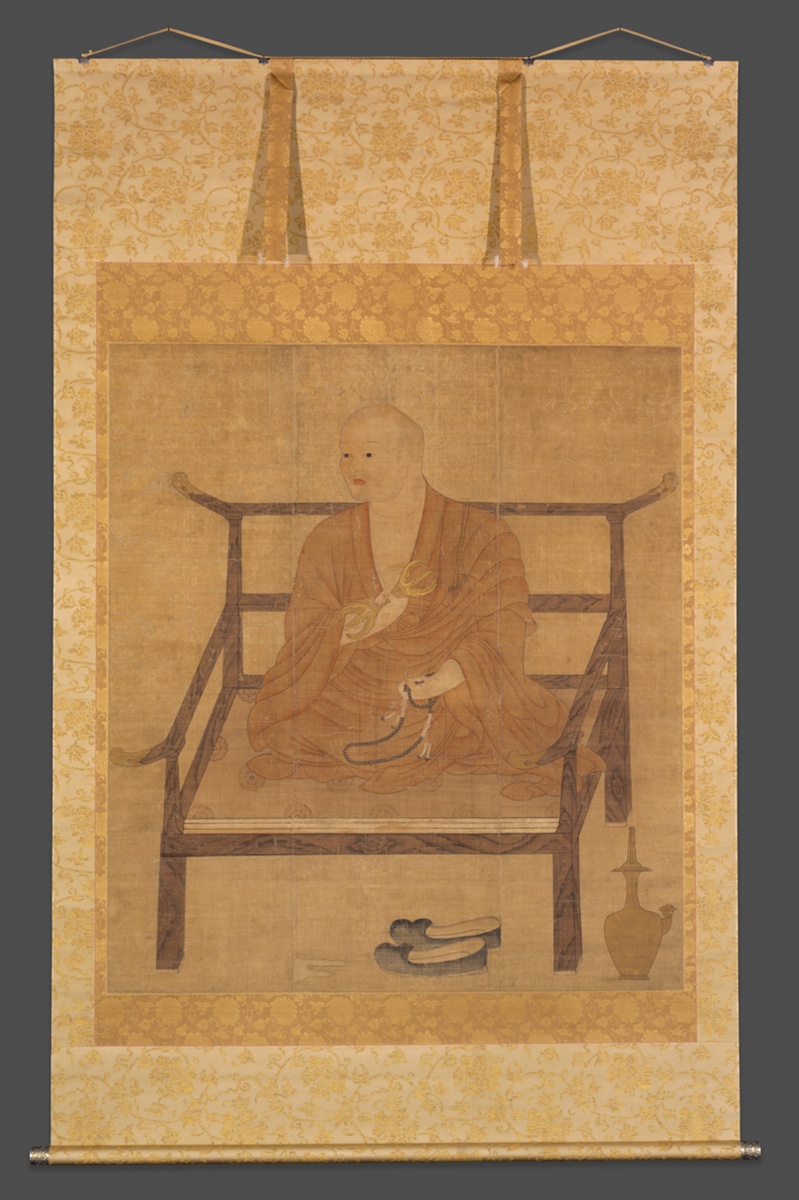
Artist unknown, Portrait of Kobo Daishi (Kukai), 14th century, Art Institute of Chicago, 1960.40, gift of Robert Allerton, CC0 · Portrait of Kobo Daishi (Kukai), hanging scroll in ink, colors and gold on silk, artist unknown, Japanese, 14th century, Art Institute of Chicago, reference number 1960.40, gift of Robert Allerton. The museum's own object page carries a CC0 Public Domain Designation and its API lists the work as public domain with no copyright notice; the work is roughly 700 years old. A devotional portrait painted some five centuries after his death, so shown as a later depiction and not as a likeness. The photograph shows the whole mounted scroll. Original image 3623 x 5440 pixels from the museum's IIIF server, downscaled to 799 x 1200 with no cropping and no upscaling. · CC0 1.0 Universal (Art Institute of Chicago Public Domain Designation)
종교 지도자 · 중세
구카이
774–835
헤이안 시대 일본
주요 업적 분야
아직 성격 매칭에 포함되지 않았습니다 — 기록된 근거가 성격 모델 전체를 다루기에는 충분하지 않습니다. 이 페이지의 다른 모든 내용은 자유롭게 확인하실 수 있습니다.
핵심 특성
주요 업적
804년 당나라로 건너가 혜과에게 밀교를 배운 뒤, 806년 200점이 넘는 경전과 의례 도구를 가지고 돌아와 일본에 진언종을 세웠다.
사가 천황은 816년 고야산을, 823년 교토의 도지를 그에게 내주었고, 이 두 곳이 진언종의 중심이 되었다.
《삼교지귀》와 만년의 십주심론 같은 저술로 진언 교리를 세웠고, 828년에는 신분에 관계없이 누구에게나 열린 학교 종예종지원을 열었다.
삶의 장면들
812년 그는 사이초에게 입문 관정을 해 주겠다고 승낙했지만, 수학을 마치지 못했다는 이유로 마지막 관정은 거절했고 훗날 경전 대여도 거절했다.
이는 경전만이 아니라 정식 관정 과정을 통해 가르침을 배워야 한다고 고집한 스승의 모습과 일치한다. 숙련 지향
전환점
804년 그는 견당사 일행에 합류해 당나라 장안에 이르렀고, 혜과는 805년 사망하기 직전 그에게 두 만다라의 관정을 모두 전했다.
이는 일본 내 사적 수행에서 완전한 밀교 법맥을 가지고 돌아오는 경로로의 전환과 일치한다. 숙련 지향
비슷한 인물
전체적인 프로필이 이 사람과 닮은 사람들이에요.


에이다 러브레이스

라빈드라나트 타고르

마야 안젤루

볼프강 아마데우스 모차르트

거트루드 벨
출처
- Kukai (Q222227), verified live via the Wikidata API (2026-10-30): label 'Kūkai', description 'Japanese Buddhist monk and calligrapher, the founder of the Shingon school (774-835)', born 774 (also 774-07-27), died 835-04-22, citizenship Japan, Korean label present, image 'Kukai2.jpg'. Orientation only; not used as support for any row.
- Ryuichi Abe, 'Kukai', Encyclopedia of Buddhism (via Encyclopedia.com), read in full. CANONICAL SIGNIFICANCE SOURCE: a ninth-century figure renowned for introducing esoteric Buddhism into early Heian society; a short stay at the state college, then training among privately ordained priests; ordained in 804 and sent to Tang China, where he studied under Huiguo and returned with over 210 scriptures; credited by the author with devising a paradigm for separating esoteric from exoteric Buddhism and a theory of ritual language; founded the Latter Seven-Day rite at the palace; became one of medieval Japan's most popular Buddhist saints. Scholarly reference entry by the author of 'The Weaving of Mantra'; it does not mention the school or the reservoir.
- John Bowker (ed.), 'Kukai', The Concise Oxford Dictionary of World Religions (via Encyclopedia.com), read in full (one paragraph): 804 journey to Chang'an, initiation under Huiguo into the two mandalas, return in 806 with over 200 religious objects, Emperor Saga as benefactor, the grant of Mount Koya in 816 and Toji in 823 as the centres of the school, and Shingon a recognised school by his death in 835. Short dictionary entry; corroborates the outline of the Encyclopedia of Buddhism entry and is not independent of it on the basic chronology.
- New World Encyclopedia, 'Kukai', read in the biography, works and legends sections (about 27,000 characters): his Sangō shiiki (797) comparing the three teachings, Huiguo's transmission of both mandalas, his difficult position beside the better-placed Saicho, Saicho's borrowing of texts and his refusal of Saicho's last request to borrow a scripture, his 809 catalogue of imported items and petition for state support, the 810 appointment at Todaiji, the grant of Mount Koya, the school for all ranks opened in 828, the 830 magnum opus, the 834 petition for a palace chapel, and the note that over 5,000 legends are told about him. Edited encyclopedia article derived from scholarly reading; the narrative is not footnoted, so it is used as a cross-check and for the Saicho episode.
- Mark Cartwright, 'Kukai: Japan's Founder of Shingon Buddhism', World History Encyclopedia (2017), read in full: separates a 'more historically reliable account' of his early life from legends (the leap from the cliff, the morning star), dates the Sangō shiiki to about 797-798, gives the Mount Koya foundation as 819, the Toji grant of 823 and the Shorai mokuroku, notes the asceticism reflected in a poem from the Seirei shu, and says the claim that he invented the kana script is made 'without any evidence'. Popular reference article citing Keene and others; it contradicts the 816 date for Mount Koya given by the Oxford dictionary.
- To-ji Temple (Kyoto), 'History of To-ji Temple', read in full (about 2,800 characters): the 823 gift of the temple by Emperor Saga, Kukai making it the central seminary of Shingon, his study of esoteric Buddhism, cultural arts and civil engineering in China, the community on Mount Koya in 816, and that he 'established the first private school in Japan'. Temple self-description in tourist-facing English; the 'first' claim is the temple's and is not repeated here as fact.
- Koyasan Shingon Buddhism Headquarters, Japanese-language life of Kobo Daishi (koyasan.or.jp), read in full (about 10,000 characters): a devotional life that includes the childhood leap from the cliff, the flying vajra, the rain-making at Shinsen-en, and also reports the 828 school for people of all ranks and the 821 imperial order to rebuild the Mannoike reservoir, completed, it says, in about three months. Hagiographic denominational text, so legend and chronology are mixed; used only to show what the tradition claims and to cross-check the school and the reservoir.
- Art Institute of Chicago, 'Portrait of Kobo Daishi (Kukai)', reference 1960.40, hanging scroll, 14th century, artist unknown, CC0 Public Domain Designation on the museum's own page; checked for the portrait only, not used for any scoring.