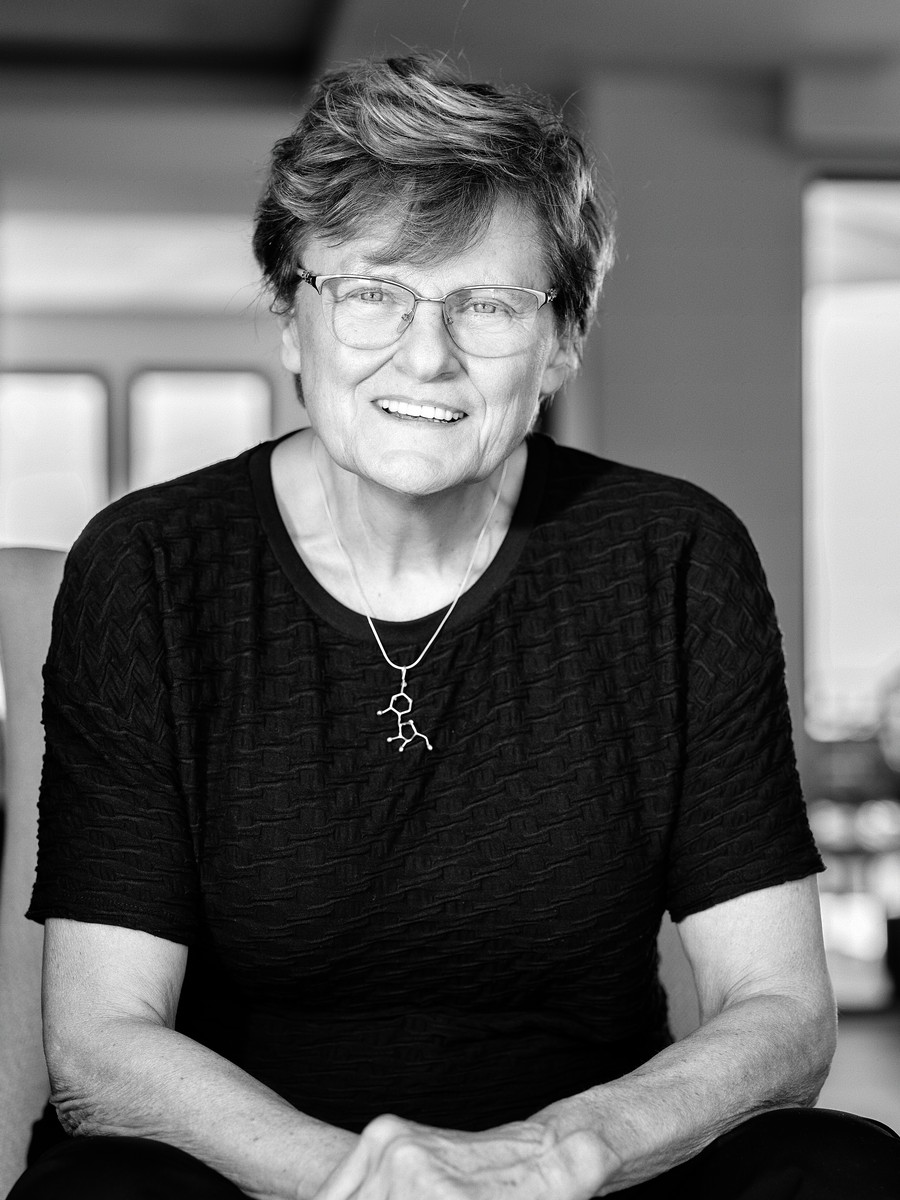

Photo: Christopher Michel, 2024, licensed under CC BY-SA 4.0; cropped and downscaled from the original · Wikimedia Commons, 'Katalin Karikó in 2024 by Christopher Michel 02.jpg' -- photograph by Christopher Michel, taken 16 September 2024, uploaded by the photographer (Commons account Cmichel67) on 17 September 2024 as own work under CC BY-SA 4.0; original JPEG 4569 x 6850 pixels (about 19.6 MB, Canon EOS R5 Mark II metadata). Black-and-white portrait. A 3:4 region (3969 x 5292 pixels) around her head and torso was cropped from the original and downscaled once to 900 x 1200 (never upscaled). · CC BY-SA 4.0
생물학자 · 현대
커털린 커리코
b. 1955
주요 업적 분야
아직 성격 매칭에 포함되지 않았습니다 — 기록된 근거가 성격 모델 전체를 다루기에는 충분하지 않습니다. 이 페이지의 다른 모든 내용은 자유롭게 확인하실 수 있습니다.
핵심 특성
주요 업적
커리코는 면역학자 드루 와이스먼과 함께, 합성 mRNA의 기본 구성 요소를 슈도우리딘 같은 변형 뉴클레오사이드로 바꾸면 mRNA가 일으키는 염증 반응이 크게 줄어든다는 것을 보였다. 2005년의 이 논문에 이어 2008년과 2010년의 연구는 같은 변형이 단백질 생산도 늘린다는 것을 보여 주었고, 노벨위원회는 이 성과가 mRNA를 임상에 쓰는 데 걸림돌이던 핵심 장애물을 없앴다고 설명한다.
화이자-바이오엔테크와 모더나의 mRNA 코로나19 백신 두 가지는 이렇게 변형된 mRNA를 토대로 만들어져 2020년 12월에 처음 승인되었고, 약 95퍼센트의 예방 효과가 보고되었다. 이 발견의 공로로 커리코는 2021년 래스커-드베이키 임상의학연구상에 이어 2023년 와이스먼과 함께 노벨 생리의학상을 받았다.
그녀는 수십 년 동안 mRNA를 의약품으로 만드는 일에 매달렸다. 노벨위원회에 따르면 1989년부터 2013년까지 일한 펜실베이니아 대학교에서 연구비 지원 기관을 설득하는 데 어려움을 겪으면서도 연구를 이어 갔고, 2013년에는 독일의 바이오엔테크로 옮겼다. 바이오엔테크가 화이자와 함께 만든 백신은 처음 승인된 mRNA 코로나19 백신 두 가지 가운데 하나였다.
삶의 장면들
합성 mRNA가 왜 염증을 일으키는지 알아내기 위해 커리코와 와이스먼은 먼저 출처가 다른 RNA들을 비교했다. 세균 RNA는 수지상세포에서 강한 반응을, 포유류 RNA는 약한 반응을 일으켰고, 포유류 운반 RNA는 아무 반응도 일으키지 않았다. 운반 RNA에는 변형 뉴클레오사이드가 많다는 점에서, 두 사람은 변형 뉴클레오사이드를 하나씩 넣은 mRNA를 여러 종류 만들어 수지상세포에 투여하고 세포의 성숙 정도와 두 가지 RNA 감지 수용체의 활성화를 측정했다. 이 실험의 순서는 래스커 재단의 설명에 따른 것이다.
가설을 단계적으로, 비교를 통해 시험하는 방식과 일치한다. 분석적 엄밀성
1990년대 중반 커리코는 펜실베이니아 대학교에서 정년 트랙을 벗어나 새로 만들어진 선임 연구원 자리로 옮겨졌고, STAT에 글을 쓴 스튜어트 벅은 mRNA 연구로 NIH 연구비를 한 번도 받지 못한 것이 그 배경이라고 적는다. 펜실베이니아 가제트에 따르면 그녀는 1997년 신경외과 연구실로 옮긴 뒤에도 논문을 계속 냈고, 1999년에는 유로키나제 수용체 단백질을 이용해 시험관에서 만든 mRNA가 살아 있는 세포에서 잘 발현된다는 것을 보인 논문을 발표했다.
제도적 좌절을 겪는 동안에도 연구 계획을 이어 간 모습과 일치한다. 끈기
전환점
1997년 커리코는 펜실베이니아 대학교에 막 부임한 면역학자 드루 와이스먼을 복사기 앞에서 만났다. 래스커 재단에 따르면 커리코는 와이스먼이 HIV 백신 실험에 필요로 하던 mRNA를 만들어 주겠다고 제안했고, 와이스먼이 이를 받아들이면서 2005년 뉴클레오사이드 변형 논문으로 이어진 협업이 시작되었다. 와이스먼은 이후 20년 넘게 함께 일했다고 말했다.
서로 보완되는 전문성을 가진 협력자를 찾아 나서고 자신의 기술을 먼저 내놓는 태도와 일치한다. 협업 성향
비슷한 인물
전체적인 프로필이 이 사람과 닮은 사람들이에요.


워런 버핏

마리 퀴리

소르 후아나 이네스 데 라 크루스

존 D. 록펠러

에이다 러브레이스
출처
- Katalin Karikó (Q88608397) -- verified live via the Wikidata API (2026-10-15): English label 'Katalin Karikó', description 'Hungarian biochemist', Hungarian and Korean labels present, instance of human, born 17 January 1955 in Szolnok, no date of death, citizenship Hungary and the United States, occupations including biochemist, researcher, university teacher and inventor; a name search for the person returns only this entity. Orientation only; not used as support for any row.
- The Nobel Assembly at Karolinska Institutet, press release for the 2023 Nobel Prize in Physiology or Medicine, 2 October 2023 (with the laureates' short biographies) -- CANONICAL SIGNIFICANCE SOURCE: the prize to Katalin Karikó and Drew Weissman 'for their discoveries concerning nucleoside base modifications that enabled the development of effective mRNA vaccines against COVID-19'; the committee's account that Karikó, 'devoted to developing methods to use mRNA for therapy', stayed true to her vision despite difficulties in convincing research funders, that the two noticed dendritic cells react to in vitro transcribed mRNA and tested mRNA variants with modified bases (inflammation 'almost abolished'), the 2005 paper and the 2008 and 2010 studies showing increased protein production, the two base-modified mRNA vaccines approved in December 2020; and her career facts (born 1955 in Szolnok, PhD at Szeged in 1982, postdoctoral work in Szeged, at Temple University and in Bethesda, at Penn from 1989 to 2013, then BioNTech, since 2021 professor at Szeged and adjunct professor at Penn). Award-body citation, honouring in tone. Read in full.
- Nobel Prize Outreach, 'Katalin Karikó' (Women who changed science series; undated feature referring to 2020-2024) -- the Nobel organisation's popular profile: grants and mistrust at Penn, a demotion after which she persisted, her late-1990s meeting with Drew Weissman at a photocopier, the discouraging first mouse experiments with inflammatory responses, the 2005 discovery, her 2013 move to BioNTech, and her use of prize money to support RNA research at Szeged. Much of the page is family, early-life and political-context material and her own recollections of her departure from Penn, none of which was used; only the professional chronology was used, and only as a secondary check. Read in full.
- Evelyn Strauss for the Lasker Foundation, 'Modified mRNA vaccines' (2021 Lasker~DeBakey Clinical Medical Research Award to Katalin Karikó and Drew Weissman: citation, the Foundation's account of the work and the laureates' acceptance remarks) -- award-body narrative: Karikó's commitment to mRNA therapeutics from her undergraduate years, steady funding rejections and lack of institutional support through the 1990s, the 1997 photocopier meeting and her offer to make mRNA for Weissman's HIV experiments, the discovery that mRNA by itself matured dendritic cells and the decision to find how to avoid the immune activation, the experiments with RNAs from different sources and with a collection of modified nucleosides (2005), pseudouridine and protein output (2008), the chromatographic purification step, the 2012 erythropoietin tests in mice and monkeys, the move to BioNTech in 2013 and the continued work at a distance, and the 2010 stem-cell paper that finally drew notice. Detailed and specific, honouring in tone; the laureates' own remarks at the end are self and were not used as support. Read in full.
- Andrew Joseph and Deborah Balthazar, '2023 Nobel Prize in Medicine: Karikó, Weissman awarded prize for mRNA research', STAT, 2 October 2023 -- news report: the two researchers' complementary expertise as the Nobel committee framed it, Karikó's 'rejection after rejection in the 1990s while applying for grants' and demotion at Penn, the 2005 discovery, how it 'did not gain wide attention' but caught the attention of the scientists who went on to found Moderna and BioNTech, and her present posts at Szeged and Penn. Her quoted recollections of the demotion and her advice to students are self and were not used. Independent journalism, sympathetic. Read in full.
- Stuart Buck (executive director of the Good Science Project), 'The Karikó problem: Lessons for funding basic research', STAT First Opinion, 1 February 2022 -- opinion essay on science funding that summarises her record: a non-tenure-track research post at Penn, demotion in 1995 because she never won an NIH grant for her mRNA research, a former colleague's remark that her history was told 'as a cautionary tale for young scientists', the copy-machine meeting with Weissman, and the 2005 paper being 'summarily rejected' by Nature and Science (Nature calling it an 'incremental contribution'). Policy writer's argument, used only for the factual summary. Read in full.
- Catherine Offord and Jon Cohen, 'mRNA discovery that paved way for COVID-19 vaccines wins Nobel Prize in Physiology or Medicine', Science, 2 October 2023 -- science-news report: the 2005 Immunity paper (replacing uridine with modified bases such as pseudouridine reduced the inflammatory response) and the 2008 follow-up on protein output, the first regulatory authorisations of mRNA vaccines in December 2020, Karikó telling Science that in the early 2000s she had no research team and did the biochemistry with her own hands, comments by Anthony Fauci ('doggedly kept at it'), by the oncologist Jessica Foster, who has worked with her, and by the Nobel Assembly's Thomas Perlmann that she 'never received an R01' grant from the NIH. Independent reporting with named colleagues and officials, admiring. Read in full.
- Megan Zahneis, 'Katalin Karikó has thoughts on how to support shunned scholars like her', The Chronicle of Higher Education, 5-6 October 2023 (print issue of 27 October 2023) -- interview-based report: the account of her demotion and pay cut at Penn for lack of grants, the 'incremental contribution' verdict on the 2005 paper, her view that blame is 'twisted' and that funding and publishing systems reward fashionable work, the two Penn colleagues who supported her (a cardiologist who paid her salary for seven years when grants were rejected and a neurosurgery resident who helped secure her a post), and her proposal for formalised institutional support for unconventional scholars. Her remarks on recognition are self; the account of a department chair's pressure over publications and grants is an employment dispute and was not used. Independent reporting. Read in full.
- Penn Today (University of Pennsylvania), 'A wrong number, a cryptic message, and a big Nobel win', 2 October 2023 -- the university's report of the prize announcement and press conference: the chance meeting in the late 1990s while photocopying papers, the 2005 discovery, the report that Weissman noted they 'stayed focused and kept working, despite not getting funding, not getting published, and failing to persuade others that mRNA was interesting and viable', his remark that 'we spent the rest of those 20-plus years working together', and the university leaders' praise. Institutional news item, admiring (the promotional adjectives of the university's president and dean were not used). Read in full.
- Matthew De George, 'The Vaccine Trenches', The Pennsylvania Gazette, May | June 2021 (cover feature, read from the magazine's PDF) -- alumni-magazine feature with interviews: her work at the bench 'never above doing the unglamorous work' even as a vice president, how her former supervisor Elliot Barnathan hired her in 1989 and describes her as 'incredibly inquisitive' and a voracious reader, her reputation as 'the RNA hassler' for offering to make RNA for colleagues, the mid-1990s move off the tenure track into a newly created senior research investigator post, the neurosurgery lab and the 1999 paper she kept publishing, the photocopier meeting with Weissman, grants and investors that did not materialise, the 2004-2005 work on nucleosides and the patent, Barnathan's 'patchwork quilt' description of her method, and Weissman's 'We never gave up'. Skims over the Pfizer chief medical officer sidebar and the vaccine-policy passages, which were not used. Independent feature journalism with named colleagues, admiring. Read in full.
- Flora Lichtman, 'The Leap: I Was Considered A Nobody' (Science Friday in partnership with the Hypothesis Fund; audio profile with transcript), 12 May 2025 -- produced radio profile whose only used material is the first-hand recollection of the neurosurgeon David Langer, who worked with her as a student: that she was 'crazy about cleaning all the glassware' and taught him how to rinse a beaker properly, and his description of how she handled disconfirming data. The segment's family, early-life and immigration passages, the narrator's speculation that her focus on truth explains her demotion and departure from Penn, a colleague's characterisations of her conduct towards senior figures, and her own recollections of the dispute were not used (personality inference from an employment dispute and private life). Audio profile with one named colleague, admiring and promotional in framing. Read in full.
- Wikimedia Commons file page 'Katalin Karikó in 2024 by Christopher Michel 02.jpg' -- checked for the portrait's file and licence: description 'Katalin Karikó in 2024', taken 16 September 2024 (12:10), source 'own work' and author 'Creator:Christopher Michel' (the photographer's Commons account Cmichel67 uploaded it on 17 September 2024), licence tag 'self | cc-by-sa-4.0' (Creative Commons Attribution-ShareAlike 4.0), original JPEG 4569 x 6850 pixels (about 19.6 MB), category Katalin Karikó. Not used for any scoring.