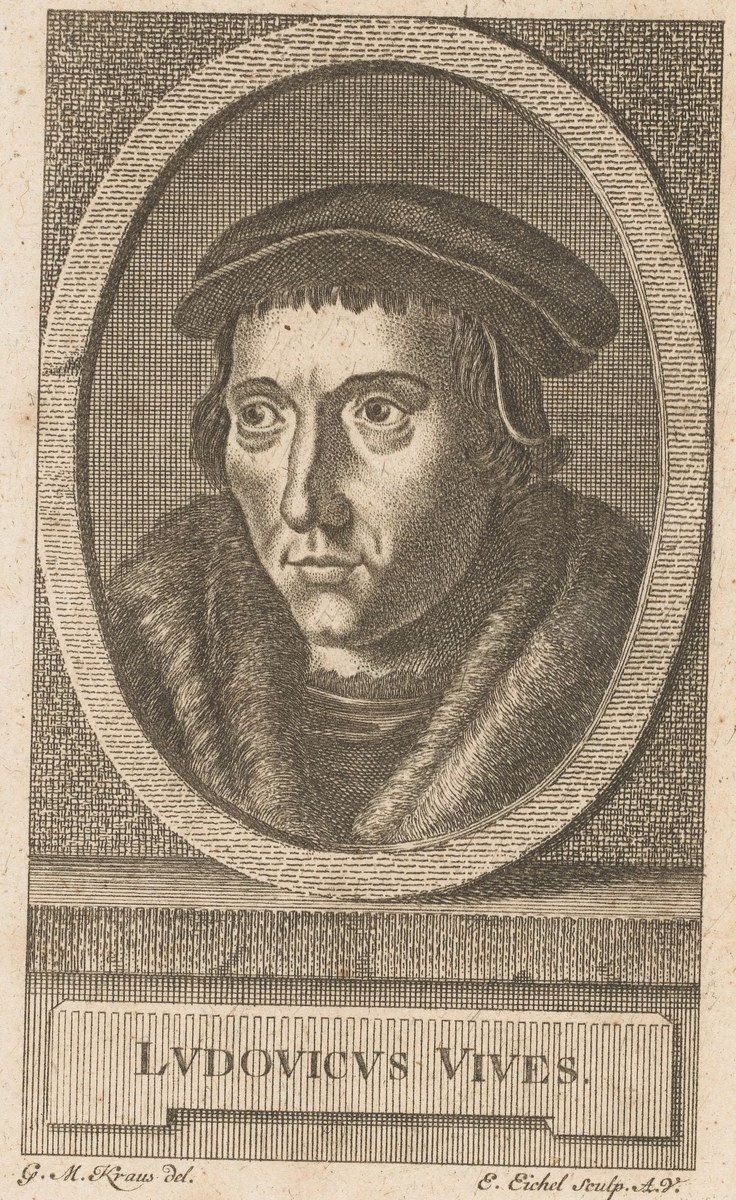
Emanuel Eichel after Georg Melchior Kraus, 'Portret van Juan Luis Vives', engraving, 1747-1782, Rijksmuseum, Amsterdam (RP-P-OB-115.961), public domain · Engraved portrait lettered 'LUDOVICUS VIVES.' by Emanuel Eichel (Augsburg) after a drawing by Georg Melchior Kraus, an eighteenth-century print made long after the sitter's death in 1540; held by the Rijksmuseum, Amsterdam (RP-P-OB-115.961). The museum scan (3,280 x 5,328 pixels) was cropped to the printed plate and downscaled once to 736 x 1,200 pixels; nothing was upscaled. Shown as a later print depiction, not as a documented sitting. · Public domain (Rijksmuseum Public Domain Mark; eighteenth-century print)
철학자 · 근세
후안 루이스 비베스
1492–1540
주요 업적 분야
아직 성격 매칭에 포함되지 않았습니다 — 기록된 근거가 성격 모델 전체를 다루기에는 충분하지 않습니다. 이 페이지의 다른 모든 내용은 자유롭게 확인하실 수 있습니다.
핵심 특성
주요 업적
북유럽 인문주의의 대표적 인물인 그는 1519년 스콜라 논리학을 공격했고, 『학문에 대하여』(1531)에서 당대 교육을 비판하면서 그 쇄신 방안을 제시했으며, 자국어 사용과 실용적 지식, 여성 교육을 옹호했다.
그는 브뤼허 시 당국에 헌정한 『빈민 구제론』(1526)에서 직업 훈련과 빈민 아동 교육을 포함하는 조직적인 공적 구제 계획을 제시했다.
『영혼과 생명에 대하여』(1538)는 영혼의 능력과 감정을 살피는 저작으로, 브리태니커는 심리학에서의 그의 명성이 이 책에 기초한다고 평가하며, 그의 저작은 사후 한 세기 동안 수백 판을 거듭했다.
삶의 장면들
1519년 그는 파리에서 배운 스콜라 논리학을 풍자적으로 공격한 『가짜 변증가들을 반박하며』를 펴내, 논리학이 일상어를 따르고 다른 학문에 봉사해야 한다고 주장했다. 다만 스탠퍼드 철학 백과는 이 저작 자체를 궤변적 연습으로 보는 해석도 전한다.
이는 자신이 받은 교육 과정과 공개적으로 결별하는 것을 마다하지 않는 모습과 일치한다. 독립적 사고
1526년 그는 조직적인 공적 구제 계획을 담은 『빈민 구제론』을 펴내 브뤼허 시 당국에 헌정했다. 황정욱은 브뤼허가 1562년에야 구빈법을 개혁했고 이 저작이 그의 사후 혹독하게 비판받았다고 지적한다.
이는 학문을 학계에 가두지 않고 공적인 문제에 적용하려는 태도와 일치한다. 영향 창출 동기
전환점
1528년 영국 궁정과 옥스퍼드에서의 시기가 끝난 뒤 그는 다시 브뤼허에 정착했고, 스탠퍼드 철학 백과에 따르면 생애 마지막 12년이 가장 왕성한 시기로, 『화합과 불화에 대하여』, 『학문에 대하여』, 『영혼과 생명에 대하여』를 내놓았다.
이는 중요한 지위를 잃은 뒤에도 방대한 학술 작업을 이어 가는 모습과 일치한다. 끈기
비슷한 인물
전체적인 프로필이 이 사람과 닮은 사람들이에요.
출처
- Juan Luis Vives (Q316357), verified live via the Wikidata API (2026-11-06): label 'Juan Luis Vives', description 'Spanish philosopher', born 6 March 1492, died 6 May 1540, Korean label 후안 루이스 비베스. Orientation only; not used as support for any row.
- Stanford Encyclopedia of Philosophy, 'Juan Luis Vives' (read in full, about 6,500 words: life and main works, dialectic and language, epistemology, moral and social philosophy, psychology, influence). CANONICAL SIGNIFICANCE SOURCE: gives Vives's Paris and Louvain years, the 1519 attack on scholastic logic, the 1524 Education of a Christian Woman and Introduction to Wisdom, the 1526 On Assistance to the Poor, the 1531 On the Disciplines, the 1538 On the Soul and Life, the years in England and the hundreds of editions of his works; also records a contrary reading in which the anti-scholastic satire is itself a sophistical exercise (Perreiah) and corrects his birth year to 1493.
- Encyclopaedia Britannica, 'Juan Luis Vives' (public-web portion read, about 600 words; the rest is behind a paywall and was not opened). General-encyclopedia summary: student of Erasmus, opposed Scholasticism, De ratione studii puerilis and De disciplinis (vernacular in schools, academies, education of women, study of nature by induction) and De anima et vita as the basis of his claim to eminence in psychology.
- Encyclopaedia Britannica, eleventh edition (1911), 'Vives, Juan Luis' (read in full, about 350 words; Wikisource transcription). Older scholarly summary with a bibliography (Mayans 1782 edition of the works; Bonilla y San Martin 1903): De causis corruptarum artium ranked with Bacon's Organon, residence at Corpus Christi College Oxford, tutor to Princess Mary reported as 'said to have' held.
- Encyclopaedia Judaica, 'Vives, Juan Luis', by Richard H. Popkin (full entry read, about 500 words; Encyclopedia.com reproduction). Independent account from the history of religion and philosophy: Inquisition records on his family, his dismissal from Oxford, the work and the 1543 posthumous De veritate fidei. COUNTER-VOICE and caution: it portrays him as returning to Bruges 'bitter and poor' and offers a speculative reading of his religion as a 'Marrano compromise', which is the author's interpretation and is not used for scoring.
- College of St George, Windsor Castle, Chapter Library, 'Katherine of Aragon's Book' by Eleanor Cracknell (full item read, about 330 words). Archivist's note on a copy of Vives's De concordia et discordia in humano genere (Antwerp, 1529) owned by Katherine of Aragon: his dedication of the Augustine edition to Henry VIII, the Oxford readership, the treatise on women's education and the content of De concordia on peace.
- Majorca Daily Bulletin, 'Juan Luis Vives, a professor at Oxford' (history column, 30 September 2020; read in full, about 700 words). Press feature on the converso background in Valencia and the Inquisition, the Oxford post, the later condemnation of his writings by the Louvain theologians (1546), Pope Paul IV (1559) and the Spanish Index (1584), and a letter of his on poverty after the loss of royal patronage; the letter is self-report quoted by the columnist.
- Hwang Jung Uck, 'The Historical Meaning of De subventione pauperum of J. L. Vives' (Journal of the Church History Society in Korea, vol. 26, 2010, pp. 233-284), abstract and bibliographic record on KoreaScholar (abstract only read; the full text is access-restricted and was not opened). Scholarly reading of the 1526 treatise for the magistrates of Bruges as a secular, organised relief scheme in contrast to the open relief of Nuremberg, Strasbourg and Ypres; says the work was harshly criticised after his death and that Bruges reformed its poor law only in 1562.
- Rijksmuseum, Amsterdam, print 'Portret van Juan Luis Vives' (RP-P-OB-115.961), Emanuel Eichel after Georg Melchior Kraus, linked-art collection record read (Public Domain Mark on the image, CC0 on the data). Holder record for the portrait; also confirms the title on the object 'Ludovicus Vives'.