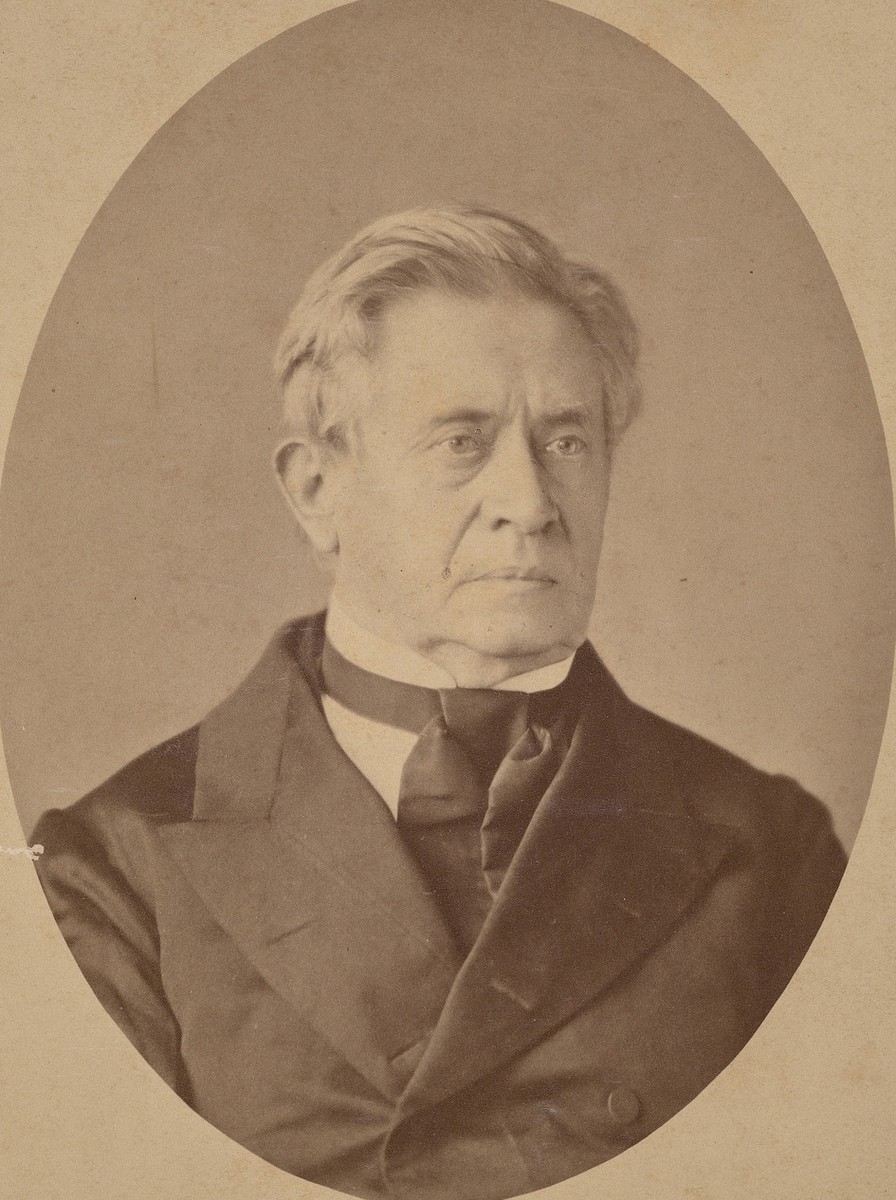

Thomas William Smillie, Portrait of Joseph Henry, April 1873, Smithsonian Institution Archives, Record Unit 95, Box 27B, image SIA_000095_B27B_097, public domain (CC0) · Photograph of Joseph Henry (1797-1878) by Thomas William Smillie, the Smithsonian's staff photographer (1843-1917), a cabinet card taken in April 1873, Smithsonian Institution Archives, Record Unit 95, Box 27B, image SIA_000095_B27B_097. The archive's item record marks the image as public domain (Creative Commons Zero) and gives the copyright status as no copyright in the United States. The file is a plain crop of the oval photograph from the archive's 3850 x 5760 pixel scan, downscaled to 896 x 1200 pixels with the card border cut away and no enlargement. · Public domain (Smithsonian Institution Archives, CC0)
물리학자 · 19세기
조지프 헨리
1797–1878
주요 업적 분야
아직 성격 매칭에 포함되지 않았습니다 — 기록된 근거가 성격 모델 전체를 다루기에는 충분하지 않습니다. 이 페이지의 다른 모든 내용은 자유롭게 확인하실 수 있습니다.
핵심 특성
주요 업적
1831년 매우 강력한 전자석을 만들고 전류의 자체 유도를 기술했으며, 패러데이가 먼저 발표하기는 했지만 전자기 유도도 독자적으로 발견한 물리학자로, 인덕턴스의 단위 헨리가 그의 이름에서 비롯되었다.
1846년부터 1878년까지 스미스소니언 협회의 초대 사무총장으로서, 대규모 도서관이나 박물관보다 과학 연구와 출판, 국제 교류를 중심으로 협회를 이끌었다.
그의 전자석 연구와 1835년까지 시연한 계전기는 모스 전신기의 상당 부분의 바탕이 되었다. 그는 자신의 연구에 특허를 내지 않았고, 한 역사가는 그가 없었다면 전신의 발명이 늦어졌을 것이라고 결론짓는다.
삶의 장면들
1831년 논문에서 그는 23가지 실험을 했다. 25개 전지로 바로의 전선 길이 시험을 되풀이한 뒤, 병렬로 감은 코일과 하나의 긴 코일을 비교해 가장 큰 자기력을 내는 배열을 찾았다.
이는 문제를 체계적으로 단계를 밟아 검증하는 방식과 일치한다. 분석적 엄밀성
1847년 그는 전신선으로 관측자에게 폭풍 접근을 알릴 수 있다고 스미스소니언 이사회에 말했고, 1850년경부터 협회에서 기상 보고를 지도에 표시했으며, 이후 이 일을 육군 통신대에 넘겼다.
이는 새로운 사업을 시작하고 다른 기관이 운영할 수 있게 되면 넘기는 방식과 일치한다. 선제적 행동력
전환점
1846년 프린스턴 교수직을 떠나 스미스소니언의 초대 사무총장이 되면서 자신의 연구 대부분을 포기했는데, 한 역사 항목은 그가 이를 아쉬워했지만 의무로 여겼다고 전한다.
이는 자신의 실험실 연구를 희생하면서까지 기관을 이끄는 책임을 받아들이는 성향과 일치한다. 주도 성향
비슷한 인물
전체적인 프로필이 이 사람과 닮은 사람들이에요.


오토 폰 비스마르크

루스 베이더 긴즈버그

넬슨 만델라

수전 B. 앤서니

무스타파 케말 아타튀르크
출처
- Joseph Henry (Q157043), verified live via the Wikidata API (2026-10-31): label 'Joseph Henry', description 'American scientist and the 1st Secretary of the Smithsonian (1797-1878)', born 1797-12-17, died 1878-05-13, Korean label present. Orientation only; not used as support for any row.
- Simon Newcomb, 'Biographical Memoir of Joseph Henry', read before the National Academy of Sciences on 21 April 1880 (about 110,000 characters, read in the PDF text for the sections on the electrical research, the Smithsonian administration, the Jewett contest, weather telegraphy and character). CANONICAL SIGNIFICANCE SOURCE: the National Academy's memoir of its late president; it names the 1831 electromagnet and induction work, the self-induction discovery, and the Smithsonian secretaryship as his central contributions, and notes that Faraday published first. A colleague's tribute, so admiring; it is the memoir that the Academy keeps, and it admits its debt to earlier notices.
- David Hochfelder, 'Joseph Henry: Inventor of the Telegraph?', Joseph Henry Papers Project, Smithsonian Institution Archives (essay, about 36,000 characters, read in full): an independent historian's account of Henry's 1831 paper and his coil experiments, his lecture-hall telegraph and relay, his advice and endorsements to Samuel Morse in 1839-1842, his unwilling testimony in the 1849-1852 patent suits, Morse's 1855 attack and Henry's appeal to the Smithsonian regents. It concludes that Henry did not invent the telegraph but that its invention would have been delayed without him. Written by a doctoral candidate for the papers project of the Smithsonian, which is a party with an interest in Henry's reputation, but it criticises Henry's slowness to reduce his work to practice and cites his students' notebooks.
- Smithsonian Institution Archives catalogue record for 'Educator and Researcher, Administrator and Public Servant: Joseph Henry's Career as a Scientist' (Annotation newsletter, March 2004; the author edited volumes 6-11 of the Henry papers), read as the catalogue summary only (not the article text): Henry was described at his death as the most eminent scientist in the United States, announced a powerful electromagnet in 1831, discovered mutual induction and self-induction, became professor at Princeton in 1832 and Smithsonian secretary in 1846, advised the federal government, and his reputation declined after his death before being restored in the 1960s. CANONICAL SIGNIFICANCE SOURCE (with the National Academy memoir). Institutional summary; only the catalogue abstract was read.
- Engineering and Technology History Wiki (IEEE), 'Joseph Henry' (unsigned entry, last edited 1 February 2016), read in full via the fetch tool: self-education, professor at Albany Academy from 1826, electromagnet work, the 'henry' unit, Princeton from 1832, first Secretary of the Smithsonian from 1846, his refusal to patent, and the statement that he turned down more lucrative offers because he believed the Smithsonian was the best way to serve science. Short, uncited professional-society wiki entry.
- 'Sketch of Professor Henry', Popular Science Monthly, volume 2 (April 1873), read in full in the Wikisource transcription (unsigned): a contemporary biographical sketch written during his lifetime on his upbringing, the Albany experiments, the Princeton years, the Smithsonian secretaryship and its 25 annual reports to 1871, and his work on the Light-House Board, the Civil War inventions commission and the National Academy. Popular and favourable, and does not mention Morse.
- Smithsonian Institution Archives catalogue summaries of 'The Library of Congress and the Smithsonian Institution: A Legislated Relationship' and of the 1951 biography of Charles Coffin Jewett, read as catalogue summaries only: they describe Henry's wish for a small research library, the regents' push for a larger one, Jewett's plan for a national library, the clashes ending in Jewett's dismissal in 1854, the 1848 international exchange and publications programme, and the 1866 transfer of the Smithsonian library to the Library of Congress. Gives the librarian's side of the quarrel at summary level; the full texts were not read.