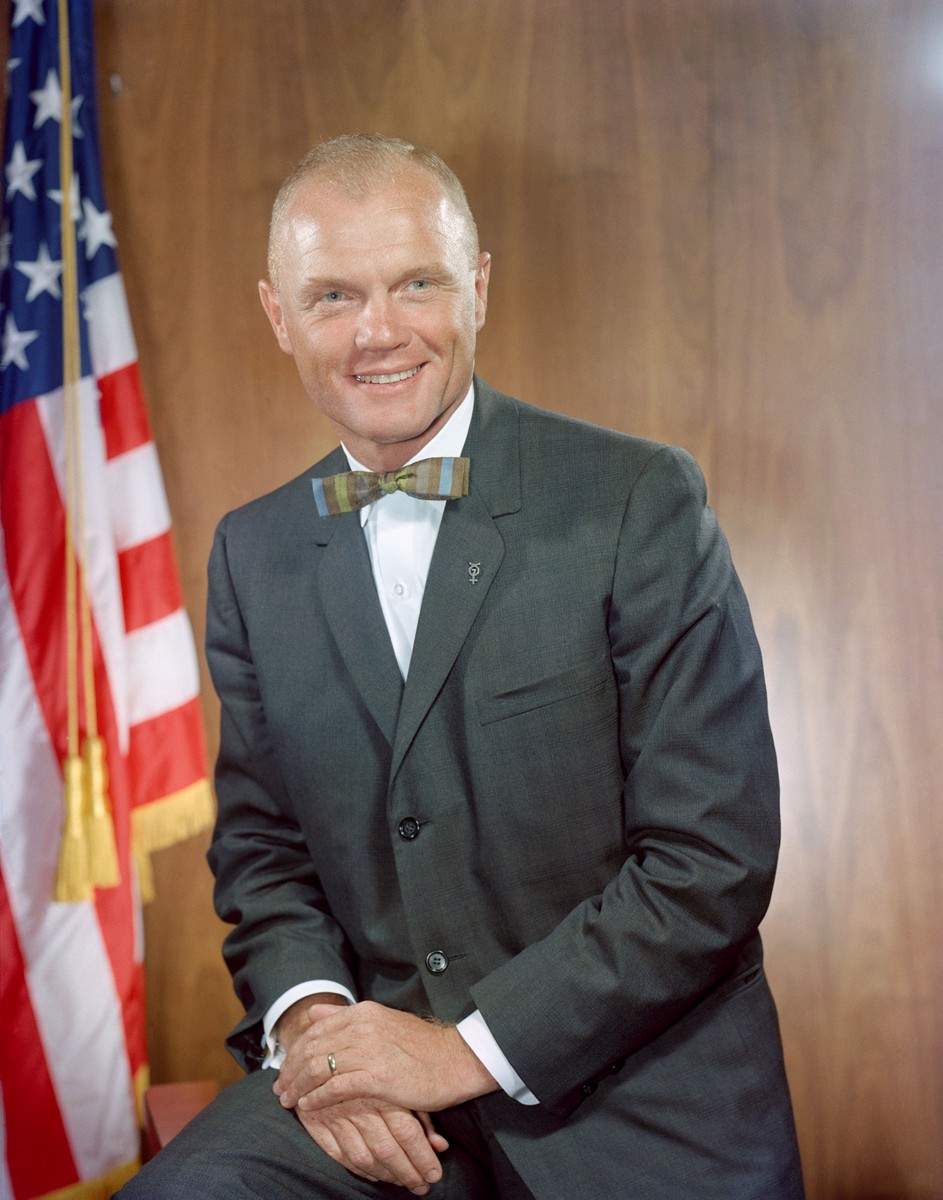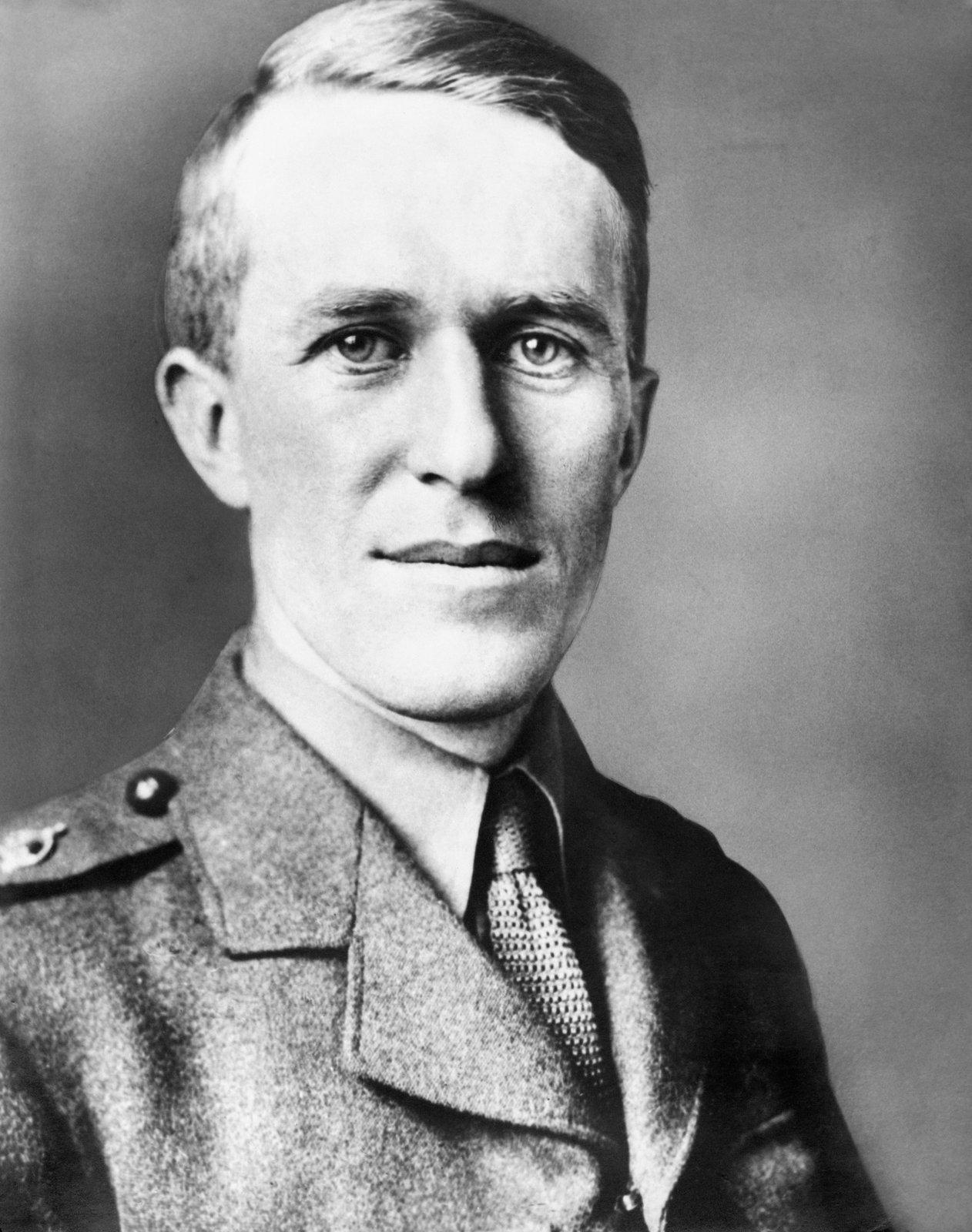

NASA / Johnson Space Center, photo S62-05540, December 1962, downscaled from the original · NASA Image and Video Library record S62-05540, 'Official portrait of astronaut John H. Glenn Jr., the first American to orbit Earth in a Project Mercury spacecraft' (December 1962, Photo credit: NASA, JSC), downloaded from the NASA original (2358 x 3000 pixels); NASA's Media Usage Guidelines say NASA content is generally not subject to copyright in the United States; the record carries only a NASA credit. Downscaled once to 943 x 1200 (never upscaled). The Commons Senate Historical Office portrait ('John Glenn Low Res crop.jpg', 1488 x 1984) was checked as an alternative and not used: it is an undated derivative file with a thin provenance record and shows him in a political-office setting. · Public Domain (NASA work)
우주비행사 · 20세기
존 글렌
1921–2016
주요 업적 분야
아직 성격 매칭에 포함되지 않았습니다 — 기록된 근거가 성격 모델 전체를 다루기에는 충분하지 않습니다. 이 페이지의 다른 모든 내용은 자유롭게 확인하실 수 있습니다.
핵심 특성
주요 업적
1962년 2월 20일 프렌드십 7호로 지구를 세 바퀴 돌며 미국인 최초로 지구 궤도를 비행했고, 자동조종장치가 고장 나자 수동으로 우주선을 조종했다.
제2차 세계대전과 한국전쟁에서 싸운 해병대 전투기 조종사로 해군 시험비행사가 되었고, 1957년 크루세이더 전투기로 로스앤젤레스에서 뉴욕까지 3시간 23분에 날았다(프로젝트 불릿). 초음속 대륙횡단 비행으로는 최초라고 기록된다.
1998년 10~11월 77세의 나이로 우주왕복선 STS-95에 탑승해 우주 비행이 노화한 몸에 미치는 영향을 연구했으며, 박물관은 그가 지금도 우주를 비행한 최고령자라고 전한다.
삶의 장면들
프렌드십 7호 재진입 때 열 차폐판이 느슨할 수 있다는 이유로 역추진 로켓 묶음을 달고 있으라는 지시를 받은 글렌은, 파편이 창밖으로 흩날리는 가운데 통신 두절 구간 내내 수동으로 캡슐의 흔들림을 잡았다.
이는 자동 시스템과 계획이 불확실한 상황에서도 방법을 바꿔 가며 작업을 계속하는 능력과 일치한다. 적응력
전환점
해병대 및 해군 시험비행사로 수년간 일하며 1957년 프로젝트 불릿 비행까지 마친 글렌은 1959년 NASA의 최초 머큐리 우주비행사 중 한 명으로 선발되었다.
이는 시험비행과 기술 프로젝트를 중심으로 쌓은 경력이 우주 비행으로 이어진 흐름과 일치한다. 숙련 지향
비슷한 인물
전체적인 프로필이 이 사람과 닮은 사람들이에요.
출처
- John Glenn (Q182642) -- verified live via the Wikidata API (2026-10-23): English label 'John Glenn', description 'American astronaut and politician (1921-2016)', born 18 July 1921, died 8 December 2016, Korean label '존 글렌', P18 images 'John Glenn Low Res crop.jpg' and 'John Glenn Mercury (small).jpg'. Orientation only; not used as support for any row.
- Michael Neufeld, 'Remembering Senator John Herschel Glenn Jr.', National Air and Space Museum (Smithsonian), 8 December 2016, read in full: Marine fighter pilot with 59 combat missions in the Pacific, two Korean War combat tours and three MiG-15 victories; Navy test pilot from 1956; selected for the astronaut team in 1959; first American to orbit the Earth in Friendship 7 on 20 February 1962 ('performed superbly in the face of worrying problems'); payload specialist on Space Shuttle STS-95 (29 October to 7 November 1998), researching the effects of spaceflight on the aging body, still the oldest person to have flown in space per the museum. CANONICAL SIGNIFICANCE SOURCE. Its passages on his Senate career, honours and the museum lecture were not used.
- 'Astronaut John Glenn and the Friendship 7 Mission', U.S. National Archives featured document page, read in full: orbital flight of 20 February 1962 (three orbits, about five hours); the automatic control function failed and Glenn piloted the spacecraft manually; Mission Control received a signal that the heat shield was loose and ordered him to retain the retropack; huge chunks flew past the window during re-entry and he wondered whether it was the retropack or the heat shield breaking up; the heat shield held and his worst injury was scraped knuckles; archival excerpt of the official flight transcript is shown. Institutional/archive account, admiring in tone.
- Smithsonian National Air and Space Museum collection record, 'Capsule, Mercury, MA-6' (Friendship 7 hatch), read in full: the original Mercury hatch was bolted on by pad technicians; the astronauts pushed through a redesign adding a window and an explosively ejected hatch; after Gus Grissom's hatch blew off accidentally in July 1961 and his capsule sank, Glenn decided not to eject the hatch until Friendship 7 had been lifted onto the destroyer Noa's deck. Museum object record.
- '16 July 1957', This Day in Aviation (thisdayinaviation.com), read in full: Major John H. Glenn Jr., USMC, flew a Vought F8U-1P Crusader from NAS Los Alamitos to Floyd Bennett Field in 3 hours 23 minutes (2,360 miles, 725.25 mph average), described there as the first supersonic transcontinental flight; Project Bullet's stated purpose was to test the sustained capability of the F8U at near maximum power over a long distance; the route needed three aerial refuellings with Savage tankers; Pratt & Whitney tore down the engine afterwards and lifted power limitations; Glenn was Navy/Marine Corps project officer for the Crusader and flew the XF8U-1 prototype on 4 May 1956. Aviation-history website; independent of Glenn.
- 'Zero-G and I Feel Fine': Remembering John Glenn's Mercury Flight (Part 1), AmericaSpace, 18 February 2017, read in full: the December 1961 date slipped to February 1962 through repeated delays; Glenn alone on top of an Atlas with a lukewarm success record and a pulse of 60 to 80; he bought a $45 Minolta camera in Cocoa Beach, NASA adapted it, and he photographed through the flight; he ran attitude-control checks, exertion tests and a vision chart in orbit, and reported 'fireflies' (later attributed to ice crystals); the landing-bag signal led Mercury Control to ask him about the switch; quotes Gene Kranz that Mission Control saw 'John Glenn's life was in peril'. Spaceflight-history press; draws heavily on Glenn's memoir, so memoir-derived lines are self-account and were never the sole support for a row.
- 'Just a Normal Day': Remembering John Glenn's Mercury Flight (Part 2), AmericaSpace, 19 February 2017, read in full: Glenn told to keep the retropack on through re-entry (overriding the 0.05 G switch and retracting the periscope manually); Max Faget agreed but noted the plan's own risk, and Flight Director Chris Kraft feared the retropack could cause a tumble and later resolved never to agree to such an exercise again; Glenn switched from manual to fly-by-wire control, damped capsule oscillations by hand during blackout, and kept trying to contact Al Shepard; he later said he was irritated at being kept in the dark; the false landing-bag signal was traced to a loose switch stem; splashdown 45 miles off target because retrofire calculations had not allowed for consumables used; he opened the hatch only after being lifted aboard the Noa. Spaceflight-history press with named counter-views from Kraft and Faget.
- 'A Chart Jumped Out at Me' and 'The Single Data Point': Remembering John Glenn's Return to Space (Parts 1 and 2), AmericaSpace, 29-30 October 2016, both read in full: how STS-95 came about (Glenn proposed an older-person study in late 1995; NASA Administrator Dan Goldin set two conditions, scientific value and passing the active-duty astronaut exams; Glenn was reported as the most persistent man Goldin had met, a line from Glenn's memoir; training followed the Senate calendar); the critics' views, including the 'publicity stunt' charge, a 'single data point' objection which Glenn answered with 'You've got to start somewhere', and astronaut Story Musgrave's remark that 'we are flying a legislative passenger'; the mission's crew reactions. The political-support and election passages of the articles were not used. Spaceflight-history press with named critics.
- Ben Panko, 'For a Larger-Than-Life Space Icon, John Glenn Was Remarkably Down-to-Earth', Smithsonian Magazine, December 2016, read in full: museum colleagues and a co-author describe his curiosity about anything scientific or medical, his habit of collecting sunsets in photographs, and his approachability at museum events. Admiring friends' remembrances at his death (retrospective); used only for one low-weight row. Family, political and charity passages not used.
- NASA Image and Video Library record S62-05540, 'Official portrait - astronaut Glenn, John H., Jr. - MSC' (December 1962, Photo credit: NASA), with its metadata; portrait rights check only. Not used for any scoring.