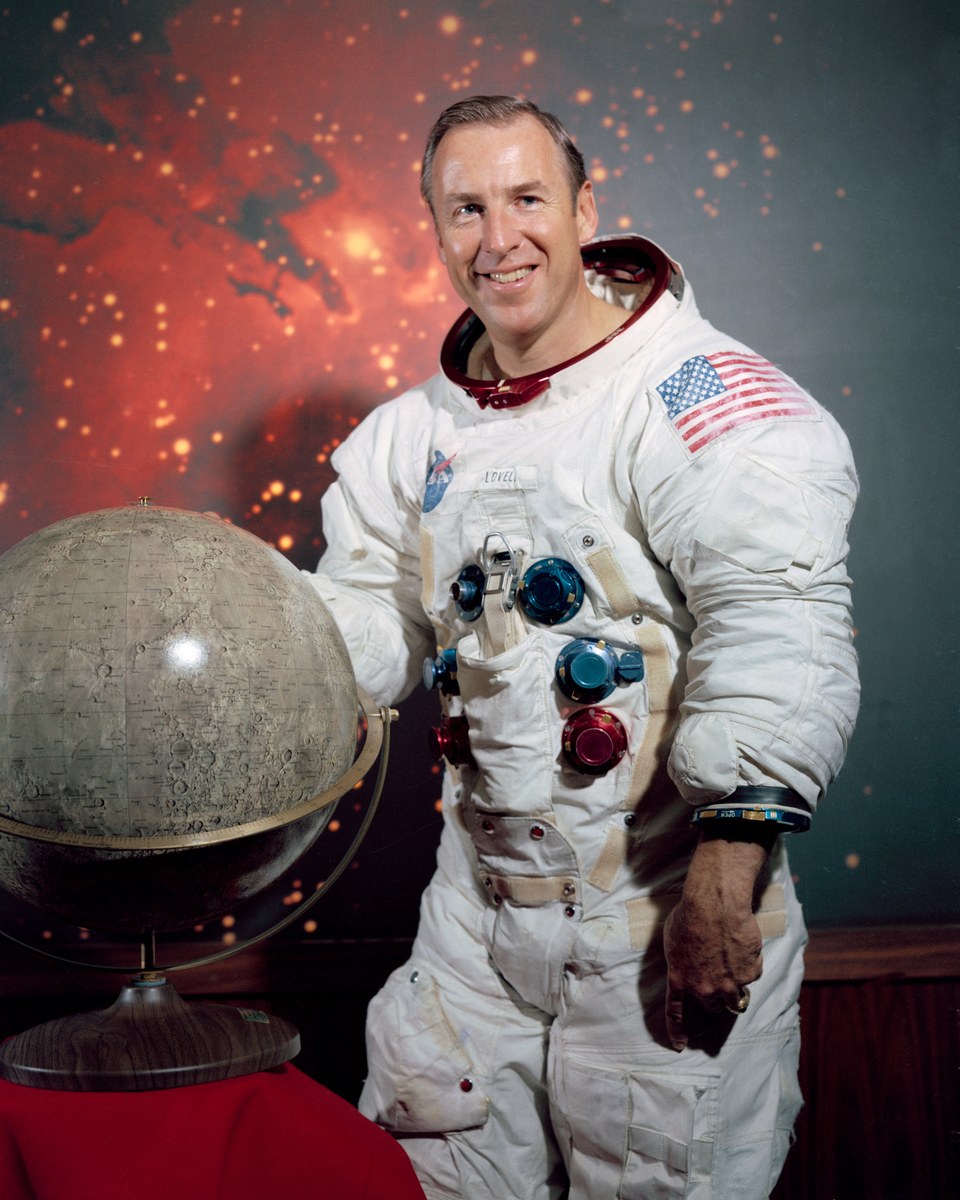

NASA, 1969 · NASA Image and Video Library S69-62241 'Portrait - Astronaut James A. Lovell Jr.' (Johnson Space Center, 1969), as the Wikimedia Commons file 'James Lovell.jpg'; the Commons description dates it December 1969 while the NASA record gives 1969. Public domain as a work of NASA, a US government agency, with no conflicting copyright notice found on the NASA record. Original 6548 x 8185 from the NASA library; downscaled once to 960 x 1200 (no upscaling, no crop). A 'LOVELL' name tag is visible on the suit. · Public Domain (NASA work)
우주비행사 · 20세기
짐 러벨
1928–2025
주요 업적 분야
아직 성격 매칭에 포함되지 않았습니다 — 기록된 근거가 성격 모델 전체를 다루기에는 충분하지 않습니다. 이 페이지의 다른 모든 내용은 자유롭게 확인하실 수 있습니다.
핵심 특성
주요 업적
1970년 4월 아폴로 13호의 사령관으로서, 산소 탱크 폭발로 달 착륙이 무산된 뒤 동료 스위거트, 헤이즈와 함께 휴스턴 관제팀과 협력해 달 착륙선을 구명정으로 삼아 무사히 지구로 귀환했다.
1968년 아폴로 8호에 탑승해 지구 중력권을 처음 벗어나 달 궤도를 선회한 승무원이 되었으며, AP와 스미소니언 역사학자는 이 비행이 이후 달 착륙의 토대가 되었다고 평가한다.
제미니 7호, 제미니 12호, 아폴로 8호, 아폴로 13호 등 네 차례 비행했으며, 2주간의 제미니 7호 비행을 포함해 스카이랩 이전까지 715시간의 우주 체류 기록을 보유했다.
삶의 장면들
아폴로 13호 폭발 직후 몇 시간 동안, 교신 기록에는 러벨이 관제센터의 지시를 하나하나 확인하고, 스위거트가 터널을 통해 전달한 단축 달 착륙선 가동 절차를 단계별로 복창하는 모습이 담겨 있다.
이는 압박 속에서도 절차를 중시하고 질서 있게 일하는 방식과 부합한다. 자기 규율
아폴로 8호가 지구 궤도 달 착륙선 시험에서 달 선회 비행으로 바뀌었을 때 러벨은 새 임무를 수행한 승무원이었으며, 스미소니언은 이후 아폴로 13호의 궤도 수정에 그가 이때 연습한 기법이 쓰였다고 전한다.
이는 바뀐 임무에 적응하고 기술을 이어서 활용하는 능력과 부합한다. 적응력
전환점
NASA의 첫 우주비행사 선발에서 뽑히지 못한 러벨은 1962년 9월 두 번째 그룹에 선발되었고, 이것이 네 차례 우주비행으로 이어진 경력의 출발점이 되었다.
이는 한 박물관 큐레이터의 평가처럼 초기의 좌절 이후에도 목표를 이어가는 태도와 부합한다. 끈기
비슷한 인물
전체적인 프로필이 이 사람과 닮은 사람들이에요.
출처
- Jim Lovell (Q111240) -- verified live via the Wikidata API (2026-10-25): English label 'Jim Lovell', description 'American astronaut (1928-2025)', born 1928-03-25, died 2025-08-07, citizenship United States, Korean label '짐 러벨', P18 image 'James Lovell.jpg'. Orientation only; not used as support for any row.
- NASA Johnson Space Center, 'Biographical Data: James A. Lovell (Captain, USN, Ret.)' (nasa.gov, December 1994 edition), read in full: education including Test Pilot School at Patuxent River in 1958; four years as a Navy test pilot and Program Manager for the F4H Phantom; selected as an astronaut in September 1962; backup for Gemini 4, backup commander for Gemini 9 and backup to Neil Armstrong for Apollo 11; Gemini 7 with Frank Borman in December 1965, Gemini 12 as commander in November 1966, Apollo 8 as the first humans to leave Earth's gravitational influence, and Apollo 13 as spacecraft commander, where with Swigert and Haise, working closely with Houston controllers, the crew converted the lunar module into a lifeboat; record 715 hours in space until Skylab. CANONICAL SIGNIFICANCE SOURCE (with Smithsonian Magazine). Agency biography, factual and self-supplied in part; later business, council and family passages not used.
- Smithsonian Magazine, 'Jim Lovell, Apollo 13 Commander Who Thrived Under Pressure, Dies at 97' (smithsonianmag.com, August 2025), read in full: curator Teasel Muir-Harmony on his determination and persistence after not being chosen for the first astronaut group and being selected in 1962; the 14-day Gemini 7 flight; Apollo 8 as a late change to a lunar-orbit mission; historian and museum voices (Orwoll, Johnston, Larson) on calm composure in the first hour after the Apollo 13 explosion, the improvised carbon-dioxide canister adapter built from plastic bags, cardboard and tape on instructions from Mission Control, and the manual course correction aligned on the Earth's day-night line, a procedure he had practised on Apollo 8; his book with Jeffrey Kluger and decades of public speaking. Museum-curator-sourced journalistic obituary; admiring and retrospective; childhood, marriage and medical passages deliberately not used.
- Associated Press obituary carried by PBS NewsHour, 'James Lovell, commander of harrowing Apollo 13 moon mission, dies at 97' (pbs.org, 8 August 2025), read in full: four flights (Gemini 7, Gemini 12, Apollo 8, Apollo 13); Apollo 8 as the first crew to fly to and circle the Moon; Apollo 13 as the explosion, four days in the lunar module lifeboat and the return; Smithsonian historian Roger Launius on quiet confidence and 'I measure risk', and on Apollo 8's importance; Gene Kranz on Lovell as a pillar of the early programme; his 'Houston, we've had a problem' wording versus the film; his own 1994-1999 interview remarks and his one regret at missing the lunar landing. Wire-service obituary quoting named historians and a flight director; admiring; much of the reflective material is Lovell's own recollection.
- Encyclopaedia Britannica, 'Jim Lovell', read: naval academy graduate of 1952 who became a test pilot; selected as an astronaut; Gemini 7, Gemini 12, Apollo 8 and Apollo 13; the April 1970 oxygen-tank rupture that forced abandonment of the Moon mission, the swing around the Moon and return, and a total of more than 715 hours of space travel; retirement and later corporate career. Reference biography, used for chronology and as an orientation cross-check.
- NASA Apollo Flight Journal, 'Day 3, part 2: Lifeboat' (apollojournals.org, corrected air-to-ground transcript with editors' commentary), read for the period after the explosion: Lovell acknowledging and reading back each of Mission Control's instructions, including battery charging and valve resets, and reading back each step of the abbreviated Lunar Module activation checklist (Activation 1, 11, 12 and 13) while Swigert relayed instructions through the tunnel; commentary on the improvised power-up and on the lifeboat decision. Primary record with volunteer editors' commentary; used for the documented read-back behaviour.
- NASA Apollo Flight Journal, 'Day 5, part 3: The Manual Course Correction Burn' (apollojournals.org, corrected transcript with commentary), read: Mission Control's briefing of the crew on the midcourse burn with one abort rule, Haise's reply that he and Lovell had already worked out the Sun angle from the Earth's terminator, the crew's discussion of aligning on the Earth through the optical sight, and the burn pad shut-down instructions. Primary record with commentary; Lovell speaks little in this section, so it is used only for the crew's joint preparation, not for any trait of Lovell alone.
- NASA Johnson Space Center Oral History Project, interview with Seymour Liebergot (27 April 1998; Apollo 13 EECOM flight controller), read in full: his statement that Swigert said 'We've had a problem' and Lovell repeated it; his view that Apollo 13 was a mission-operations mission and that the crew 'did some great piloting, but they did what we told them to do'; his judgement that the Lovell-Kluger book was well done apart from some systems errors. A flight controller's counter-voice to the heroic-commander narrative; used to temper the independent-initiative and leadership readings. Oral history, personal and partial.
- NASA Image and Video Library record S69-62241 'Portrait - Astronaut James A. Lovell Jr.' (images.nasa.gov, Johnson Space Center, 1969) with the Wikimedia Commons file page 'James Lovell.jpg', checked for the portrait: official NASA portrait of Lovell in a spacesuit beside a lunar globe, with a 'LOVELL' name tag visible; Commons tags it as a public-domain NASA image. Not used for any scoring.