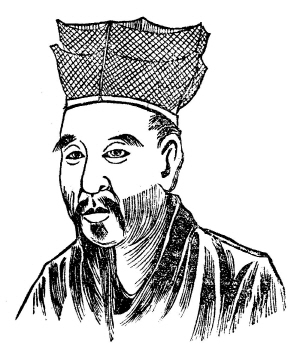

Jeong In-ho, illustration in Chodeung Daehan yeoksa (1908); digitised by History Net, National Institute of Korean History · Printed illustration of Jeong Yak-yong in 'Chodeung Daehan yeoksa' (Elementary Korean History, 1908), vol. 4, drawn by Jeong In-ho, as digitised by History Net of the National Institute of Korean History, which states free-use terms (including commercial use) for its national history textbooks collection. A stylised later depiction, not a portrait from life. Published in 1908, so public domain in the United States on age grounds. Original file 300 x 359 pixels, used as is; no upscaling. · Public domain (published in 1908); host institution states free use
핵심 특성
주요 업적
조선 후기 실학자인 그는 통치, 법, 유교 경전에 관한 저술을 남겼으며, 그의 글은 사후 『여유당전서』 154권 76책으로 정리되어 1934~1938년에 간행되었다.
1801년 이후 강진 유배지에서 그는 지방 관리를 위한 48권의 지침서 『목민심서』를 1818년에 완성했고, 『경세유표』에서는 기술을 도입할 국가 관청 신설 등의 개혁을 제안했다.
정조 치하의 관리로서 그는 한강 배다리(1789)와 화성 축조(1792) 설계에 참여했고 거중기를 고안했으나, 한 역사학자는 실제 사용이 기록된 거중기가 한 대뿐이라고 지적한다.
삶의 장면들
거중기를 만들 때 그는 수입된 『기기도설』을 참고하되 철과 구리 사용을 줄이고 불필요한 조항을 덜어내 기본 원리에 집중했다.
이는 외부의 설계를 현지의 재료와 필요에 맞게 고쳐 쓰는 태도와 부합한다. 자원 활용 성향
그는 1818년 강진에서 자신의 지방관 경험을 바탕으로 48권 16책의 지방 행정 지침서 『목민심서』를 완성했다.
이는 실용을 목표로 한 꾸준하고 세밀한 저술과 부합한다. 끈기
전환점
1801년 박해 이후 그는 18년간 유배 생활을 했고 그중 11년을 강진 다산초당에서 보냈으며, 통치와 경전에 관한 그의 저술 대부분이 이 시기에 이루어졌다.
이는 관직 생활에서 꾸준한 학문 저술로 활동의 중심이 옮겨 갔음과 부합한다. 끈기
비슷한 인물
전체적인 프로필이 이 사람과 닮은 사람들이에요.
출처
- Jeong Yak-yong (Q256246), verified live via the Wikidata API (2026-10-30): label 'Jeong Yak-yong', description 'Korean scholar and philosopher (1762 - 1836)', born 1762, died 1836, Korean label present. Orientation only; not used as support for any row.
- Wikipedia, 'Jeong Yak-yong', fetched for orientation (names, dates, main works). Orientation only; never counted as a source for any row.
- Academy of Korean Studies, Encyclopedia of Korean Culture, entry on the Yeoyudang jeonseo (written 1995 by Yi Eul-ho; last revised 2025), read: describes the collected works of the practical-learning scholar Jeong Yak-yong, 154 volumes in 76 books, issued 1934-1938 in seven collections (poetry and prose, classics, rites, music, governance and law, geography, medicine), and lists his memorials to King Jeongjo as groundwork for the Gyeongse yupyo. CANONICAL SIGNIFICANCE SOURCE: national academy's reference entry. A single-author scholarly entry that presents him favourably.
- Academy of Korean Studies, Encyclopedia of Korean Culture, entry 'Gangjin Jeong Yak-yong yujeok' (the Dasan Chodang site in Gangjin; written 1995, revised 2025), read: says he spent 11 of his 18 years of exile at the Dasan Chodang, where he wrote extensively on governance, and that the site was designated a historic site in 1963. Short; the building is a 1958 reconstruction.
- LTI Korea Digital Library of Korean Literature, 'Mongminsimseo' (Admonitions on Governing the People) entry, read: the institute's description says he wrote the book in exile at Gangjin and completed it in 1818 (48 chapters in 16 volumes), that it reflects his own experience as a secret inspector, post-station and county official, and its twelve sections. Public cultural-agency description; admiring in tone.
- Song Seong-su (Pusan National University), 'Dasan Jeong Yak-yong was a master of convergence who loved technology', Daum News syndication of a newspaper column (30 October 2023), read in full: a historian-of-technology column on the pontoon bridge of 1789, the 1792 fortress design report, the geojunggi crane, the multipurpose Yuhyeonggeo cart and the proposed state institute for technology; it also says the crane and the pulley hoist probably contributed little to the Hwaseong works since only one geojunggi and two nokro are recorded. The main independent, partly critical source on the engineering.
- Young-Chan Ro, review of 'The Analects of Dasan, Volume 1: A Korean Syncretic Reading' by Hongkyung Kim, Acta Koreana 20(2), December 2017, read (Project MUSE excerpt): calls him arguably the most prolific writer of late Joseon, describes the 18 years of exile in Gangjin, his syncretic method and the recent scholarly shift away from fitting him only into anti-Neo-Confucian or practical-learning labels. Scholarly review; only the visible part was read.
- Dobin Choi, review of 'The Analects of Dasan, Volume 1', Philosophy East and West 68(1), January 2018, pp. 1-4, read (Project MUSE excerpt): summarises his career, exile of 1801-1818, and the two pillars of his fame (reform writing culminating in the Mongmin simseo; his commentary on the Analects completed in 1813 as a philosophical critique of mainstream Neo-Confucianism). Scholarly review; only the excerpt was read.
- Gyeonggi Ilbo, 'Namyangju Jeong Yak-yong historic site' (26 May 2020), read in full: a regional newspaper feature on his birthplace and memorial museum; says most of his roughly 500 volumes were written in exile and that he taught disciples there and had them take part in the writing. Popular regional feature that also repeats an unsourced claim about the crane saving funds, which is not used.