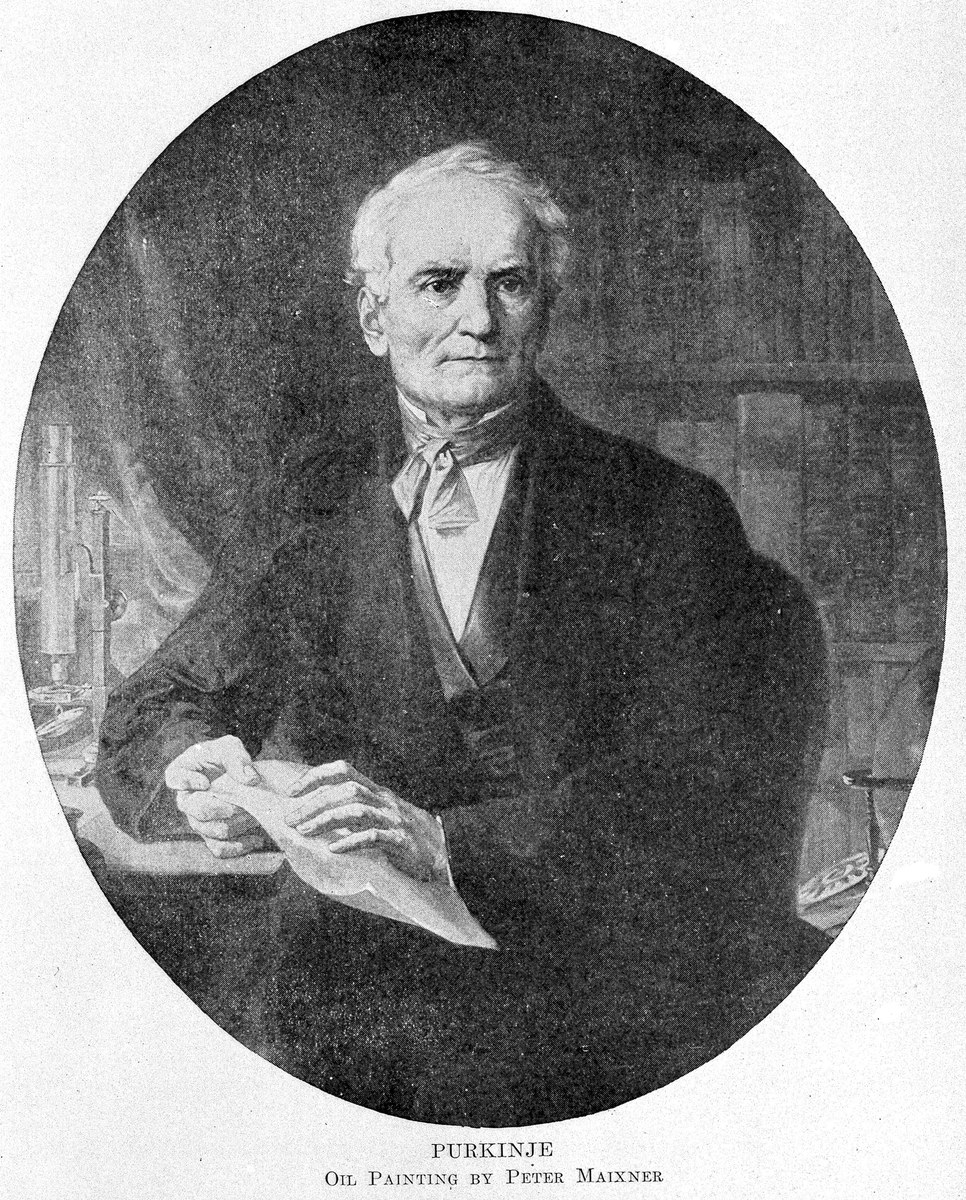
Peter Maixner, portrait of Jan Evangelista Purkyne, oil painting, reproduced in The Scientific Monthly (1948); Wellcome Collection, London (work wr3arg9q), CC BY · Oil painting of Jan Evangelista Purkyne by Peter Maixner (1831-1884), as reproduced in The Scientific Monthly and photographed on a glass-plate negative in 1948; printed caption 'Purkinje, Oil Painting by Peter Maixner'. Wellcome Collection, London (work wr3arg9q). The museum scan (2998 x 3660 pixels) was cropped to the oval and caption and downscaled once to 966 x 1200 pixels; nothing was upscaled. Shown as a later painting depiction, not as a documented sitting; the painting's date and present location are not given by the holder. · CC BY 4.0 as stated by Wellcome Collection for the photograph; the underlying painting is public domain by age (painter died 1884)
의사 · 19세기
얀 에반겔리스타 푸르키녜
1787–1869
주요 업적 분야
아직 성격 매칭에 포함되지 않았습니다 — 기록된 근거가 성격 모델 전체를 다루기에는 충분하지 않습니다. 이 페이지의 다른 모든 내용은 자유롭게 확인하실 수 있습니다.
핵심 특성
주요 업적
1830년대 현미경 연구를 통해 소뇌의 크고 가지가 많은 신경세포(1837)와 심실의 특수한 섬유를 기술했으며, 둘 다 오늘날 그의 이름으로 불린다.
1818~19년의 주관적 시각에 관한 학위 논문은 조명이 약해질수록 파란 물체가 붉은 물체보다 밝게 보이는 푸르키녜 효과로 이어졌고, 그는 눈에 비치는 반사상도 기술했으며 이것 역시 그의 이름으로 불린다.
브레슬라우에서 독립된 생리학과(1839)와 생리학 연구소(1842)를 만들었고 1851년에는 프라하에 두 번째 연구소를 열어, 대학 교육에 실험실 훈련을 자리 잡게 했다.
삶의 장면들
프라하의 공공 놀이공원 그네와 회전 놀이기구에서 적은 비용으로 자신을 실험 대상 삼아 현기증을 연구했고, 이후 의사들이 처방하는 용량이 너무 적다는 것을 보이려고 디기탈리스와 아트로핀을 직접 복용해 시험했다.
이는 장비나 대상을 기다리기보다 단순한 수단으로 자기 자신에게 직접 시험하는 태도와 부합한다. 실험 성향
브레슬라우에서 새 현미경 요청이 거절되어 9년을 기다렸고, 대학이 공간과 장비를 마련해 주지 않자 연구와 교육의 상당 부분을 자기 집 실험실에서 진행했다.
이는 제도적 지원이 없을 때 우회로를 찾아 연구를 이어 가는 태도와 부합한다. 자원 활용 성향
전환점
1839년 브레슬라우에 독립된 생리학과를, 1842년에는 생리학 연구소를 세웠고, 집 실험실에서 하던 실험과 교육을 현대적 장비를 갖춘 대학 시설로 옮겼다.
이는 임시변통의 집 실험실을 지속되는 기관으로 바꾸어 가는 태도와 부합한다. 선제적 행동력
비슷한 인물
전체적인 프로필이 이 사람과 닮은 사람들이에요.


레오나르도 다빈치

루이 파스퇴르

에이다 러브레이스

에이브러햄 링컨

힐데가르트 폰 빙엔
출처
- Jan Evangelista Purkyně (Q159542), verified live via the Wikidata API (2026-11-06): label 'Jan Evangelista Purkyně', description 'Czech biologist, physiologist, doctor, inventor and politician (1787-1869)', born 17 December 1787, died 28 July 1869, Korean label 얀 에반겔리스타 푸르키녜. Orientation only; not used as support for any row.
- Encyclopaedia Britannica, 'Jan Evangelista Purkinje' (public-web article read in full, about 500 words; the page also carries machine-generated summaries that were ignored). CANONICAL SIGNIFICANCE SOURCE: pioneer experimental physiologist whose work in histology, embryology and pharmacology helped create the modern understanding of the eye and vision, brain and heart function and cells; the Purkinje effect, the Breslau department (1839) and Physiological Institute (1842), Purkinje cells (1837) and fibres (1839), the term protoplasm, his self-testing of drugs, and a list of techniques Britannica says he was first to use.
- Lois N. Magner, 'Jan Evangelista Purkinje', Science and Its Times (Gale), reproduced on Encyclopedia.com (entry read in full, about 700 words). Independent reference account with a cautious tone on priority: his vision thesis of 1818-19, Goethe's interest, the Breslau chair of 1823 and his home laboratory 'cradle of histology' when the university would not provide space and equipment, the term protoplasm, a knife that was a precursor of the microtome (while the same entry's opening says he invented the microtome) and the observation that others are generally credited with early discoveries about the nucleus and cell division.
- Harold Ellis, 'Johann Purkinje: pioneering Czech histologist and physiologist', British Journal of Hospital Medicine, July 2019 (anniversary article by a surgeon-anatomist read in full, about 900 words). His inaugural lecture on the physician's task, the vertigo studies on amusement-park rides using himself as the experimental subject, the flood of publications from his department, the microtome, his self-experiments with drugs, and two limits: he never wrote a comprehensive textbook and, publishing in provincial journals, was less known in the west than he deserved.
- Magdalena Mazurak and Jacek Kusa, 'Jan Evangelista Purkinje: A Passion for Discovery', Texas Heart Institute Journal 45(1), 2018 (open-access biography by two Wroclaw cardiologists read in full, about 2,000 words). Dated life account: his education, the nine-year wait for a microscope at Breslau, the self-tests of digitalis and atropine, the fingerprint classification, the move of his work from his home to the institute, his translation and cultural work, and the later Prague institute and journals.
- Wellcome Collection, 'Portrait of Jan Evangelista Purkyne (1787-1869), Peter Maixner' (work wr3arg9q; catalogue record and IIIF image record read, item-level licence stated). Holder record for the portrait: glass-plate photograph of a reproduction of an oil painting by Peter Maixner published in The Scientific Monthly.